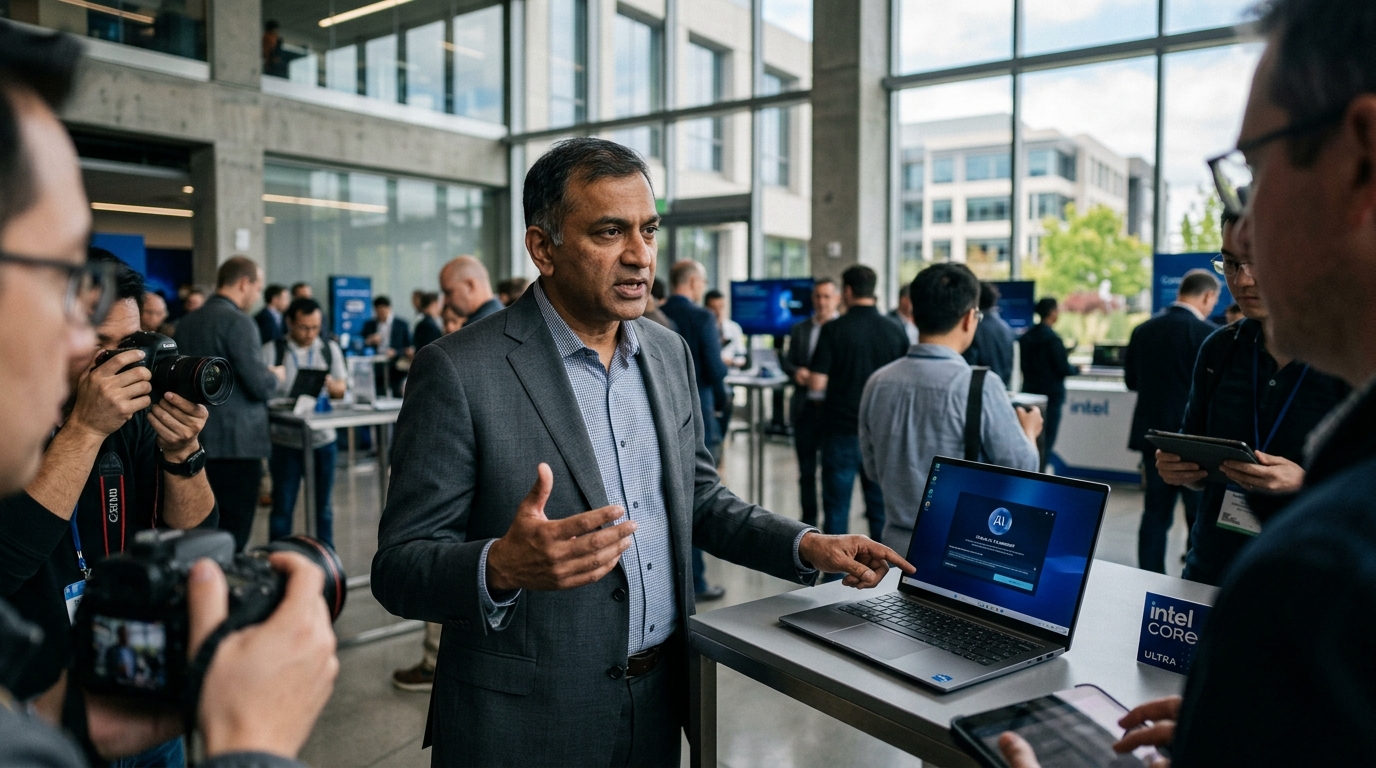
For decades, the semiconductor battlefield was defined by clock speeds and core counts. Today, Intel, the historical market leader, is orchestrating a radical paradigm shift. By officially bringing Artificial Intelligence (AI) into the mainstream PC segment, the company isn't just aiming to sell faster chips; it is seeking to redefine the very relationship between humans and machines. This move, hailed by many as the most significant change in PC architecture since the Centrino era, marks the dawn of the "AI PC" age.
The Architecture of Change: From Megahertz to TOPS
Intel's strategy hinges on the integration of dedicated Neural Processing Units (NPUs) directly into its Core Ultra series processors. Until recently, running complex AI models required either expensive discrete graphics cards (GPUs) or the backing of massive cloud data centers. Intel is breaking this monopoly, enabling everyday applications—from video editing and image generation to real-time translation and power management—to run locally on the device.
This decentralized approach offers three fundamental advantages: speed (lower latency), security (data never leaves the device), and cost-efficiency. As the operational costs of Large Language Models (LLMs) in the cloud remain prohibitively high for mass usage, shifting the workload to the "edge"—the user's computer—is the only viable path for widespread AI adoption. Leveraging its massive installed base, Intel is betting it can establish this standard faster than its rivals.
Competition and the New Ecosystem
Intel’s move does not occur in a vacuum. Apple has already paved the way with its M-series chips, integrating the Neural Engine for years, while AMD with its Ryzen AI series and Qualcomm with the Snapdragon X Elite are exerting immense pressure. However, Intel’s primary advantage remains the Windows ecosystem. Close collaboration with Microsoft to fully integrate Copilot+ and support from hundreds of Independent Software Vendors (ISVs) create a moat that competitors find difficult to breach.
Analysts point out that the battle will be fought not just on hardware specs, but on who provides the most "useful" AI experience.
- Productivity Optimization: Automated meeting summaries and email drafting.
- Creativity: Content generation using tools like Adobe Premiere Pro and Lightroom with minimal power consumption.
- Battery Longevity: By offloading AI tasks to the NPU, the CPU and GPU remain free, significantly extending battery life.
Geopolitical Implications and the IDM 2.0 Strategy
Beyond the technological aspect, Intel’s pivot to AI carries deep political significance. Under the leadership of Pat Gelsinger, the company is executing the IDM 2.0 strategic plan, which includes building new fabrication plants (fabs) in the US and Europe. The success of Intel’s AI processors is inextricably linked to the West's effort to regain dominance in semiconductor manufacturing over Asia. If Intel succeeds in making the AI PC the new gold standard, it will secure not only its financial future but also the strategic autonomy of the Western tech industry.
"AI is the most transformative technology we have seen in decades. With the AI PC, we are bringing this power to every desk and every home," the Intel CEO recently stated.
In conclusion, Intel is not merely adding another feature to its chips. It is attempting to lead a new upgrade cycle for the global PC fleet, which had stagnated in recent years. The success of this endeavor will depend on whether users find genuine value in AI features or perceive them as another marketing gimmick. What is certain is that the competition in the silicon sector has never been more intense, and the implications for our daily lives will be profound.