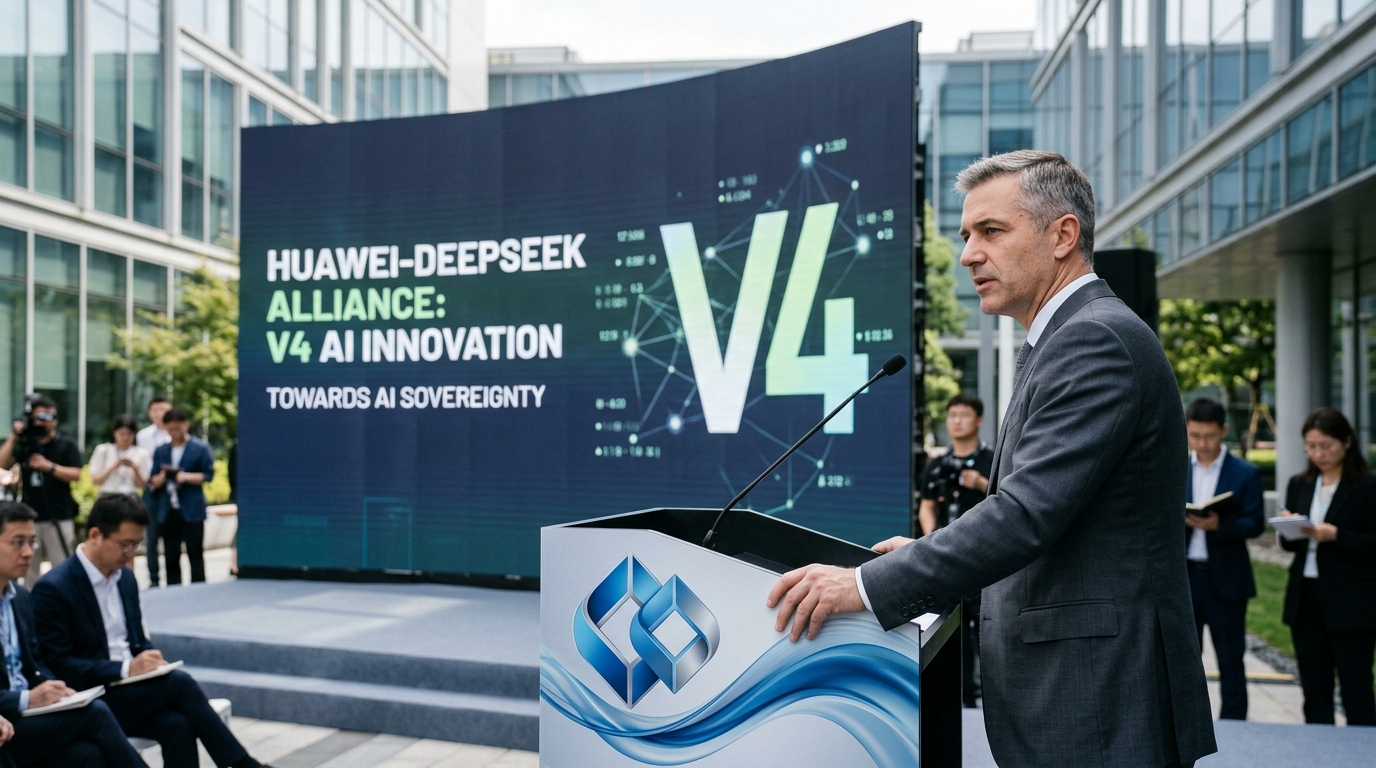
In a watershed moment for global tech geopolitics, Huawei and DeepSeek have announced a strategic alliance aimed at decoupling Chinese artificial intelligence from Western architectural dependence. The release of DeepSeek V4, optimized specifically for Huawei’s Ascend ecosystem, is far more than a technical iteration; it is a declaration of sovereignty. As US export controls on high-end semiconductors, such as Nvidia’s H100 series, grow increasingly stringent, Beijing is responding by forging a closed-loop, highly efficient domestic production cycle.
The Hardware Backbone: The Rise of Ascend Chips
Despite years of crippling sanctions, Huawei has managed to evolve its Ascend processor line, with the 910C model now emerging as a credible rival to Nvidia’s flagship solutions within the Chinese market. China’s challenge was never solely about chip design, but rather the ability to manufacture at scale and, crucially, to develop a software layer capable of competing with Nvidia’s ubiquitous CUDA platform. The partnership with DeepSeek addresses this head-on. DeepSeek V4 is engineered from the ground up to leverage Huawei’s CANN (Compute Architecture for Neural Networks), delivering performance that rivals Western benchmarks while maintaining a significantly lower energy and cost profile.
The success of this endeavor hinges on Huawei’s ability to verticalize its production. From AI accelerators to servers and the underlying operating system, the company offers a full-stack solution. This enables DeepSeek to train massive models without the looming threat of the next round of Washington-imposed sanctions. This strategy, dubbed "AI Self-Reliance," has become the cornerstone of Chinese industrial policy as we move through 2026.
DeepSeek V4: Efficiency as a Strategic Weapon
DeepSeek V4 is not just a successor to previous models; it is a refinement of the Mixture-of-Experts (MoE) architecture. This approach allows the model to activate only the necessary parameters for any given task, a critical feature when hardware resources are constrained compared to the massive clusters operated by Microsoft or Google. DeepSeek has a proven track record of achieving GPT-4 level results at a fraction of the training cost, and V4 aims to widen this efficiency gap even further.
DeepSeek’s commitment to an open-weights philosophy has also fostered a massive developer community that iterates on the model daily. With Huawei’s backing, DeepSeek V4 is becoming the de facto standard for Chinese enterprises and government institutions. The ability to run such sophisticated models on domestic hardware mitigates security risks and ensures data residency, a top priority for the Chinese leadership. This creates a robust feedback loop: more users lead to better data, which in turn leads to more optimized hardware-software integration.
Geopolitical Implications and the Silicon Curtain
This move signals the solidification of a bipolar AI world. On one side stands the Western ecosystem, powered by Nvidia, OpenAI, and Google; on the other, an emerging Chinese pole led by Huawei and DeepSeek. This bifurcation has profound implications for the global supply chain. If China proves it can sustain cutting-edge AI development without Western silicon, the long-term efficacy of US sanctions will be brought into serious question.
- Reduction of reliance on high-end GPU imports.
- Acceleration of domestic innovation through tight hardware-software co-design.
- Creation of an alternative technological blueprint for Global South nations.
Furthermore, the success of DeepSeek V4 on Ascend chips could compel other Chinese tech giants, such as Alibaba and Tencent, to abandon their efforts to secure "neutered" versions of Nvidia chips and instead pivot entirely to Huawei’s ecosystem. Such a shift would represent a massive loss of long-term revenue for the American semiconductor industry and a permanent loss of market influence in the world's second-largest economy.
The Future: Competition or Isolation?
The lingering question is whether this localized ecosystem can remain at the bleeding edge of innovation without the cross-pollination of ideas and resources from the global community. History suggests that technological isolation often leads to stagnation, yet China’s position in 2026 is unique due to its vast internal market and unparalleled data generation. Huawei and DeepSeek are not just building tools; they are constructing a fortress.
In conclusion, Huawei’s backing of DeepSeek V4 represents China’s most audacious step toward technological independence. If this experiment succeeds, the map of global computing power will be redrawn, with Beijing holding the keys to its own digital destiny. The coming months will be critical in determining whether the real-world performance of V4 justifies the hype and whether Ascend chips can truly shoulder the weight of the next generation of artificial intelligence.