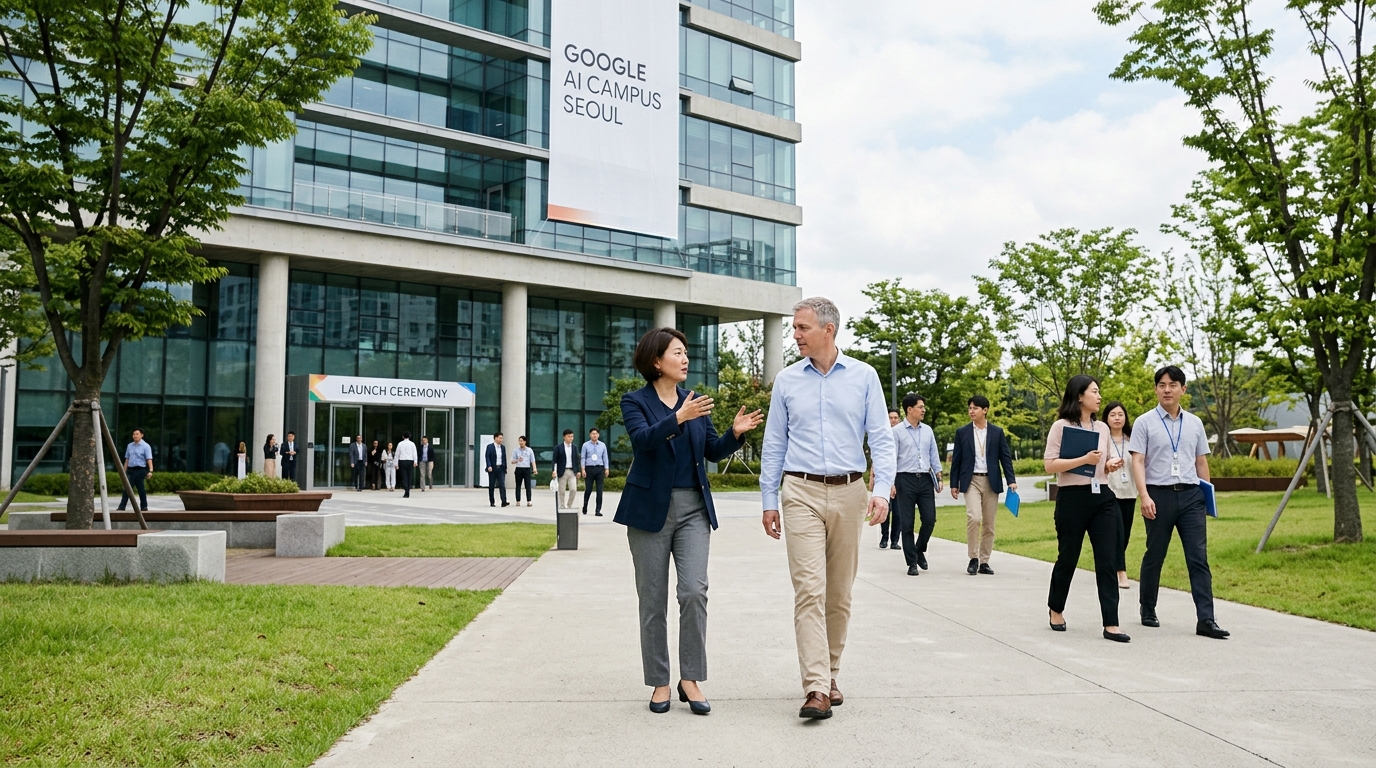
In the vibrant heart of Seoul, where the glass towers of tech conglomerates pierce the skyline, Google is preparing to anchor a new chapter of its global strategy. The announcement of a dedicated AI Campus in the South Korean capital is far more than a mere real estate expansion; it is a calculated move on the geopolitical chessboard of artificial intelligence. South Korea, the birthplace of Samsung and SK Hynix, has become the critical nexus where Silicon Valley’s software prowess meets the physical hardware powering the AI revolution.
The Strategic Allure of the Korean Peninsula
Google’s choice of Seoul is neither accidental nor purely aesthetic. South Korea boasts one of the world’s most sophisticated and integrated technology ecosystems. As global demand for High Bandwidth Memory (HBM) chips—essential for training large-scale AI models—reaches unprecedented levels, Google recognizes that proximity to semiconductor manufacturers is a strategic necessity. The new AI Campus is designed to function as a dual-purpose hub: a center for cutting-edge Research and Development (R&D) and a high-octane incubator for local startups specializing in machine learning and data analytics.
Industry analysts view this move as a direct response to the expanding influence of Microsoft and OpenAI in the Asia-Pacific region. By establishing a physical presence, Google aims to attract South Korea’s elite engineering talent, offering them direct access to the company’s massive computational resources and the Gemini model suite. Furthermore, engaging with the local academic community and fostering the "K-AI" ecosystem allows the American giant to infuse its models with local cultural and linguistic nuances—a prerequisite for dominating the diverse Asian markets.
Competition and the 'Chip Diplomacy'
The campus launch occurs against a backdrop of increasing domestic pressure. The South Korean government has unveiled ambitious plans to bolster its national AI industry, wary of becoming overly dependent on foreign-owned platforms. Through this Campus, Google is positioning itself as a collaborative partner rather than a disruptive interloper. The goal is to create a synergy where Korea maintains its hardware supremacy while simultaneously accelerating its software capabilities.
- Fortifying the partnership with Samsung for the co-development of specialized AI processors.
- Launching massive upskilling programs for thousands of Korean students and developers.
- Establishing an "Open Lab" environment for real-world testing of generative AI applications.
However, the path forward is fraught with complexity. South Korea is home to formidable domestic champions like Naver and Kakao, both of which have developed sophisticated Large Language Models (LLMs) tailored for the Korean language. Google will need to navigate the fine line between healthy competition and perceived corporate colonialism in a nation where technological sovereignty is a matter of intense national pride.
Geopolitical Implications and the Road Ahead
Within the broader context of the U.S.-China technological rivalry, Google’s deepened footprint in Seoul reinforces the technological alliance of democratic nations. South Korea serves as a vital bulwark against Chinese ambitions in the semiconductor sector. By planting its flag with an AI Campus, Google is effectively "locking in" its relationship with critical suppliers, ensuring that future iterations of its Tensor Processing Units (TPUs) are designed and optimized in tandem with the world's leading memory producers.
"Artificial Intelligence is no longer just about lines of code; it is about supply chain resilience and geopolitical alignment," states a source close to Google Korea's leadership.
In conclusion, the AI Campus in Seoul is a profound statement of intent. Google is no longer content with governing the digital realm from the comfort of Mountain View. It is moving to the factory floor of the world, where silicon meets the machine spirit, in a bid to lead the next great technological epoch from the front lines of the Indo-Pacific.