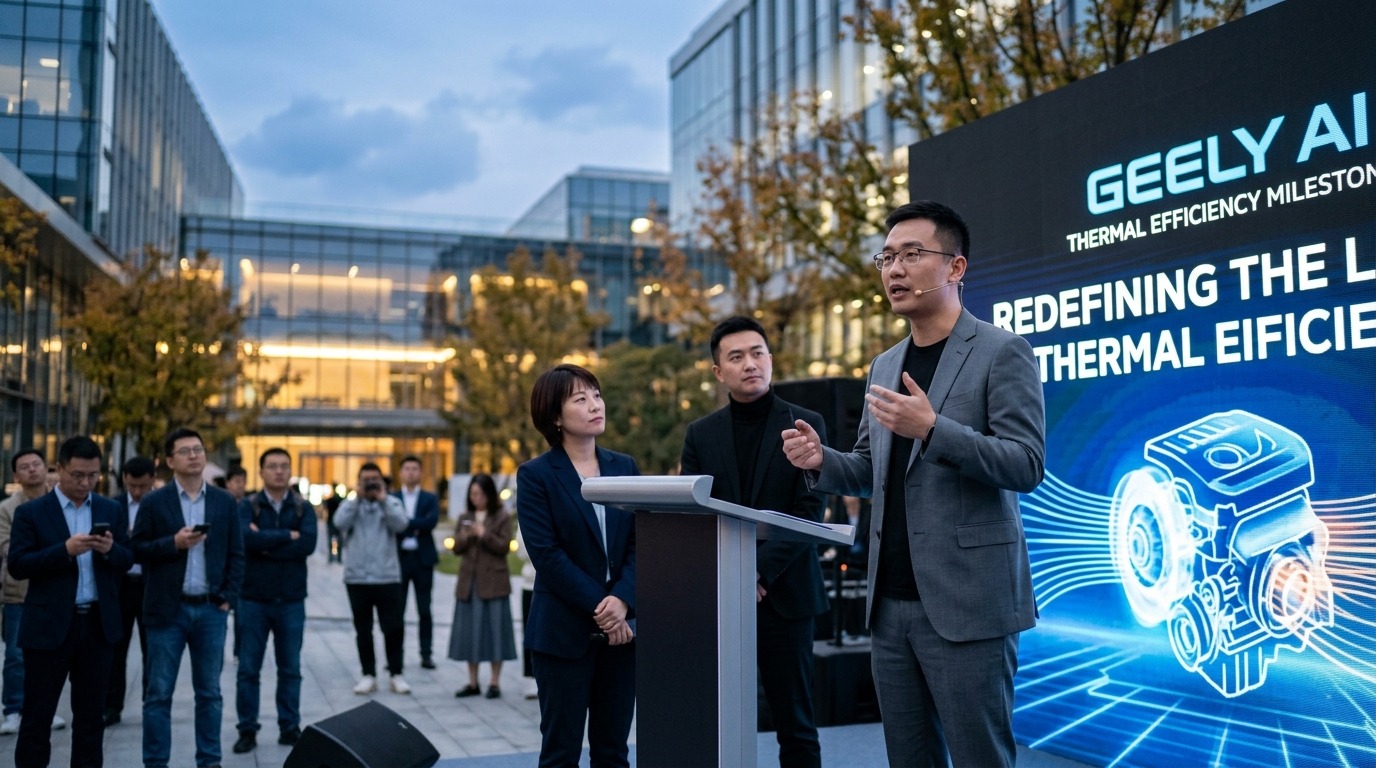
In an era where the global automotive industry seems to have pivoted exclusively toward full electrification, Chinese giant Geely has made a move that challenges the prevailing narrative. By announcing the creation of the world's most efficient internal combustion engine (ICE) with a thermal efficiency of 46.11%, Geely is proving that the traditional engine is far from obsolete—especially when augmented by Artificial Intelligence. This breakthrough isn't just a technical milestone; it’s a strategic assertion of dominance in a field many had written off.
The Thermal Efficiency Frontier
For decades, the thermal efficiency of gasoline engines hovered stubbornly between 25% and 35%. The majority of the energy stored in fuel was lost to heat, friction, and incomplete combustion. Breaking the 40% barrier was long considered the "Holy Grail" for engineers at Toyota, Mercedes, and Mazda. Geely’s achievement of 46.11% pushes the boundaries of what was once thought theoretically possible for a mass-produced unit.
This means nearly half of the energy in every drop of fuel is converted into actual movement. In practical terms, this translates to a dramatic reduction in fuel consumption and carbon emissions. For the plug-in hybrid (PHEV) systems where these engines will be deployed, it represents a leap in range and environmental performance. Geely achieved this not through traditional mechanical intuition alone, but by employing AI as its lead architect.
AI: The Invisible Engineer
Traditional engineering relies on iterative testing and human-led simulations. Geely’s AI, however, analyzed millions of fluid dynamics scenarios within the combustion chamber in a fraction of the time a human team could. It optimized piston geometry, fuel injection timing, and airflow at a micro-second scale of precision.
- Combustion Optimization: AI predicted the exact behavior of air-fuel mixtures under extreme pressures, enabling a leaner, cleaner burn that maximizes energy extraction.
- Thermal Management: Machine learning algorithms designed cooling channels that minimize energy loss to the environment, keeping the heat where it belongs: doing work.
- Friction Reduction: By analyzing material interactions at a molecular level, AI helped select coatings and components that reduce internal resistance, further boosting efficiency.
"This is no longer a battle of metals; it is a battle of algorithms. AI has allowed us to see beyond the physical constraints traditionally taught in engineering schools," stated a senior researcher at Geely’s R&D center.
The Geopolitical Engine War
Geely’s announcement does not exist in a vacuum. It follows closely on the heels of similar claims from BYD and comes as Toyota unveils a new generation of compact, highly efficient engines designed for carbon-neutral fuels. China, already the global leader in battery technology, is now making a play for the crown of internal combustion technology, specifically focusing on hybrid powertrains as the crucial bridge to a net-zero future.
Geely’s strategy is clear: while full EVs are the long-term goal, the world requires ultra-efficient hybrids for the next decade. Through its ownership of brands like Volvo, Lotus, and Polestar, Geely has a global platform to deploy this technology. This puts immense pressure on European manufacturers, who are currently caught between the stringent Euro 7 regulations and the sluggish rollout of charging infrastructure.
Sustainability and the Future of ICE
The debate over whether a gasoline engine can ever be truly "green" remains contentious. However, at 46% efficiency, the CO2 emissions of a vehicle drop to levels that challenge the total lifecycle carbon footprint of an EV—especially when battery production and non-renewable charging grids are factored in. Geely is betting that AI will continue to push these numbers toward the 50% mark, potentially forcing policymakers to reconsider the 2035 bans on internal combustion engines in favor of a more technology-neutral approach.