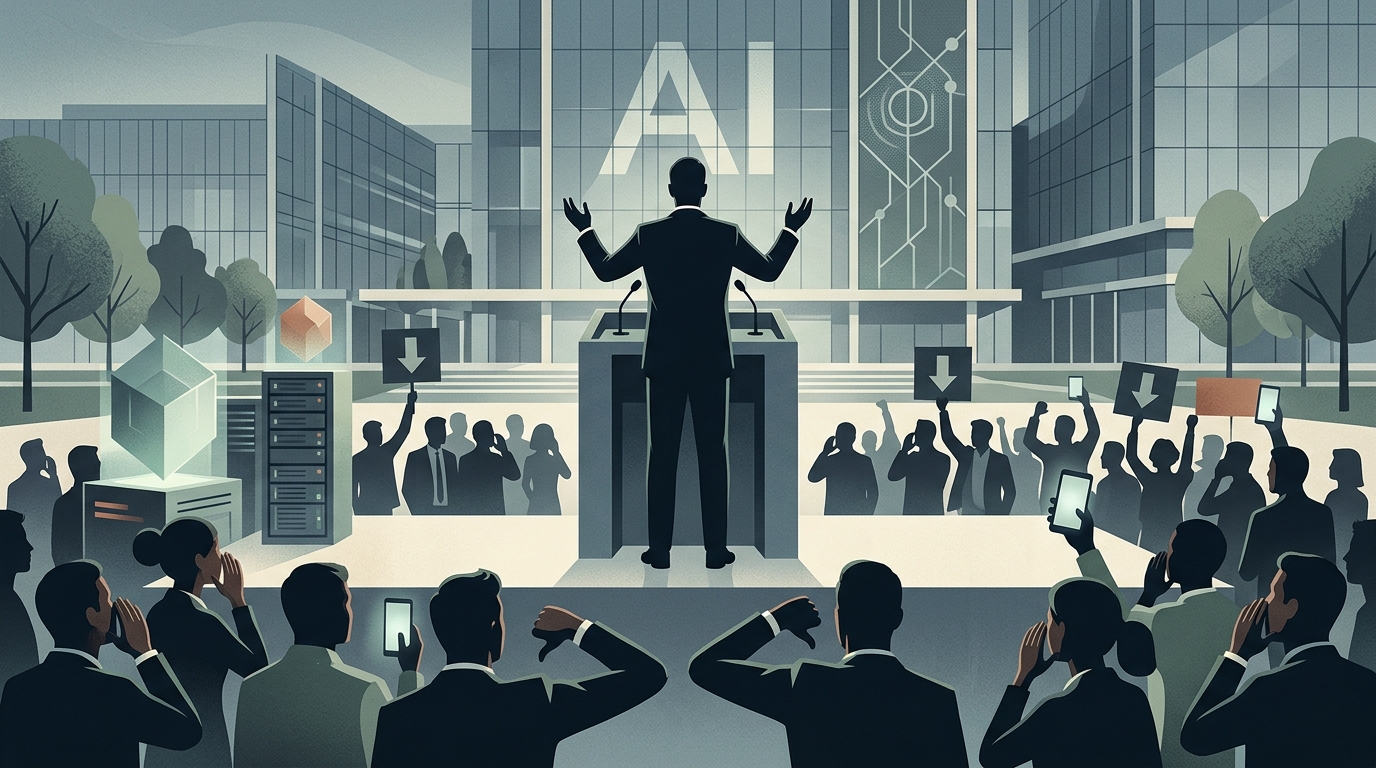
In the hallowed halls of Stanford University, where the future titans of industry are typically minted with cheers and applause, a different sound echoed recently: the sharp, unmistakable sting of boos. Eric Schmidt, the former CEO of Google and a central figure in the rise of the modern internet, found himself on the receiving end of a generational backlash. The incident, which occurred during a discussion on Artificial Intelligence, serves as a watershed moment for Silicon Valley, revealing a profound disconnect between the tech aristocracy and the workforce of tomorrow.
The Productivity Paradox: Hustle Culture vs. Modern Reality
The primary catalyst for the crowd's ire was Schmidt's candid—some would say callous—assessment of Google's current standing in the AI race. He suggested that the search giant had fallen behind nimble competitors like OpenAI because it had embraced a culture of remote work and prioritized work-life balance over raw output. To a graduating class that views flexible work as a hard-won right rather than a privilege, Schmidt’s rhetoric felt like a regression to a 19th-century factory mindset, updated for the fiber-optic age.
Schmidt’s argument rests on the belief that breakthrough innovation requires the friction and intensity of in-person collaboration. However, his delivery ignored the economic reality facing Gen Z graduates. In an era of skyrocketing housing costs and AI-driven job insecurity, being told to "work harder" by a billionaire who benefited from a very different economic landscape was never going to land well. The tension highlights a growing rift: the old guard sees AI as a reason to accelerate, while the new generation sees it as a reason to recalibrate what human labor actually means.
AI, Ethics, and the Military-Industrial Complex
Beyond the debate over office hours, the hostility toward Schmidt is rooted in his political and ethical alignments. As a key advisor to the U.S. government on AI defense strategies, Schmidt has been a vocal proponent of integrating machine learning into military hardware. For many at Stanford—a campus with a storied history of anti-war sentiment—Schmidt represents the "securitization" of technology.
- The legacy of Project Maven, which saw Google employees protest military contracts, continues to haunt the company's reputation.
- Concerns over AI's role in autonomous weaponry and mass surveillance are no longer theoretical; they are immediate ethical hurdles for young engineers.
- The perception that Schmidt is more interested in national hegemony than global safety fuels the skepticism of his audience.
The Death of Techno-Optimism
For thirty years, the Silicon Valley narrative was one of unalloyed progress. Figures like Schmidt were the high priests of this religion, preaching that every problem had a software solution. But as we stand in 2026, that techno-optimism has been replaced by a gritty techno-realism. The graduates booing Schmidt aren't Luddites; they are the very people who will build the next generation of LLMs and neural networks. However, they are doing so with their eyes open to the externalities: environmental impact, wealth inequality, and the erosion of privacy.
"You cannot ask us to burn the midnight oil to build the very systems that threaten our future autonomy, all while the rewards accrue solely to a handful of shareholders," seemed to be the unspoken sentiment behind the protest.
In conclusion, the Stanford incident is a warning shot. The leadership style that built the web—centralized, aggressive, and often dismissive of social costs—is no longer socially licenseable. As AI becomes the central nervous system of our civilization, the people building it are demanding a seat at the table, not just a desk in the office. Eric Schmidt’s experience at Stanford suggests that if Big Tech doesn't learn to listen, the boos will only get louder.