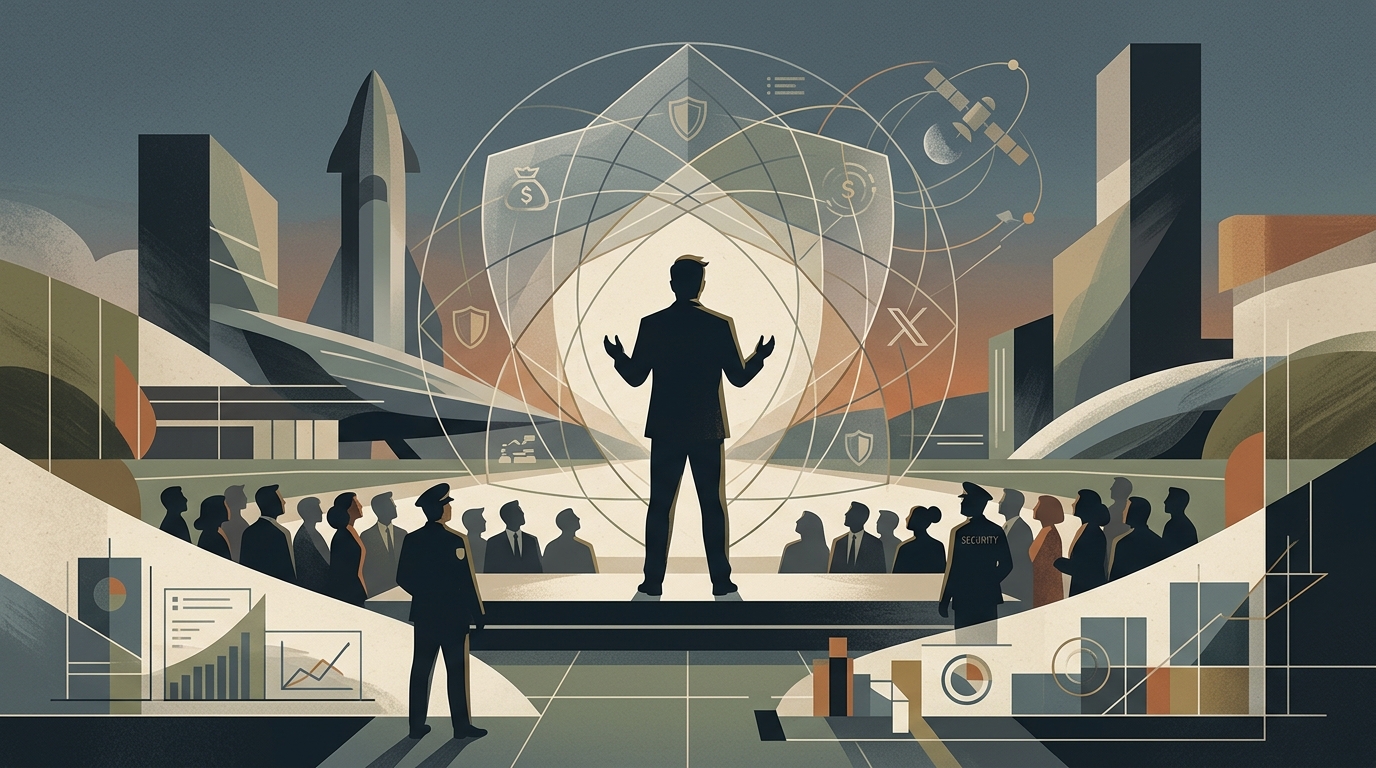
In the world of the ultra-wealthy, personal security has always been a necessary expenditure. However, in the case of Elon Musk, the "bill" for his protection has transformed into a phenomenon that transcends the boundaries of corporate governance and enters the realm of geopolitical significance. According to recent data and analyses, the security expenses for the CEO of Tesla and SpaceX have skyrocketed to unprecedented levels, creating a protective "bubble" that reflects increasing hostility in a sharply polarized global environment.
The Architecture of a Private Army
Musk's security is no longer just about a few bodyguards in suits. It is a multi-layered operation involving advanced surveillance systems, armored vehicles, and a team of specialists operating almost as a private intelligence agency. In 2023, Tesla paid approximately $2.4 million to a security firm owned by Musk himself for protection services, and this figure is expected to rise sharply in 2024 and 2025.
The need for this intensification is not accidental. Musk has transformed from a tech visionary into a central player on the political stage, especially following his acquisition of the X platform (formerly Twitter). His public rhetoric, interventions in electoral processes, and clashes with governments have created an explosive cocktail of admiration and animosity. Sources close to him report that death threats have increased exponentially, with Tesla acknowledging in official filings that Musk's security is critical to the company's operational continuity.
The Price of "Absolute Freedom"
There is an irony in the way the self-proclaimed "free speech absolutist" is forced to live. While promoting open communication, he is surrounded by an impenetrable wall of protection. The expenditure on his security is not just about physical integrity, but also about protecting the information and strategic moves of his companies. In the case of SpaceX, where technology is considered of national importance to the US, security takes on national security dimensions.
- Increased use of armored Cybertruck-style vehicles for his movements.
- Constant monitoring of digital threats and real-time risk analysis.
- Expansion of security perimeters at his residences and offices.
- Use of private jets with enhanced security protocols at airports.
Comparatively, other tech giants also spend enormous sums. Meta (formerly Facebook) has historically spent over $20 million annually on Mark Zuckerberg. However, the difference lies in the fact that Musk himself is the "product" and the "brand" of his companies to a much greater extent. If Musk were to become inactive, Tesla's market value could collapse within hours, making the millions spent on security a form of insurance premium for shareholders.
Corporate Governance and Ethical Dilemmas
The surge in these expenditures raises questions about corporate governance. Shareholders are asked to approve funds that often end up in companies controlled by the CEO himself. Furthermore, there is a debate over whether Musk's provocative statements are the very things triggering the threats, subsequently forcing the company to pay for protection against the consequences of his own words.
"We aren't just protecting a man; we are protecting the future of sustainable energy and multi-planetary life," says a Tesla executive who wishes to remain anonymous.
In the future, as artificial intelligence and automation become more central to his businesses, Musk's protection methods are expected to become even more technologically advanced. The use of drones, robotic systems, and advanced risk-prediction algorithms will be the next stage. However, the fundamental question remains: can a person remain connected to the reality of society when living inside a golden, yet perfectly armored, cage?