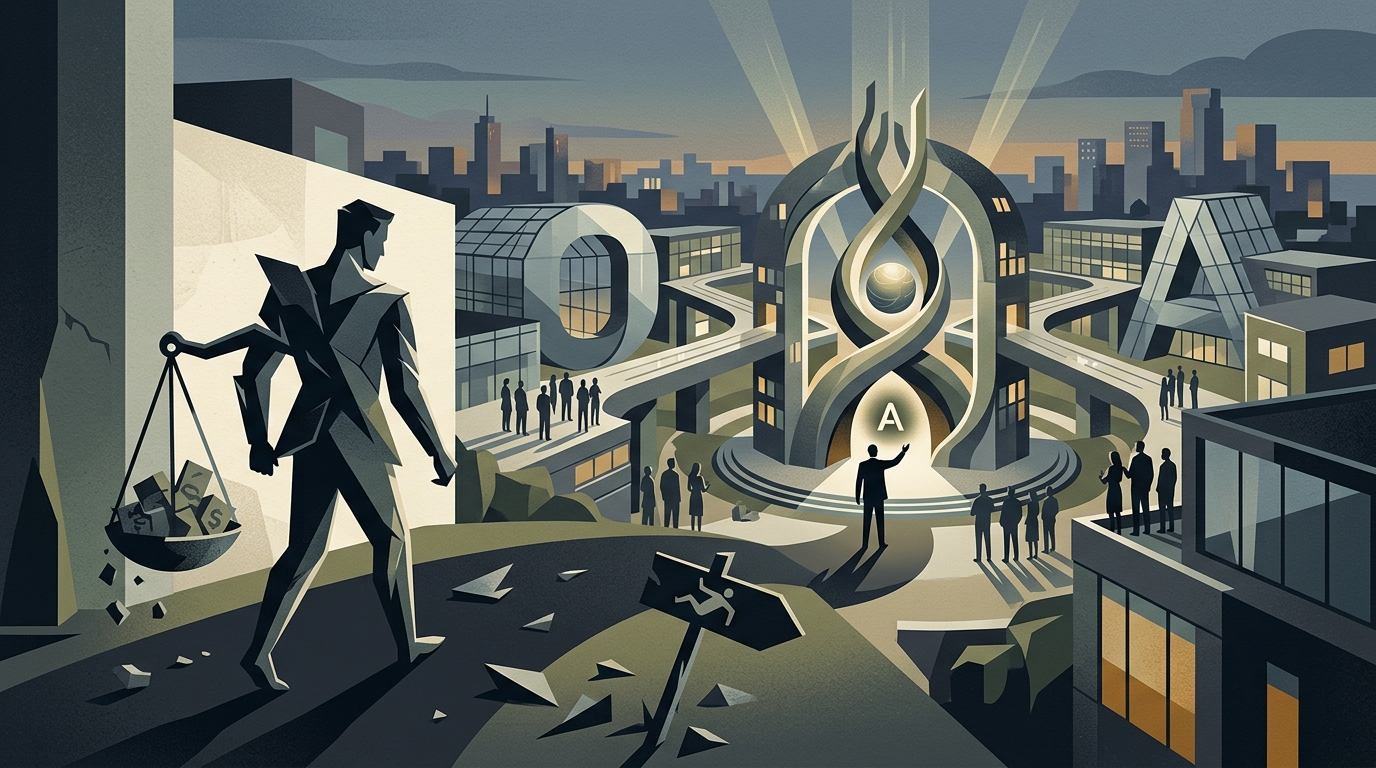
In a decision poised to define the future of technology governance, a court has dismissed the $150 billion lawsuit filed by Elon Musk against OpenAI and its CEO, Sam Altman. The case, watched with bated breath by Silicon Valley and the global investment community, centered on the allegation that OpenAI abandoned its original mission as a non-profit organization in favor of profits and a close partnership with Microsoft.
The Anatomy of a High-Stakes Rivalry
The rift between Musk and OpenAI’s leadership is not new, but its escalation into the courtroom took on the dimensions of an existential threat to the creator of ChatGPT. Musk, a founding member and key early donor, argued that OpenAI's transition into a "capped-profit" entity constituted a breach of a "founding agreement." According to Musk's side, the technology developed should have remained open and accessible to all, rather than being locked behind private interests.
However, the court ruled that there was never a formally signed and legally binding "founding contract" with the terms described by Musk. The judges emphasized that public statements and email exchanges do not constitute a contract, especially when dealing with the management of billions of dollars and the development of technologies affecting global security. This ruling is a massive victory for Sam Altman, who managed to maintain control of the company despite internal and external pressures.
Legal Precedents and the "Founding Agreement" Myth
The dismissal of the lawsuit was based on two main pillars. First, the lack of a legal basis for the claims of breach of contract. The court observed that OpenAI had the right to adapt its corporate structure to secure the necessary resources for the development of Artificial General Intelligence (AGI). Second, the claim for $150 billion in damages was deemed "excessive and unsubstantiated," as Musk failed to prove direct personal harm from OpenAI's business decisions.
- The absence of a written contract made Musk's allegations legally weak.
- OpenAI successfully argued that the Microsoft partnership was essential for compute resources.
- The ruling protects the right of startups to pivot their business models.
Altman’s legal team successfully argued that Musk's obsession with the case stemmed more from personal rivalry and a desire to bolster his own AI company, xAI, than from a genuine concern for humanity. The disclosure of internal messages during the trial showed that Musk himself had previously proposed merging OpenAI with Tesla, undermining his argument for "pure non-profit action."
The Ripple Effects on Silicon Valley
This verdict sends a clear message to the entire tech industry: founding values are important, but the legal reality of corporate structures outweighs idealistic declarations. For OpenAI, the end of this legal hostage situation means it can now proceed with new funding rounds at much higher valuations, without the fear of a sudden asset seizure or forced dissolution.
"The justice system has confirmed that progress cannot be halted by personal feuds. We continue our mission to ensure that AI benefits all of humanity," an OpenAI spokesperson stated following the announcement.
On the other hand, Elon Musk is expected to appeal, although legal analysts believe the chances of a reversal are slim. This defeat may force him to focus more on xAI and Tesla, attempting to outperform OpenAI through innovation rather than litigation. However, the blow to his image as a "protector of ethical AI" is significant.
Corporate Sovereignty in the Age of AGI
With this legal hurdle removed, Microsoft is expected to further deepen its partnership with OpenAI, potentially increasing its stake in the company’s for-profit arm. Meanwhile, regulators in the US and the EU are closely monitoring the situation, as the concentration of power in so few hands remains a concern. The court's decision may have closed one chapter, but the debate over who controls the most powerful technology of the 21st century is only just beginning.