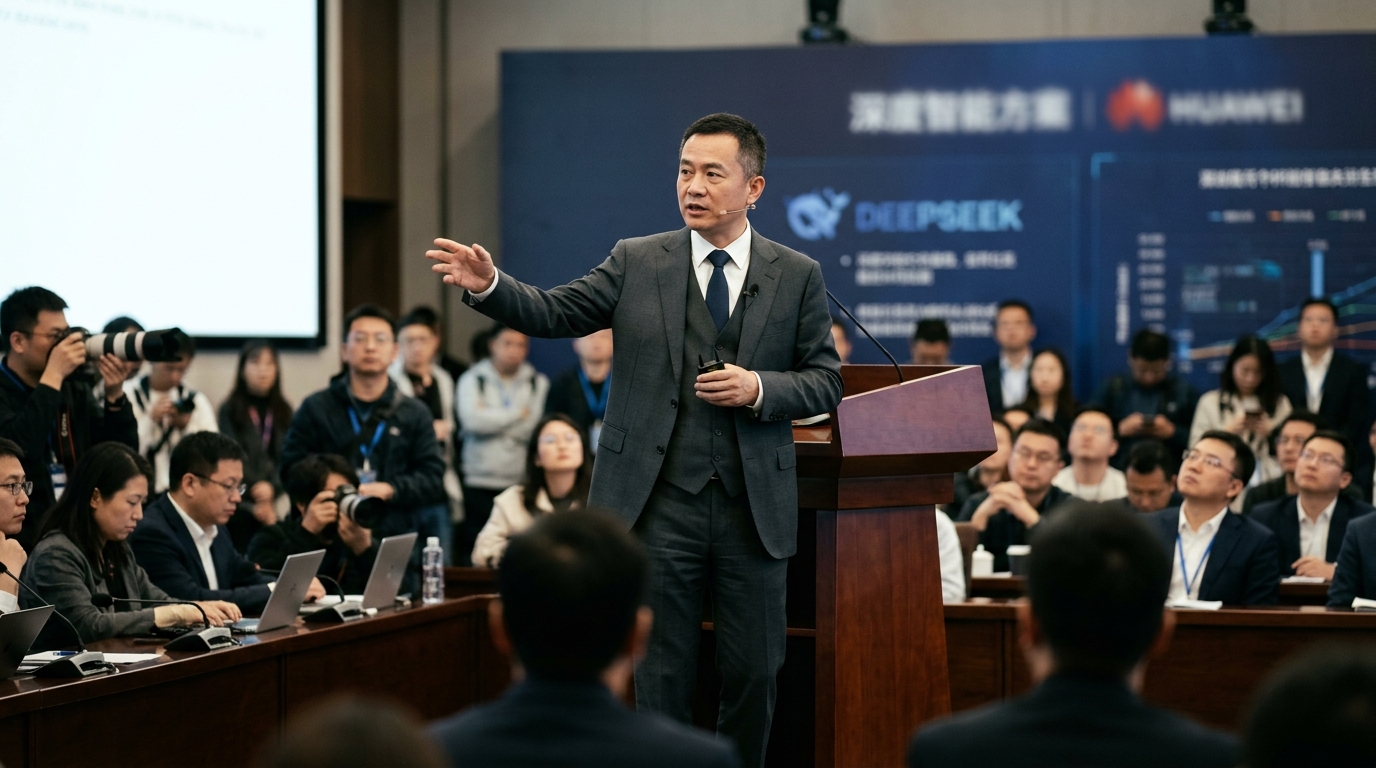
In the rapidly evolving landscape of global artificial intelligence, DeepSeek has emerged as one of the most unpredictable and efficient players. The recent preview of the DeepSeek V4 model, specifically optimized for Huawei’s Ascend chip architecture, is more than just a technical upgrade. It is a declaration of geopolitical independence. At a time when US restrictions on high-end semiconductor exports—such as Nvidia’s H100 and B200—are becoming increasingly stringent, China is responding with full vertical integration of its ecosystem: Chinese software running on Chinese hardware.
The Architecture of Autonomy
DeepSeek V4 builds on the success of its predecessors, V3 and R1, which stunned the global community by achieving GPT-4 level performance at a fraction of the training cost. The distinguishing factor of V4 lies in its tight integration with Huawei. DeepSeek engineers have reportedly refactored their algorithmic kernels to take full advantage of Huawei’s Da Vinci architecture, which powers the Ascend 910B and the upcoming 910C accelerators.
This optimization isn’t just about speed; it’s about survival. Historically, most Large Language Models (LLMs) have been developed with Nvidia’s CUDA ecosystem in mind. Transitioning to Huawei’s CANN software stack requires radical changes to low-level code. DeepSeek’s success in this area demonstrates that the gap between Chinese and Western raw compute power can be bridged through clever engineering and algorithmic efficiency.
Mixture-of-Experts and Enhanced Reasoning
Technically, V4 is expected to utilize an advanced iteration of the Mixture-of-Experts (MoE) architecture. In this model, only a small subset of parameters is activated for any given query, drastically reducing computational requirements during inference. Furthermore, V4 incorporates sophisticated Chain of Thought (CoT) capabilities, allowing the model to solve complex mathematical and programming problems with accuracy that rivals top-tier models from OpenAI and Anthropic.
- Full optimization for Huawei’s CANN software ecosystem.
- Reduced reliance on Nvidia’s proprietary CUDA libraries.
- Improved efficiency for large-scale enterprise deployment.
- Enhanced reasoning capabilities for scientific research and coding.
The Geopolitical Chessboard
This move has massive implications for the global market. For Chinese enterprises fearing they might be cut off from US-based cloud services at any moment, DeepSeek V4 on Huawei hardware offers a secure, domestic alternative. Simultaneously, DeepSeek continues its policy of releasing "open weights," allowing developers worldwide to study how top-tier AI can be achieved without the need for Silicon Valley’s most expensive hardware.
"Innovation doesn't stop because doors are closed; it simply changes direction. V4 is proof that necessity is the mother of invention," say industry analysts in Beijing.
In conclusion, DeepSeek V4 is not just another AI model. It is the cornerstone of a new, parallel technological reality where China is no longer a mere follower, but a pioneer forging its own path, independent of the standards set by the West. As the AI arms race intensifies, the synergy between DeepSeek’s software and Huawei’s hardware may well define the next decade of digital sovereignty.