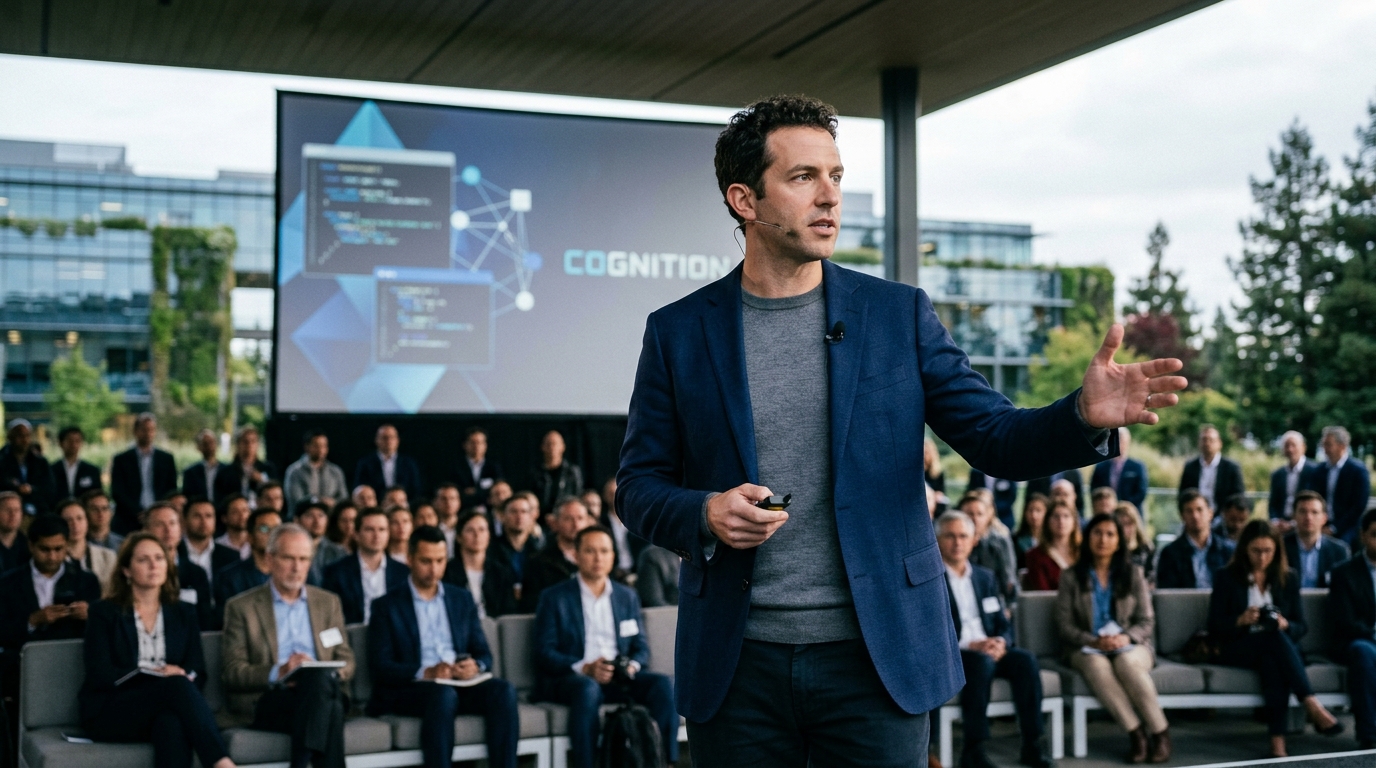
In the breakneck world of artificial intelligence, some companies don't just change the game; they rewrite the rulebook entirely. Cognition AI Inc., the startup that sent shockwaves through Silicon Valley with the introduction of 'Devin,' the world’s first autonomous AI software engineer, is now in advanced discussions for a new funding round. According to sources familiar with the matter, the company’s valuation is expected to reach a staggering $25 billion, a development that underscores the insatiable investor appetite for technologies that automate software creation.
The Ascent of the Autonomous Developer
Cognition AI is far from your typical startup. Founded by a team of competitive programming legends and international Olympiad winners, the firm managed to turn the promise of 'AI that writes code' into a tangible, commercial reality in record time. Devin, the company’s flagship product, is not merely an assistant like GitHub Copilot. It is an 'agent' capable of planning, executing, and debugging entire software projects with minimal human intervention.
The proposed $25 billion valuation represents a more than doubling of the company’s previous worth, which had already skyrocketed following its initial public debut in 2024. This surge reflects a broader market shift: investors are no longer just looking for chatbots that answer questions; they are seeking systems that 'produce work.' In Cognition’s case, that 'work' is the very code that powers the global economy.
The Strategic Significance of AI Coding
Why are Venture Capital giants willing to commit such capital? The answer lies in the cost and speed of software production. Traditionally, software development has been a labor-intensive, expensive, and error-prone process. Cognition AI’s promise is the radical reduction of these barriers. If an enterprise can deploy an application in hours rather than months, the competitive advantage is incalculable.
Furthermore, Cognition AI appears to be winning the trust battle. While other AI solutions often produce code with security vulnerabilities or logical flaws, Devin’s architecture focuses on real-time problem solving. Its ability to learn from its own mistakes during compilation and adapt to new APIs makes it a tool that appeals not just to hobbyists, but to seasoned engineering teams looking to offload repetitive tasks.
Challenges and the Competitive Landscape
Despite the euphoria, the road to $25 billion is not without hurdles. Competition is fierce. Microsoft, via GitHub, is constantly integrating new AI capabilities, while Google and Amazon are pouring billions into their own automated programming platforms. There is also the question of long-term viability: can an AI handle the labyrinthine complexity of legacy systems that form the backbone of banks and government infrastructure?
Moreover, ethical and social questions are surfacing. The automation of programming is causing anxiety about the future of the software engineering profession. While Cognition AI maintains that Devin is a 'collaborator,' the labor market may perceive its presence as a threat to entry-level positions, forcing junior developers to upskill faster than ever before.
The Future of Creation
This funding round, if finalized, will be a landmark event for 2026. It signals the maturation of generative AI from an experimental phase to full integration into the production chain. Cognition AI isn't just selling software; it is selling the capability to create software. In a world digitalizing at an exponential rate, that capability might be the most valuable currency of the decade.