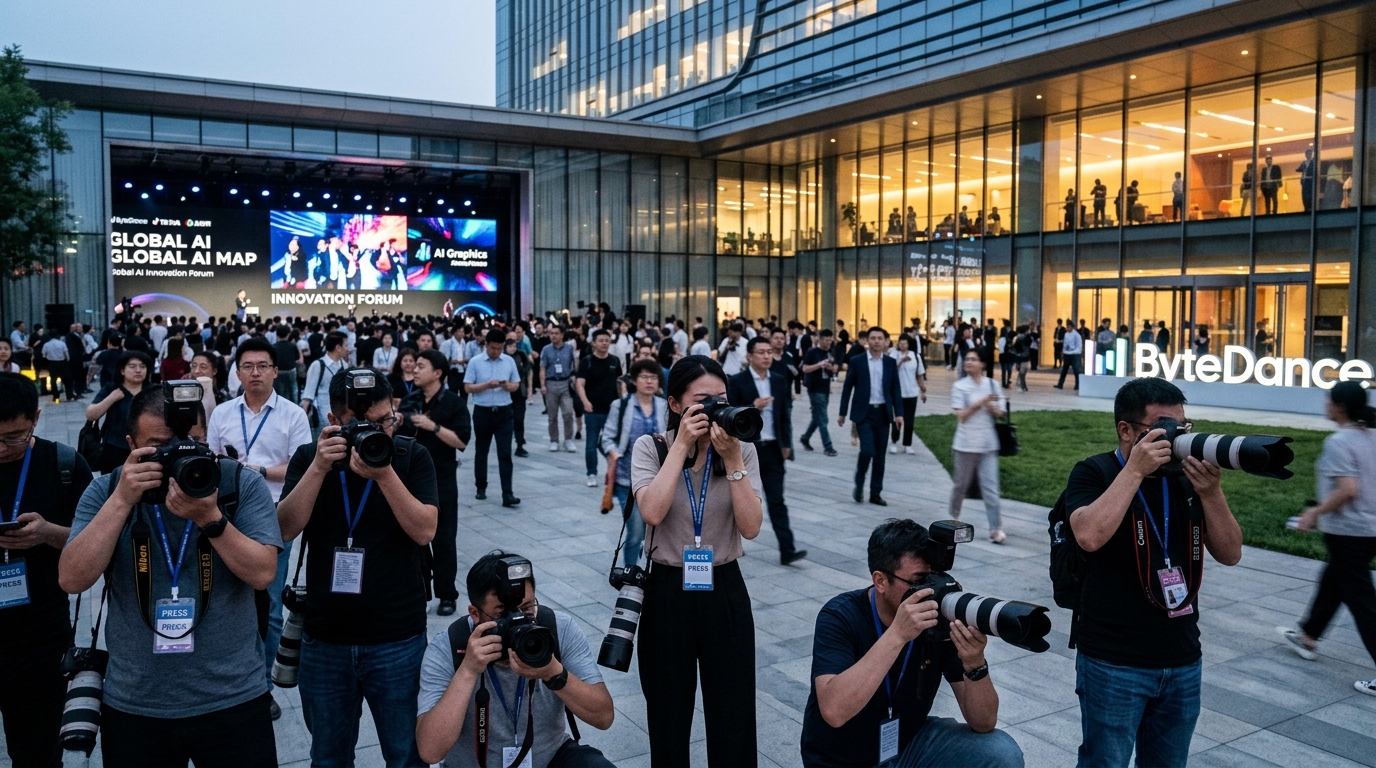
In the breakneck world of global technology, figures often lose their impact due to the sheer inflation of expectations. However, when ByteDance, the parent company of TikTok and the world’s most valuable startup, signals a potential spending spree of $89 billion on Artificial Intelligence (AI), the market doesn't just listen—it recalibrates. This is not merely an algorithmic facelift; it is an all-out offensive for dominance in the next generation of cloud computing, semiconductors, and generative intelligence.
The Scale of Ambition: Beyond the Feed
For the average user, ByteDance is synonymous with TikTok and Douyin—platforms that captured Gen Z's attention through an algorithm that seemingly reads minds. But the $89 billion strategy reveals a far deeper ambition. The company aims to pivot from a social media firm to a full-stack AI infrastructure titan. This investment is reportedly earmarked for three core pillars: the development of proprietary Large Language Models (LLMs), the construction of massive data centers, and, most crucially, the design of custom silicon.
ByteDance has already tasted success with 'Doubao', its AI chatbot which has consistently topped download charts in China, outpacing many domestic rivals. With this new capital injection, the company plans to train models capable of competing with OpenAI’s GPT-5 and Google’s Gemini, focusing not just on text, but on multimodal capabilities that integrate video and audio in real-time—a natural fit for the world's leading short-video ecosystem.
The Semiconductor Hurdle and Geopolitical Maneuvering
The greatest challenge for ByteDance isn't a lack of talent or data; it’s the tightening noose of U.S. export controls. With Nvidia facing strict prohibitions on selling its top-tier AI processors (like the H100 and B200) to Chinese entities, ByteDance is forced toward a path of radical self-reliance. A significant portion of the $89 billion is expected to flow into the R&D of internal semiconductors, working with domestic foundries and international partners to find workarounds for Western restrictions.
This financial hemorrhage is a strategic necessity. Without the requisite compute power, dreams of AI hegemony remain purely theoretical. ByteDance understands that the recommendation engines that fueled its rise were built on previous-generation hardware; the next phase of AI requires an infrastructure that few nations, let alone companies, can afford to finance.
Internal Reorganization and the Quest for ROI
Despite staggering ad revenues, ByteDance is under immense pressure to prove that AI can be converted into sustainable profit. The $89 billion bet is a high-stakes gamble. The company has already undergone internal shifts, prioritizing its 'Flow' unit, which focuses on embedding AI across its suite of apps. From AI-driven content creation tools for TikTok influencers to automated customer service for its burgeoning e-commerce arm (TikTok Shop), AI is the new connective tissue of the organization.
"We are not just investing in technology; we are investing in our survival in a world where user attention will be brokered by personal digital assistants," a source close to the company's leadership noted.
This strategy puts ByteDance on a collision course with Mark Zuckerberg’s Meta, which is also spending tens of billions on its Llama models and AI hardware. The distinction lies in ByteDance's unique position: it possesses an iron grip on the Chinese market while maintaining a formidable (albeit legally precarious) foothold in the West. This dual presence provides a data diversity that few American firms can match.
Conclusion: A New World Order in AI
The $89 billion figure is more than a budget; it is a manifesto of power. In an era where AI is viewed as the new "black gold," ByteDance refuses to be a bystander. If it can successfully navigate the semiconductor blockade and leverage its unparalleled data silos, it may emerge as the first truly global AI leader not headquartered in Silicon Valley. The stakes are not just about quarterly earnings, but about who will write the code for the digital future. As May 2026 unfolds, the AI arms race has found its most aggressive participant.