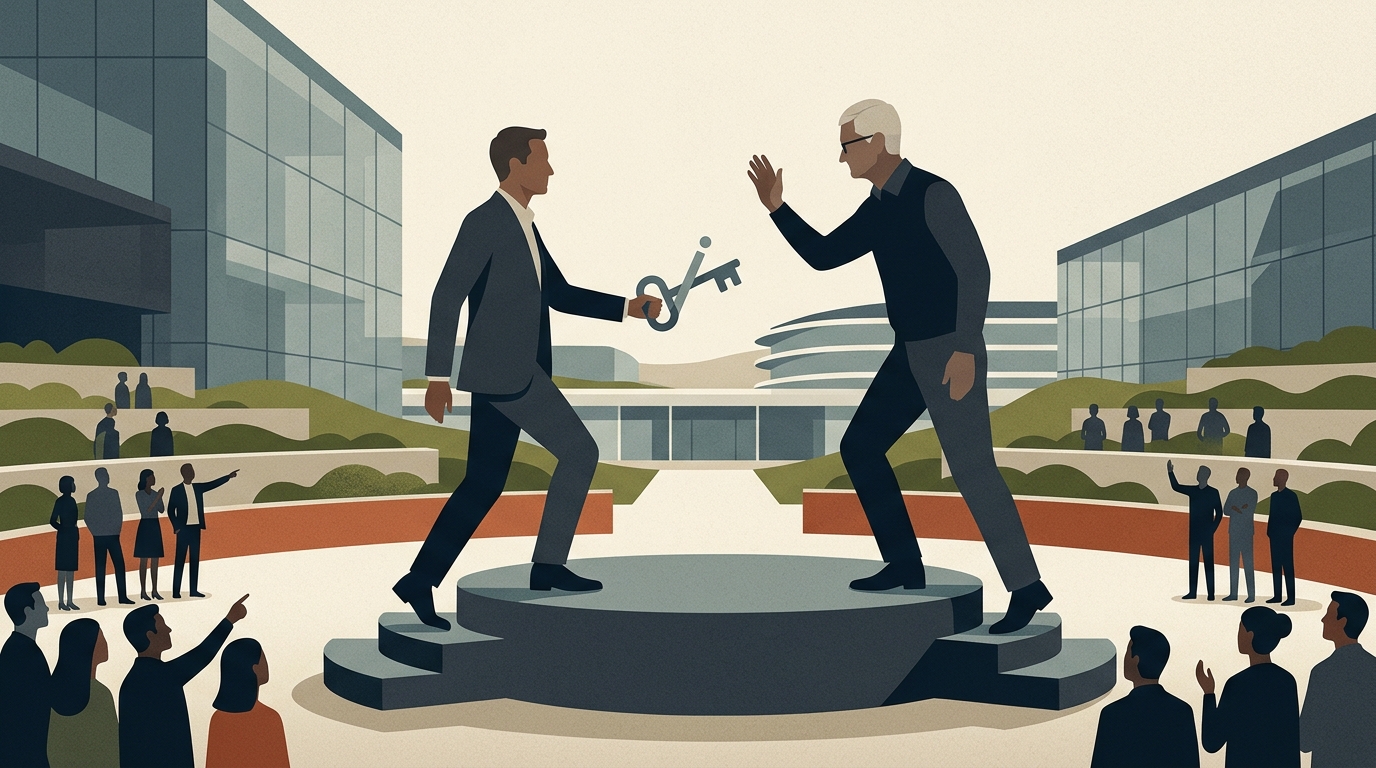
In Cupertino, April 20, 2026, will be remembered as the day Apple decided to turn the page, while remaining steadfastly committed to its doctrine of continuity. In a concise but momentous announcement, the tech giant formalized what Wall Street whispers had predicted for months: John Ternus, the man behind the Apple Silicon revolution, is the company's new Chief Executive Officer. Tim Cook, the architect of Apple’s financial stratospheric rise over the past 15 years, is not departing entirely but will transition to the role of Executive Chairman of the Board.
The Hardware Man and the Strategy of Continuity
John Ternus is no ordinary executive. He joined Apple in 2001, the same year the first iPod was released, and his trajectory since then has been consistently upward. As the head of Hardware Engineering since 2021, he is credited with some of the company’s most pivotal successes: the transition from Intel processors to proprietary M-series chips, the redesign of the iPad, and the development of the Vision Pro. The choice of Ternus sends a clear message to the markets: Apple remains, at its core, a product company.
Unlike other potential candidates who emerged from services or finance, Ternus is considered a "child of the lab." He is well-liked by engineers and enjoys Cook’s absolute trust. The transition, to be completed by September 1, 2026, has been designed with Apple’s characteristic methodical precision, echoing Cook’s succession of Steve Jobs in 2011, albeit under very different socioeconomic circumstances.
The Tim Cook Legacy: From $350 Billion to $3.5 Trillion
When Tim Cook took the helm in 2011, many doubted whether a "supply chain manager" could maintain Apple’s luster without Jobs’ visionary spark. Fifteen years later, the numbers provide the answer. Cook transformed Apple into the most profitable enterprise in the world, expanding the services ecosystem (App Store, iCloud, Apple Music) and establishing the iPhone as the ultimate global consumer staple. Under his leadership, the company’s market capitalization soared from $350 billion to levels approaching $3.5 trillion.
"Apple is not just a company; it is an institution. John has the talent, experience, and integrity to lead this institution into the next decade," Cook stated in the official release.
His move to the Executive Chairman role suggests he will continue to oversee strategic direction, particularly regarding data privacy and environmental sustainability—areas that became his personal hallmarks.
Challenges of the Ternus Era: AI and Regulatory Pressure
The new CEO does not inherit a cloudless empire. Apple finds itself at a critical juncture. The rise of Generative AI found the company following with cautious, perhaps slow, steps compared to Google and Microsoft. Ternus will have to prove that "Apple Intelligence" can become an indispensable part of users' daily lives without sacrificing the security that is the brand’s trademark.
Furthermore, pressure from the European Union and the US Department of Justice regarding monopolistic practices in the App Store remains suffocating. Ternus will be called upon to balance maintaining high profit margins with compliance with new laws (such as the Digital Markets Act), which threaten to "open up" Apple’s closed ecosystem. Finally, the bet on Vision Pro and Spatial Computing remains unsettled. Can Ternus make virtual reality a mass-market success, as Cook did with the Apple Watch?
Conclusion: A Choice for Stability
The market reacted positively to the news, with Apple shares ticking slightly higher in after-hours trading. John Ternus represents the "safe choice." He is a man who knows hardware like few others, who has been nurtured in the culture of secrecy and perfectionism at Cupertino, and who is not expected to make abrupt shifts in direction. In a world full of uncertainty, Apple has chosen its engineer to ensure that the machine of profit and innovation does not miss a single beat.