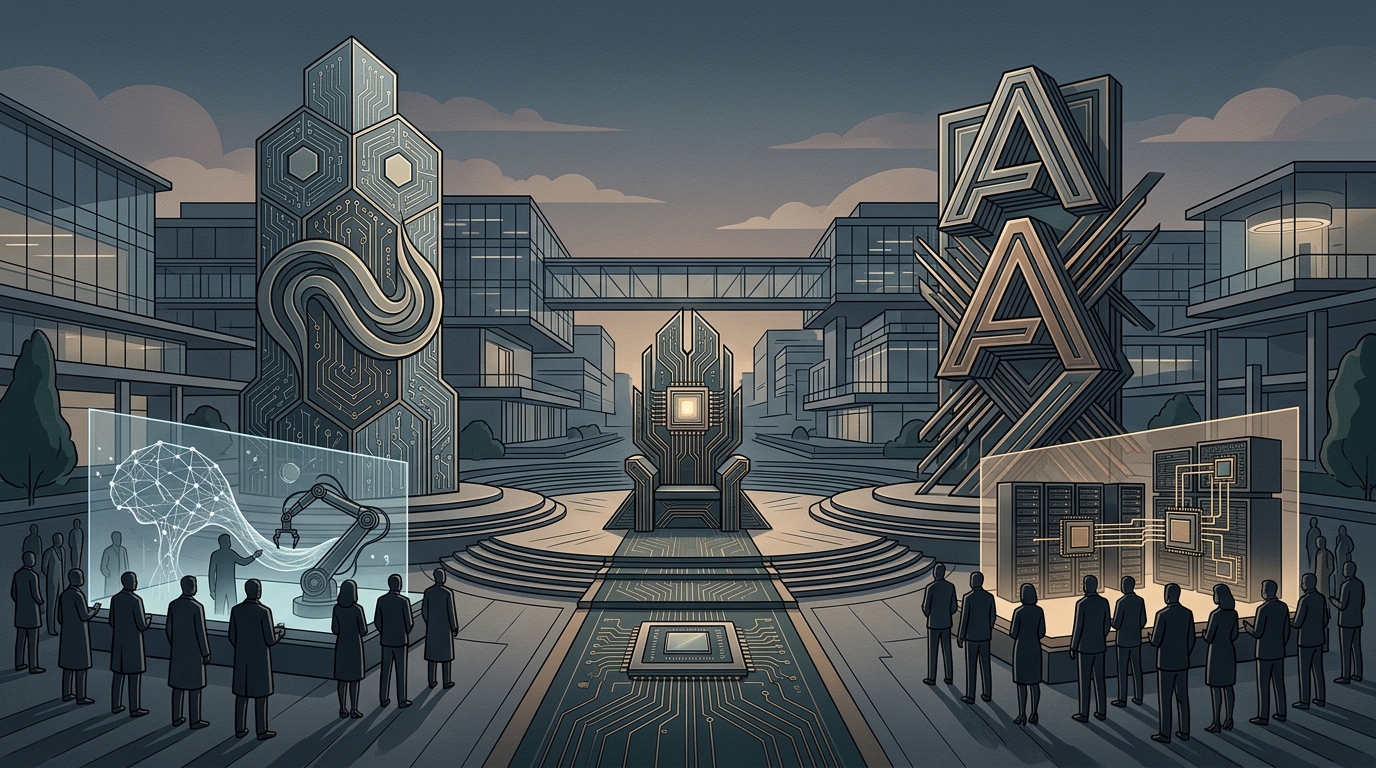
In today's technological landscape, the battle for Artificial Intelligence (AI) supremacy is not just fought in software laboratories, but deep within the silicon crystals of semiconductors. NVIDIA and AMD, two companies that once primarily competed for the favor of gamers, are now at the heart of a geopolitical and economic revolution. As we move through 2026, the question is no longer whether AI will change the world, but which architecture will form the backbone of this transformation.
NVIDIA’s Hegemony and the CUDA Moat
NVIDIA, under the leadership of Jensen Huang, has managed to transform from a graphics card company into a global computing systems leader. Its success is not built on hardware alone, but significantly on software. The CUDA (Compute Unified Device Architecture) ecosystem has become the de facto standard for AI developers worldwide. With the advent of the Blackwell architecture and the recent announcement of the next-generation 'Rubin' platform, NVIDIA continues to push the boundaries of computational power.
However, NVIDIA’s dominance faces mounting challenges. The high cost of its chips and the proprietary nature of its ecosystem have prompted major cloud providers (Hyperscalers), such as Microsoft and Google, to seek alternatives. This is where AMD finds its opening, offering a more open and cost-effective approach to the market's insatiable demand for compute power.
AMD’s Counter-Strike: The Strategy of 'Open' Silicon
Lisa Su, CEO of AMD, has repeatedly proven that her company can go toe-to-toe with giants. With the Instinct MI300X series of accelerators and their successors, AMD has managed to capture significant market share in the training of Large Language Models (LLMs). AMD's strategy rests on the 'open' ROCm architecture, which allows developers to port their code from CUDA with increasing ease and minimal performance loss.
"AI is the most transformative technology of the last 50 years, and no single company can control it alone," Su recently stated, emphasizing the need for a collaborative ecosystem rather than a walled garden.
Furthermore, AMD maintains a critical advantage in the Central Processing Unit (CPU) domain. EPYC processors dominate modern data centers, providing the necessary computational infrastructure that complements GPUs. AMD’s recent acquisition of ZT Systems signals its intent to offer full-scale rack solutions, directly challenging NVIDIA’s integrated 'system-on-a-chip' model and its dominance in the data center fabric.
Robotics and Edge AI: The Next Frontier
As AI migrates from the cloud to physical devices, the battleground is shifting toward robotics. NVIDIA has already made significant strides with Project GR00T, a foundation model platform for humanoid robot development. NVIDIA’s ability to combine simulation in the digital world (via Omniverse) with execution in the physical world gives it a formidable head start in the race for embodied AI.
On the other hand, AMD is leveraging its expertise from the Xilinx acquisition. AMD’s FPGAs (Field Programmable Gate Arrays) and adaptive SoCs are ideal for robotics applications that require low latency and high energy efficiency. In the future, dominance may not be decided by who has the fastest chip in the data center, but by who controls the 'brain' of the autonomous systems operating in our daily lives.
Investment Outlook and Conclusion
For investors, the choice between NVDA and AMD is often a choice between 'momentum' and 'value.' NVIDIA remains the premium play for those betting on absolute technological superiority, despite its high valuation multiples. AMD, however, offers a compelling alternative with significant upside potential as the market seeks diversification and price competition.
In conclusion, the next phase of AI will be characterized by the convergence of CPUs and GPUs and the integration of intelligence into every aspect of physical reality. Whether it is NVIDIA with its integrated, high-performance ecosystem, or AMD with its flexibility and open-source commitment, the victor of this silicon war will dictate the trajectory of human innovation for decades to come.