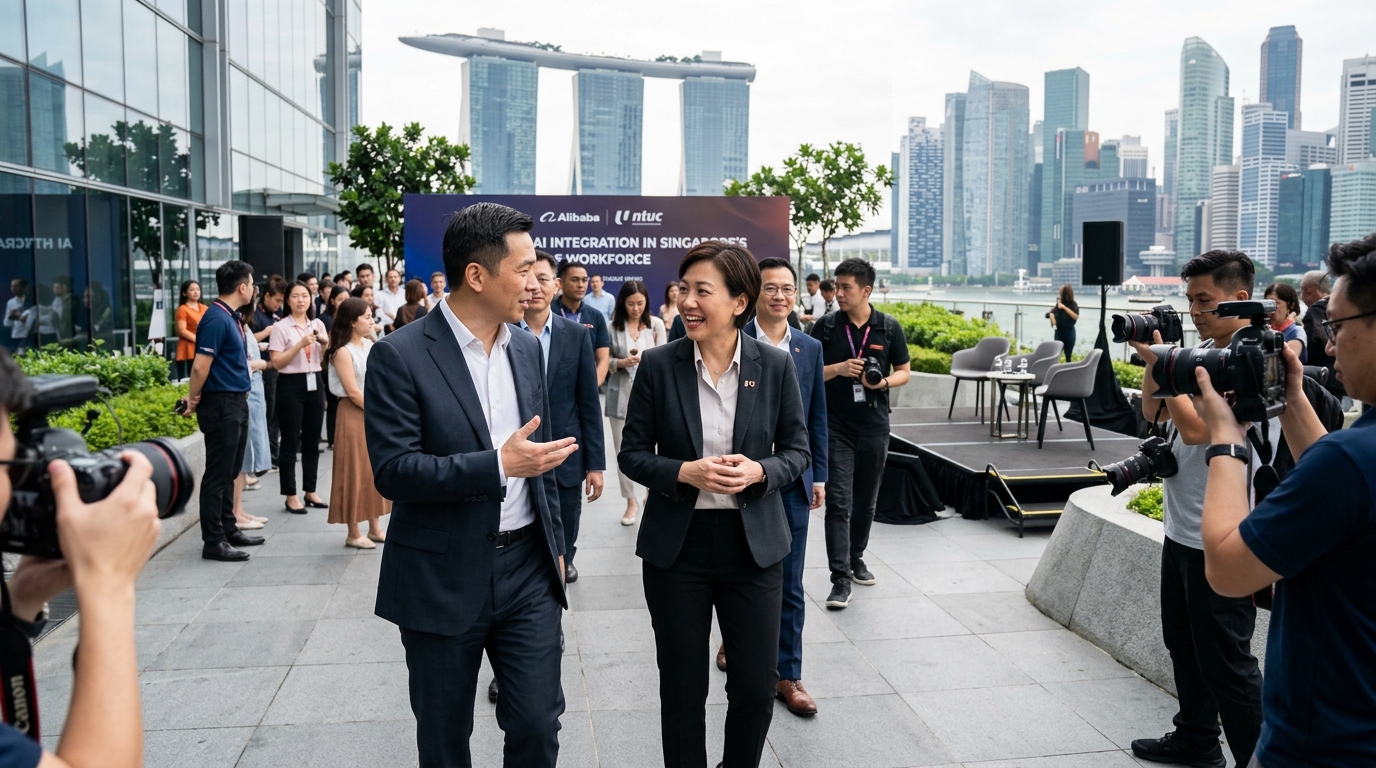
In an era where Artificial Intelligence (AI) is no longer a futuristic promise but an immediate economic imperative, Singapore is reaffirming its position as a global living laboratory for innovation. The recent partnership between Chinese tech giant Alibaba, through its Alibaba Cloud arm, and Singapore’s National Trades Union Congress (NTUC), marks a critical turning point in how national economies approach the integration of AI into the social and labor fabric.
The Strategic Alliance
This collaboration is more than just a commercial agreement; it is a strategic response to the challenge of 'digital lag.' Alibaba Cloud has committed to providing expertise, cloud infrastructure, and access to its advanced Large Language Models (LLMs), such as Tongyi Qianwen, to help local businesses and workers familiarize themselves with Generative AI tools. On the other hand, NTUC, representing the bulk of the island nation’s workforce, provides the network and social legitimacy required for such a massive transition.
The focus of the initiative lies in empowering Small and Medium-sized Enterprises (SMEs), which often struggle to keep pace with the costs and complexities of new technologies. Through specialized training programs and subsidized access to cloud services, Alibaba and NTUC aim to democratize access to AI, allowing even small retail shops or local supply chains to optimize their operations.
Upskilling: Human Capital at the Forefront
One of the most compelling aspects of this partnership is the emphasis on 'human-centric AI.' Rather than fostering a fear of replacement, NTUC’s rhetoric focuses on 'augmentation.' According to the announced plans, over 100,000 workers are expected to undergo specialized digital literacy seminars. The training is not limited to using tools but extends to understanding the ethical use of AI and data management.
"Technology is the tool, but the worker remains the craftsman. Our partnership with Alibaba ensures that our workers will not be mere spectators of change, but the protagonists of the new economy," an NTUC representative stated.
This move reflects Singapore’s unique model of 'tripartism,' where the government, employers, and unions work in close coordination. In a global environment where AI often causes friction in labor relations, Singapore chooses the path of proactive integration and consensus-building.
Geopolitical and Economic Implications
The choice of Alibaba Cloud by NTUC also carries deep geopolitical weight. While the United States and Europe often place hurdles in the path of Chinese tech firms, Singapore continues to maintain an 'open door' policy, balancing its relationships between East and West. For Alibaba, the success of this venture in Singapore serves as a showcase for the rest of Southeast Asia, a market expected to see explosive growth in cloud adoption in the coming years.
Furthermore, this partnership bolsters Singapore’s 'Smart Nation 2.0' vision. By integrating AI into traditional sectors such as shipping, hospitality, and manufacturing, the country seeks to maintain its competitive edge against emerging tech hubs like Vietnam and Indonesia. Using AI for demand forecasting, customer service automation, and energy consumption optimization are just a few of the practical benefits anticipated.
Conclusion
The Alibaba-NTUC alliance is a bold experiment in social and technological engineering. If successful, it will prove that the transition to the AI era does not have to be a painful process of creative destruction but can be an organized evolution. For the rest of the world, and particularly for Europe, Singapore’s example offers valuable lessons on how collaboration between the private sector and labor organizations can mitigate the inequalities driven by technological progress.