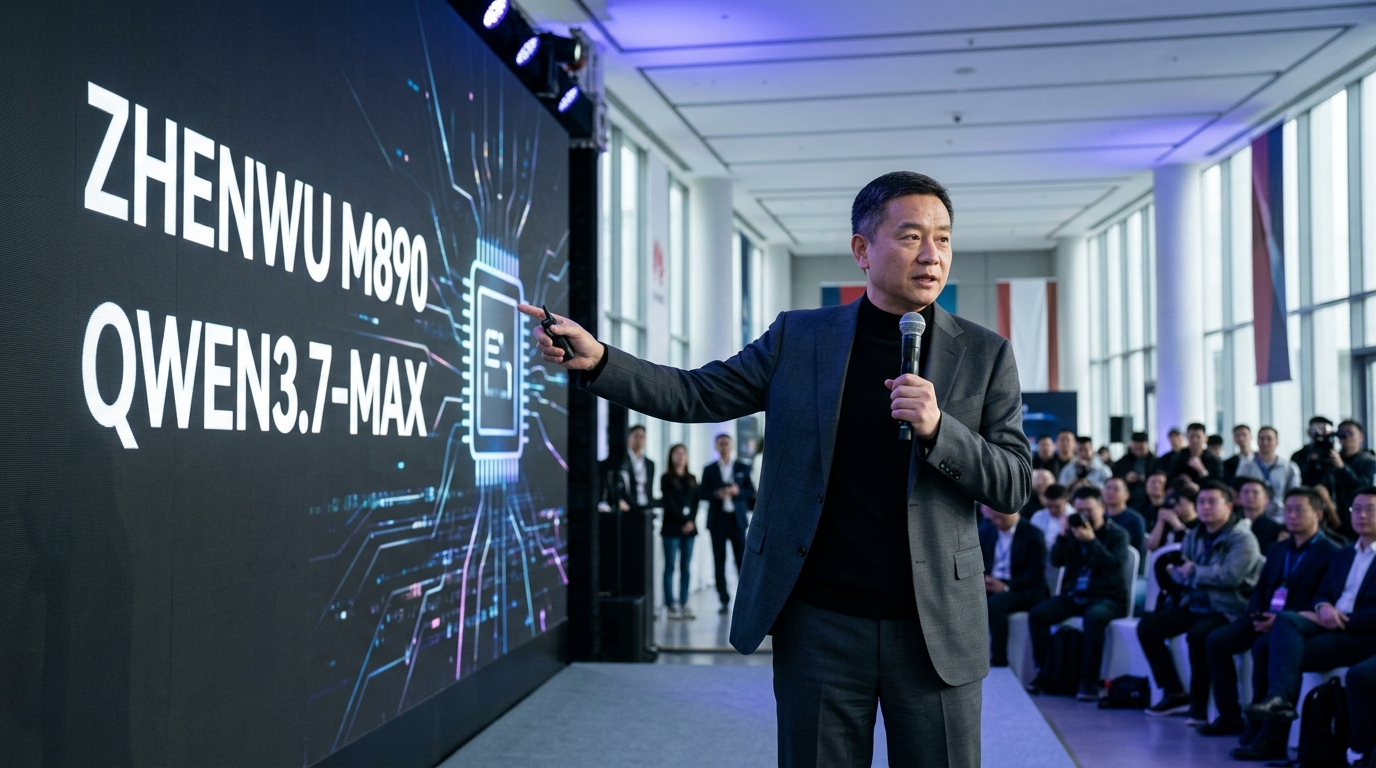
In the heart of Hangzhou, where ancient tradition meets digital revolution, Alibaba Cloud staged a massive demonstration of strength that reshapes the global AI landscape. The announcement of the Zhenwu M890 processor and the Qwen3.7-Max large language model is not merely corporate news; it is a geopolitical declaration of independence. In an era where U.S. trade restrictions aim to stifle China’s access to high-end semiconductors, Alibaba has responded with a homegrown solution, proving that innovation knows no borders.
Zhenwu M890: The Silicon of Autonomy
The Zhenwu M890 processor represents the pinnacle of Alibaba’s long-term investment in semiconductor design. Designed exclusively to accelerate AI workloads within the company’s data centers, the M890 promises a 40% improvement in energy efficiency compared to its predecessor. Its architecture is optimized for transformer-based model training and inference, integrating advanced interconnect technologies that allow for the creation of massive computational clusters.
What makes the Zhenwu M890 truly groundbreaking is its ability to handle immense data throughput with minimal latency. According to Alibaba engineers, the processor utilizes a novel memory management system that bypasses traditional bottlenecks, enabling Qwen3.7-Max to "think" in real-time. This move drastically reduces Alibaba's reliance on NVIDIA GPUs, providing the company with a significant cost advantage and supply chain security in a volatile political climate.
Qwen3.7-Max: The New Peak of Intelligence
Alongside the hardware, Alibaba debuted Qwen3.7-Max, the latest flagship iteration of its "Tongyi Qianwen" series. The new model features a staggering 2-million-token context window, allowing it to analyze entire libraries of documents or hours of video in a single session. Multimodality is its hallmark, with the ability to understand and generate code, text, images, and audio with unprecedented precision and nuance.
In benchmarks shared during the Summit, Qwen3.7-Max outperformed Western rivals in mathematical reasoning and complex coding tasks. Particular emphasis was placed on the model's capabilities as an "agentic AI," capable of handling sophisticated tasks such as supply chain orchestration and automated customer service for Alibaba’s sprawling e-commerce platforms. The integration of the model into the DingTalk and Taobao ecosystems is expected to fundamentally change user experience, making machine interaction feel more natural than ever before.
The Open-Source Gambit and Global Influence
One of the most compelling aspects of Alibaba’s strategy is its commitment to the open-source movement. While the Max version remains proprietary for enterprise clients via Alibaba Cloud, smaller, highly capable versions of Qwen3.7 will be released to the developer community. This move is designed to establish Qwen as the standard for AI in the "Global South" and in markets seeking alternatives to the American technology monopoly.
Alibaba Cloud is no longer just selling raw compute; it is offering a comprehensive "Model-as-a-Service" (MaaS) platform. This means businesses across various sectors can train their own specialized models on Alibaba’s infrastructure, utilizing the tools and security provided by the Chinese giant. This strategy appears to be yielding results, as the company announced a 25% increase in international clients despite ongoing geopolitical friction.
Conclusion: A Bipolar AI World
The launch of the Zhenwu M890 and Qwen3.7-Max marks the maturation of the Chinese AI ecosystem. Alibaba has proven it can innovate vertically, controlling everything from the silicon up to the final application. For the global market, this signifies a definitive transition into a bipolar AI world, where East and West compete not just on algorithmic speed, but on the dominance of the infrastructure that supports them. The question is no longer whether China can catch up to the West, but how quickly it might surpass it in specific industrial applications.