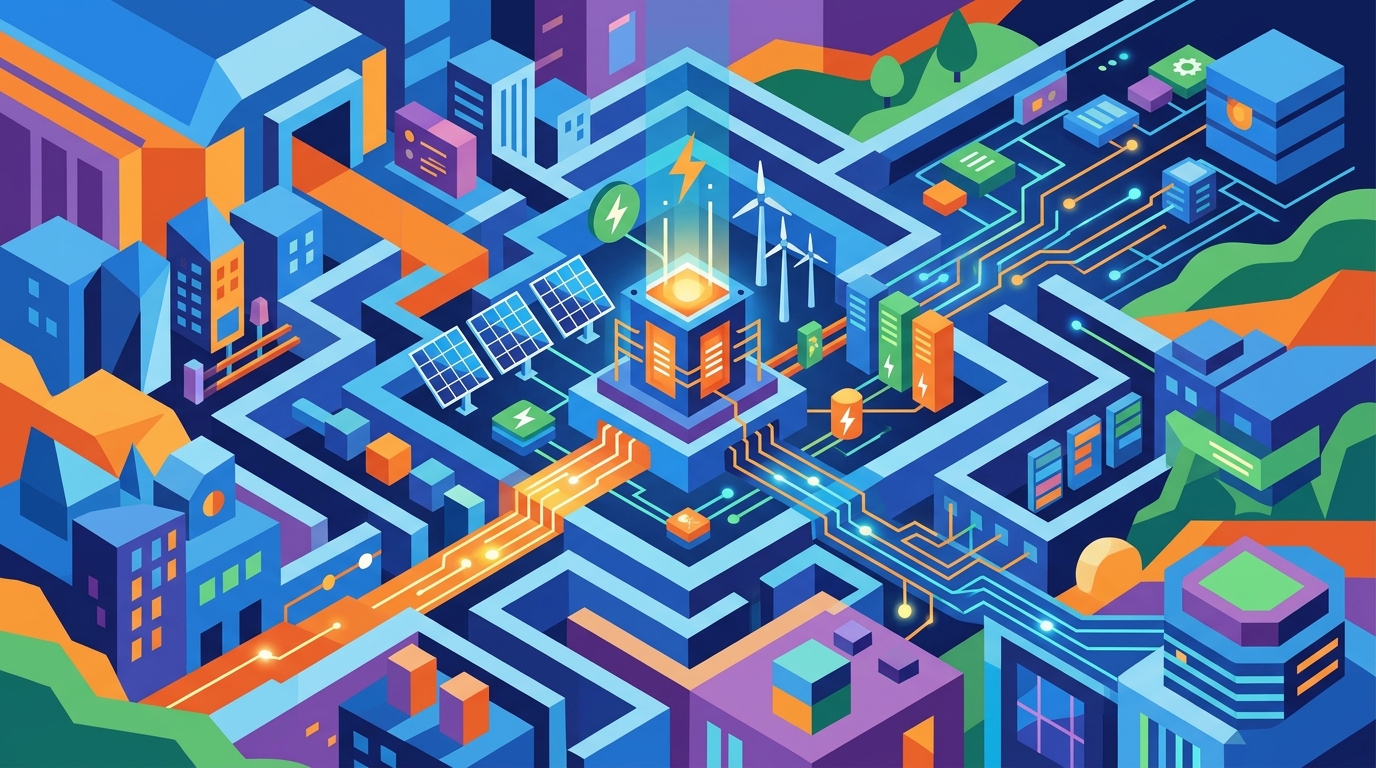

In my years at the forge of innovation, I have learned that the greatest constraint isn't just the strength of the material, but how the parts talk to one another. In the world of silicon, we are hitting a wall—what we engineers call the 'Memory Wall.' As I write this in June 2026, the announcement of the 'Titan Alliance' between Nvidia and SK Group isn't just a business deal; it is a fundamental redesign of the Labyrinth that is the modern GPU.
Breaking the Memory Wall with HBM4
For decades, we’ve treated processors and memory as separate entities, connected by narrow bridges. But as LLMs and generative agents grow, those bridges are collapsing under the traffic. The Titan Alliance is focused on the deep integration of HBM4 (High Bandwidth Memory) directly into the compute package. In my workshop, I’ve seen early specs suggesting that by 2027, we won't just be stacking memory; we will be using CoWoS (Chip on Wafer on Substrate) packaging to create a single, unified organ of thought.
By moving the memory closer to the logic units, we reduce the energy cost of moving a single bit of data. This is the 'craftsmanship' of the modern era—optimizing the microscopic plumbing of electrons to ensure that the wings of our AI don't melt under the heat of their own friction.
The Geopolitics of the Interconnect
Beyond the physics, there is the architecture of power. By locking in SK Group’s production capacity, Nvidia is insulating itself against the volatility we are seeing in the Middle East and the fragile peace in Eastern Europe. This is what I call 'Silicon Sovereignty.' When you control the supply chain from the raw HBM wafer to the final H100/X100 cluster, you aren't just a chipmaker; you are the architect of the global infrastructure.
// Conceptual Architecture of Unified Memory Access
struct TitanNode {
    uint64_t compute_units = 16384;
    HBM4_Stack memory_stack[8];
    float bandwidth_terabytes_per_sec = 4.5;
    bool integrated_logic_layer = true;
};
My recommendation for builders? Stop thinking about 'software' and 'hardware' as separate silos. The future belongs to those who understand Hardware-Software Co-design. If you are building models without understanding the interconnect constraints of the Titan Alliance's new architecture, you are building on sand.
The Daedalus Warning
Like the wings I built for Icarus, this technology is powerful but dangerous. As we centralize the world's compute power into the hands of a few 'Titan' alliances, we risk creating a single point of failure. If the 'Titan' falls, or if their proprietary architectures become too restrictive, the innovation ecosystem could become a gilded cage. We must build with open standards in mind, even as we push the limits of what silicon can do.