In the workshop of the gods, we didn't just build wings; we built the mechanisms that allowed them to respond to the wind. Today, as I look at the recent moves by Nvidia and Intel, I see a similar shift in craftsmanship. We are moving away from the 'Oracle' model—where a single, massive cloud-based brain answers our queries—toward 'Agentic AI,' where the intelligence is local, autonomous, and integrated into the very fabric of our hardware.
From Chatbots to Agents: The Architectural Shift
The industry is buzzing about Nvidia’s 'AI PC' gambit and Intel’s focus on Agentic AI. To the uninitiated, these might seem like marketing buzzwords. But as a builder, I see a fundamental change in how we structure compute. Traditional AI is reactive. Agentic AI, however, is proactive. It requires a system that can maintain state, perceive its environment (local files, sensors, user behavior), and execute multi-step tasks without constant hand-holding from a remote server.
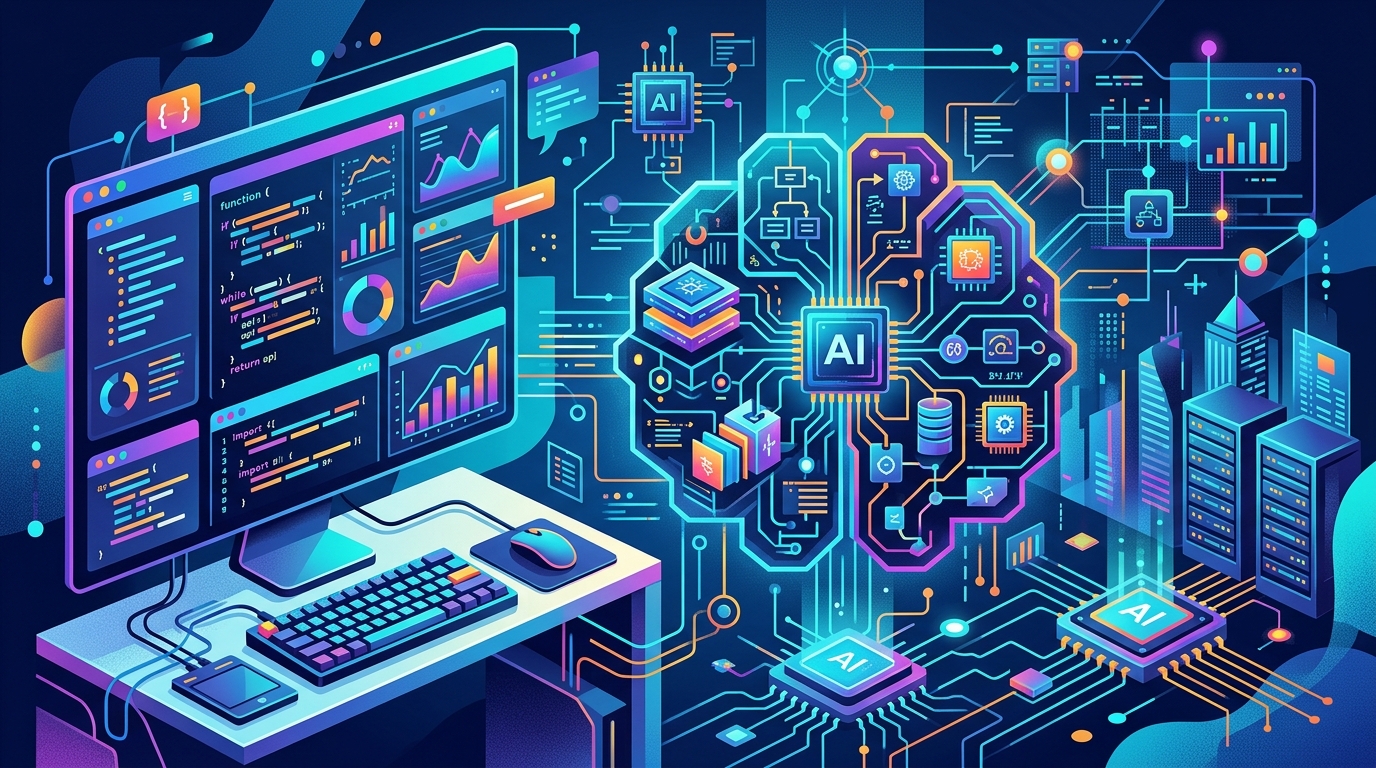
This necessitates a new silicon architecture. We are seeing the rise of the NPU (Neural Processing Unit) as a first-class citizen alongside the CPU and GPU. In my recent tests with the latest 2026-spec silicon, the key isn't just raw TOPS (Tera Operations Per Second); it's memory bandwidth and 'on-die' cache. To run an agent locally, you need to minimize the latency between the processor and the model weights.
// Conceptual Agentic Loop for Local NPU Scheduling
while(agent.status == ACTIVE) {
    Context ctx = local_sensor_array.poll();
    Action plan = npu_compute.infer(model_weights, ctx);
    if (plan.confidence > 0.92) {
        hardware_abstraction_layer.execute(plan);
    } else {
        cloud_bridge.request_refinement(plan);
    }
}
The Challenges of Local Autonomy
Like Icarus, there is a risk of flying too high without considering the constraints. The primary challenge for the 'AI PC' is the thermal envelope. Running a 70-billion parameter model locally generates immense heat. Nvidia’s Korean gambit—focusing on physical AI and robotics—suggests they are solving this by offloading specific 'reflex' tasks to dedicated micro-controllers while the 'reasoning' happens on the main NPU.
Intel’s Lip-Bu Tan has highlighted the 'Architecture of Autonomy,' which I interpret as a move toward modular AI. Instead of one giant model, we are building swarms of small, specialized models (Small Language Models or SLMs). This is practical engineering. It’s the difference between building one giant, immovable statue and a fleet of versatile automatons.
Why This Matters for the Modern Builder
For those of us building the next generation of tools, this shift means we must stop thinking in terms of APIs and start thinking in terms of local resource management. We need to optimize for quantization—shrinking models from 16-bit to 4-bit or even 2-bit precision—to fit into the 16GB or 32GB of unified memory standard in 2026 machines. The era of 'lazy' development, where we just throw more cloud compute at a problem, is ending. We are returning to the era of precision engineering, where every byte and every watt counts.