As a builder, I have always believed that the quality of a structure depends as much on the materials as it does on the tools used to shape them. In the realm of data science, we often obsess over the 'new'—new sensors, new satellites, new telescopes. But the recent breakthrough involving the discovery of over 100 new exoplanets within NASA’s legacy archives suggests that our most valuable 'materials' might have been sitting in the workshop for decades, waiting for a sharper chisel.
The Architecture of the Transit Method
To understand how AI 'unlocked' these worlds, we must first look at the engineering challenge of transit photometry. When a planet passes in front of its host star, it causes a minuscule dip in the star's brightness. Traditionally, we used heuristic-based algorithms to flag these dips. However, the universe is noisy. Stellar flares, instrumental glitches, and cosmic rays create 'false positives' that look remarkably like planets.
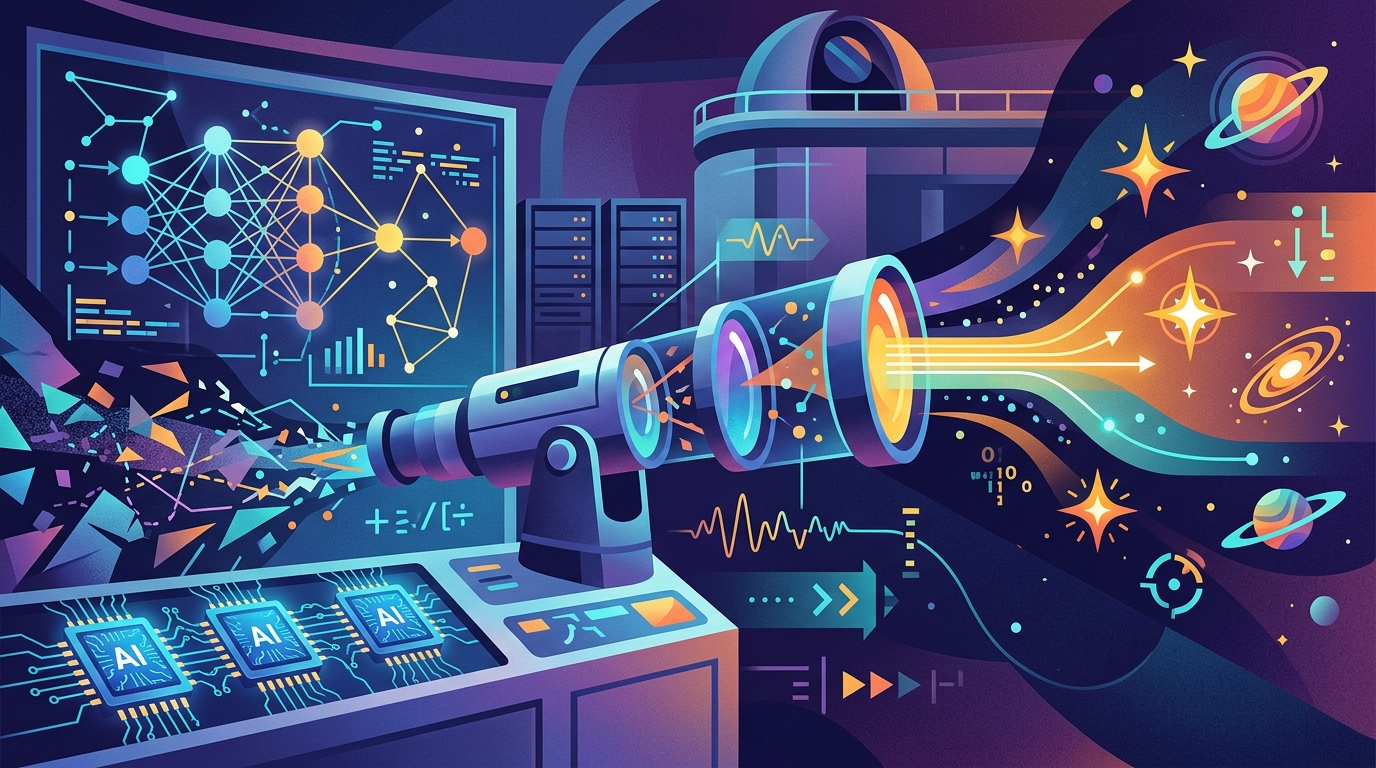
In my experience testing signal processing models, the 'signal-to-noise' ratio (SNR) is the ultimate gatekeeper. For years, astronomers had to discard low-SNR signals because human verification was too slow and traditional algorithms were too rigid. The 'Digital Astronomer' approach changes this by utilizing Deep Convolutional Neural Networks (CNNs) specifically tuned for time-series data. Instead of looking for a simple mathematical dip, the AI treats the light curve as a 1D image, recognizing the subtle 'texture' of a real planetary transit versus a sensor glitch.
The Innovation: From Heuristics to Feature Extraction
What fascinates me about this implementation is the move away from 'if-then' logic. In the old days, we told the machine: 'If the dip is U-shaped and lasts X hours, flag it.' The new architecture uses automated feature extraction. I’ve seen similar patterns in structural health monitoring; the AI learns the 'signature' of a stable system and can identify anomalies that are invisible to the naked eye.
# Conceptual snippet of a 1D CNN for Light Curve Analysis
model = Sequential([
    Conv1D(filters=64, kernel_size=5, activation='relu', input_shape=(time_steps, 1)),
    MaxPooling1D(pool_size=2),
    Flatten(),
    Dense(128, activation='relu'),
    Dense(1, activation='sigmoid') # Probability of being a planet
])
By retraining these models on confirmed planet data and synthetic 'noise' profiles, researchers have essentially built a more sensitive 'ear' for the cosmic symphony. They aren't just looking at the data; they are understanding the physics of the noise itself.
Pragmatic Takeaways for the Modern Builder
Like Icarus, many developers today are flying too close to the sun of 'Generative AI,' ignoring the foundational power of discriminative models and pattern recognition. This NASA breakthrough offers three vital lessons for any engineer:
- Data Recycling: Your old datasets are not 'dead'; they are simply waiting for a model with higher resolution.
- Domain-Specific Architectures: A generic LLM wouldn't have found these planets. We need specialized architectures (like 1D CNNs or Transformers optimized for time-series) to solve physical world problems.
- The Human-in-the-Loop Bridge: The AI flags the candidates, but the final validation remains a feat of human astrophysical engineering.
We are entering an era where the 'Labyrinth' of big data is no longer a place to get lost, but a resource to be mined. As we refine these digital chisels, I expect we will find that the secrets of the universe were right in front of us all along, hidden in the static of our own archives.