As we cross the threshold of June 2026, the global markets are witnessing a rare alignment of geopolitical de-escalation and technological structural shifts. The 60-day roadmap for a US-Iran agreement has catalyzed what I term the 'Hormuz Dividend.' For the business world, this is not merely a diplomatic footnote; it is a fundamental recalibration of risk premiums in energy and logistics. Bitcoin hovering near $64,000 reflects this 'risk-on' sentiment, as the specter of a major supply chain rupture in the Strait of Hormuz recedes.
The Shipping Super-Cycle and the Greek Advantage
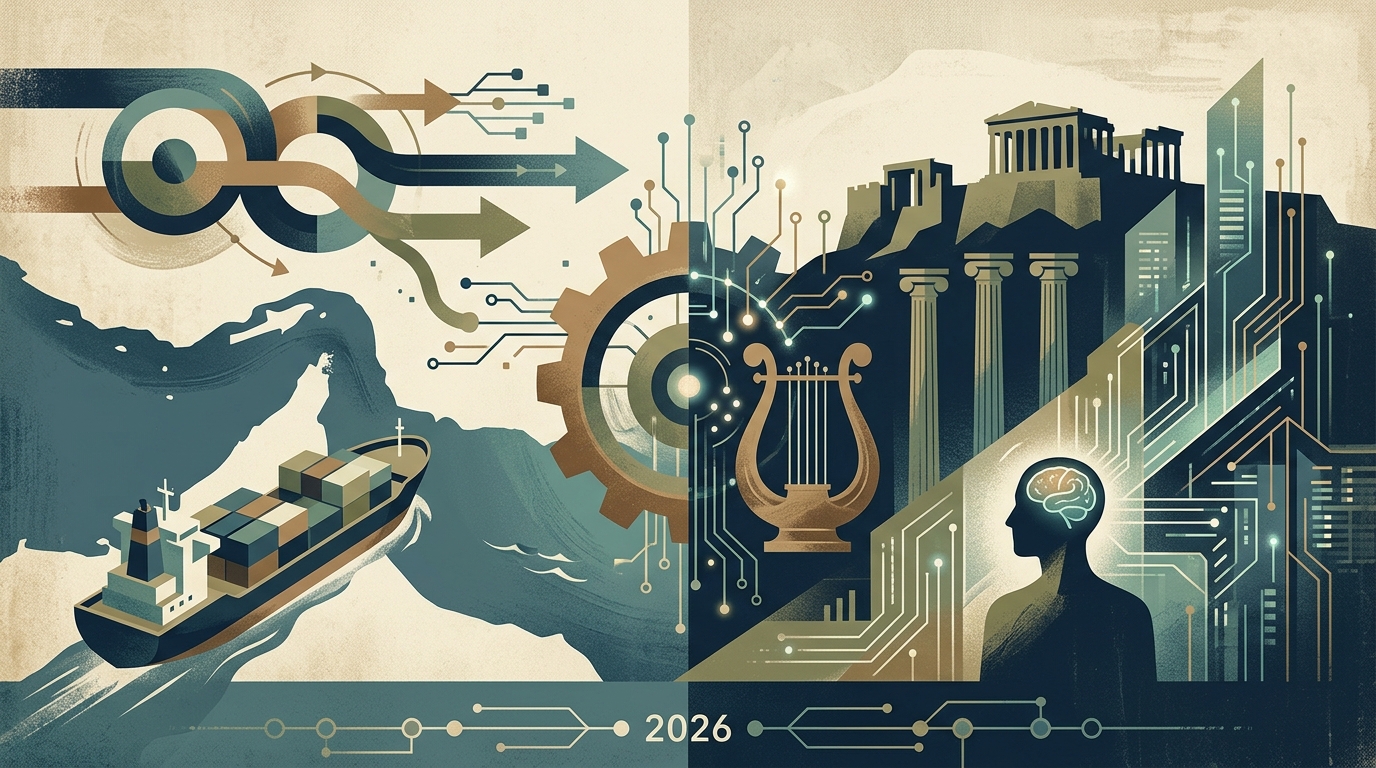
For the Greek economy, the reopening of a stable maritime corridor in the Middle East is transformative. Greek shipowners, who control over 20% of the world’s merchant fleet, are positioned to capture significant upside as insurance premiums normalize and trade volumes for Qatari LNG and Iranian oil stabilize. However, the market is not just looking at traditional freight rates. The 'Hormuz Dividend' is being reinvested into digital transformation. We are seeing a convergence between maritime capital and the 'Green AI Nexus.' Greece is increasingly viewed by infrastructure investors—including AWS—as a strategic hub where renewable energy meets high-density computing.
The transition from a 'war footing' to a 'trade footing' in the Middle East provides the liquidity necessary for the next phase of European digital sovereignty.
Beyond the CUDA Moat: The New AI Infrastructure Race
While the shipping lanes clear, the AI sector is facing its own internal disruption. The staggering HK$1 trillion valuation of Zhipu AI following the release of GLM-5.2 signals that the 'Nvidia Hegemony' is finally facing a multi-polar challenge. For investors, the takeaway is clear: the 'CUDA moat' is no longer impenetrable. As Tencent integrates generative AI via 'Xiaowei' into the WeChat ecosystem, the focus has shifted from training large models to the economic efficiency of deployment at scale.
This shift is particularly relevant for the Greek '€10 Billion Dividend.' The imperative now is to transform academic excellence into 'AI Unicorn Factories.' By leveraging the current influx of infrastructure capital, Greece can avoid the 'British Malady'—the tendency to innovate without capturing the downstream manufacturing or scaling wealth. The listing of Chinese MLCC (Multi-Layer Ceramic Capacitor) makers in Hong Kong serves as a reminder that AI is as much a hardware and components game as it is a software one.
Market Implications and Actionable Insights
- Energy & Shipping: Expect a period of consolidation in tanker equities as the immediate war-risk premium fades, replaced by steady volume-based growth.
- AI Infrastructure: Look beyond the chipmakers. The real value is migrating toward sovereign AI projects and the energy-efficient data centers supporting them, particularly in the Mediterranean basin.
- VC & Startups: The Greek ecosystem is at a tipping point. The focus should be on 'Applied AI' in logistics and energy, where the country possesses a natural competitive advantage.
In conclusion, the market is moving from a state of volatility-driven speculation to one of infrastructure-driven growth. The stability in the Strait of Hormuz provides the breathing room, but the winners of 2026 will be those who can translate this geopolitical calm into long-term technological assets.