
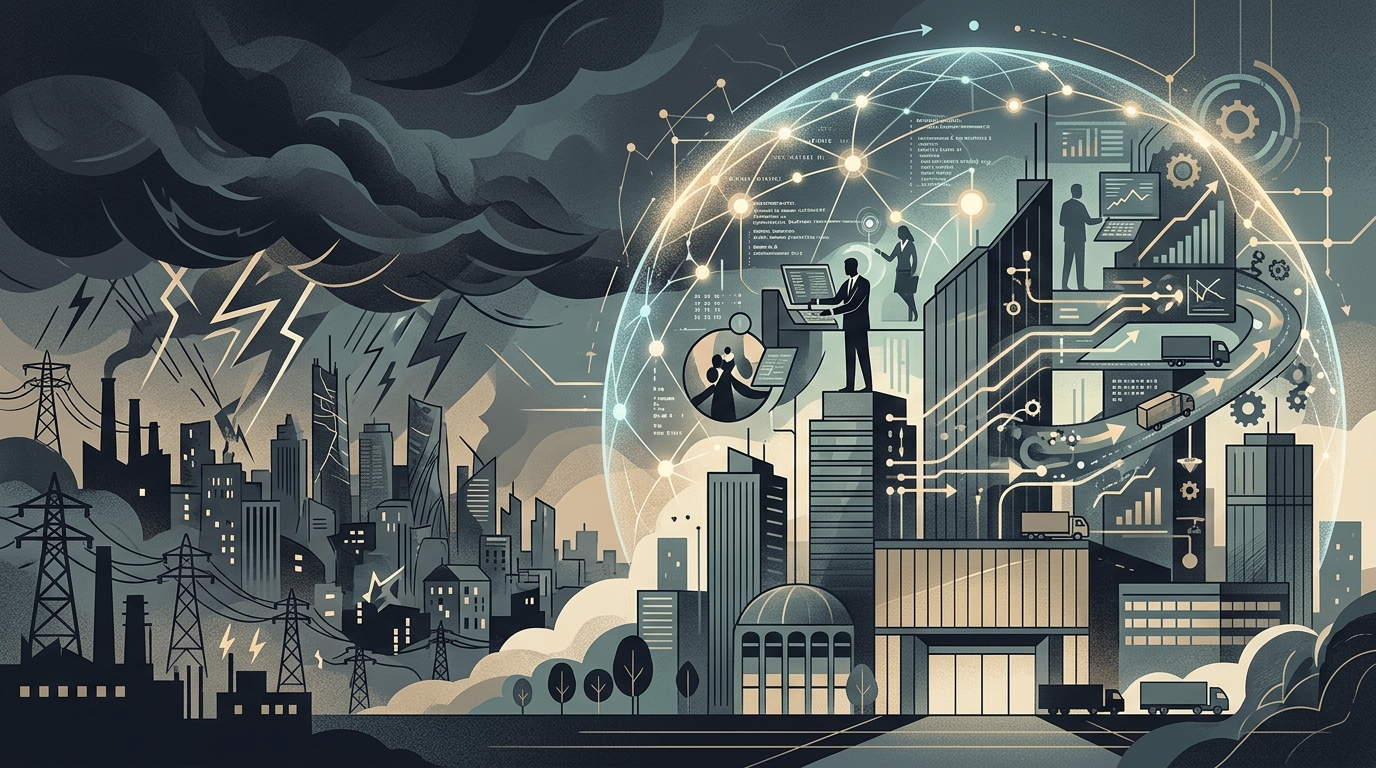
As we navigate the mid-point of May 2026, the global business landscape is defined by a stark dichotomy: a volatile energy market under siege by geopolitical tensions and a record-breaking surge in AI-driven productivity. The IMF and ECB have recently sounded the alarm on an energy shock that threatens global stability, with the conflict in the Middle East already exacting a $25 billion toll on logistics and energy sectors. However, for the astute investor and the modern enterprise, this crisis is revealing a new market truth: AI is no longer just a growth lever; it is the ultimate defensive hedge.
The $25 Billion Toll and the Efficiency Hedge
The immediate impact of the energy crisis is visible in the transportation and logistics sectors. Ryanair’s recent 'Armageddon' warning regarding fuel costs highlights the existential threat facing traditional high-overhead business models. Yet, while some airlines and logistics giants struggle, we are witnessing an 'Efficiency Hedge' strategy. Companies that integrated AI into their supply chain management early are absorbing the shock by reducing waste and optimizing routes in real-time, effectively decoupling their operational costs from the raw volatility of Brent crude.
This shift is reflected in the 'AI-First Paradigm' currently dominating global finance. Wall Street is no longer just valuing AI companies based on future promises, but on their current ability to protect margins against inflation. The $4 billion hardware pivot—where capital is flowing into the physical backbone of AI—suggests that the market is betting on a long-term structural shift where computational power replaces cheap energy as the primary driver of corporate alpha.
Greek Resilience and the €3.2 Billion Algorithmic Bet
Closer to home, the Greek market is showing remarkable resilience. The Athens International Airport (AIA) reported soaring profits and passenger traffic for Q1 2026, defying the broader European trend of stagnation. This success is partly attributed to Greece’s strategic positioning as a digital and logistical hub. The Greek government’s €3.2 billion 'AI Fiscality' roadmap is a bold statement of intent, aiming to use algorithmic auditing and digital transformation to secure a 2030 fiscal surplus.
For Greek SMEs, the 'Startup Democracy' facilitated by AI is collapsing entry barriers. Even as energy costs rise, the cost of starting and scaling a tech-enabled business in Greece is falling. This creates a unique opportunity for domestic investors to pivot toward the digital renaissance, mirroring trends seen in emerging markets like Vietnam, where AI is acting as a massive catalyst for growth.
Investment Implications: Cautious but Constructive
The market sentiment remains cautious due to the 'Digital Iron Curtain' and the risk of de-risking from major markets like China. However, the 'Great Productivity Divergence' is now the key metric for portfolio allocation. Investors should look for companies—like Alibaba in its recent pivot or Greek infrastructure leaders—that are actively converting AI capabilities into tangible margin protection. In 2026, the competitive advantage is not just who has the most data, but who can use that data to survive a high-cost energy environment.