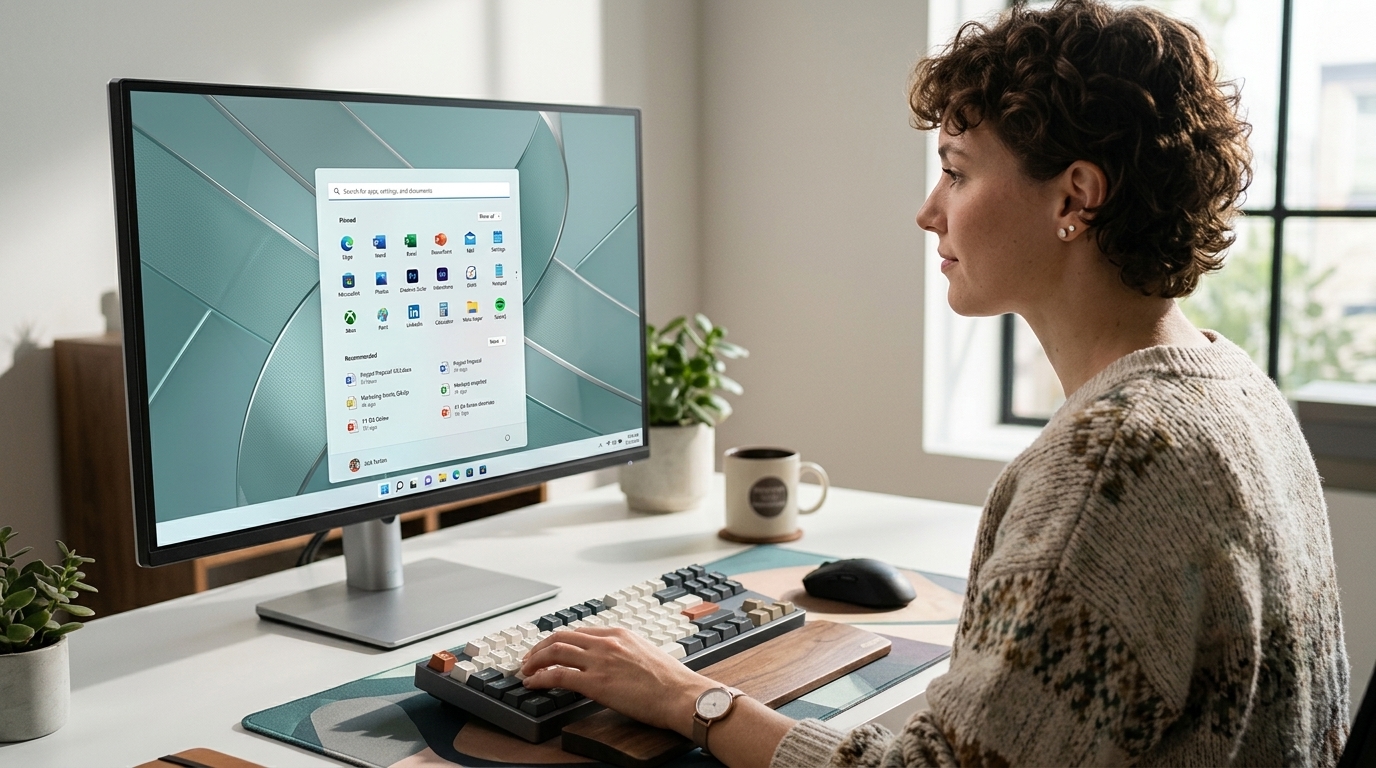
When Windows 11 launched in 2021, Microsoft promised a fresh, modernized user experience. However, for many power users and professionals, this "modernization" came with an incomprehensible restriction: the taskbar was now "pinned" to the bottom of the screen, with no option to move it. Today, nearly five years after its initial release, the company appears to be yielding to community pressure, finally testing the return of taskbar repositioning and Start menu resizing.
Restoring a Historic Functionality
In the latest test builds of Windows 11 released to the "Experimental" channel of the Windows Insider program, users discovered a feature many considered fundamental. The taskbar can now be placed at the top, left, or right side of the screen, just as it had been in every version of Windows from 1995 to 2020. This change is not merely an aesthetic tweak; it is an acknowledgment that every user's workflow is unique.
Microsoft had previously justified the removal of this feature by claiming that the Windows 11 taskbar was rewritten from scratch using modern technologies like XAML and WinUI. Supporting multiple orientations reportedly required significant effort to adapt animations and icon layouts. However, it seems this technical challenge has finally been overcome, likely in preparation for the next major Windows release, which is expected to emphasize flexibility even further.
The Start Menu Gains a New Dimension
Alongside the taskbar changes, Microsoft is experimenting with a dynamically resizable Start menu. In the current stable version of Windows 11, the Start menu has a fixed size, often leading to wasted space or excessive scrolling for those with many pinned applications. The new test allows users to drag the edges of the menu to make it taller, shorter, wider, or narrower.
This approach strongly echoes the logic of Windows 10, where the Start menu was fully customizable, allowing users to create entire groups of apps that occupied half the screen width or to restrict it to a slim column. The return of this logic signals a shift back toward "user-centric" design, moving away from the strict minimalism that characterized the early years of Windows 11.
The Power of Feedback in the Digital Age
This development is a victory for the user community. In Microsoft's Feedback Hub, the request to move the taskbar consistently remained at the top of the list with tens of thousands of upvotes. Microsoft's decision to listen to its users—albeit late—shows that tech giants can no longer ignore the needs of professionals who rely on their tools for daily productivity.
- Professional Productivity: Many users with ultrawide monitors prefer the taskbar on the sides to save vertical screen real estate.
- Accessibility: For some users with motor impairments, placing control elements in specific areas of the screen is a matter of functionality, not just preference.
- Ecosystem Consistency: With this feature, Windows becomes competitive again against environments like macOS and various Linux distributions, which offer excellent desktop layout flexibility.
In conclusion, Microsoft's move is not just a "fix" but a statement of intent. In a world where the operating system is becoming increasingly complex with the integration of Artificial Intelligence (Copilot), maintaining user control over the interface is more important than ever. We look forward to seeing if these changes will make it into the final version of Windows 11 in the next major autumn update or if they will serve as the cornerstone for Windows 12.