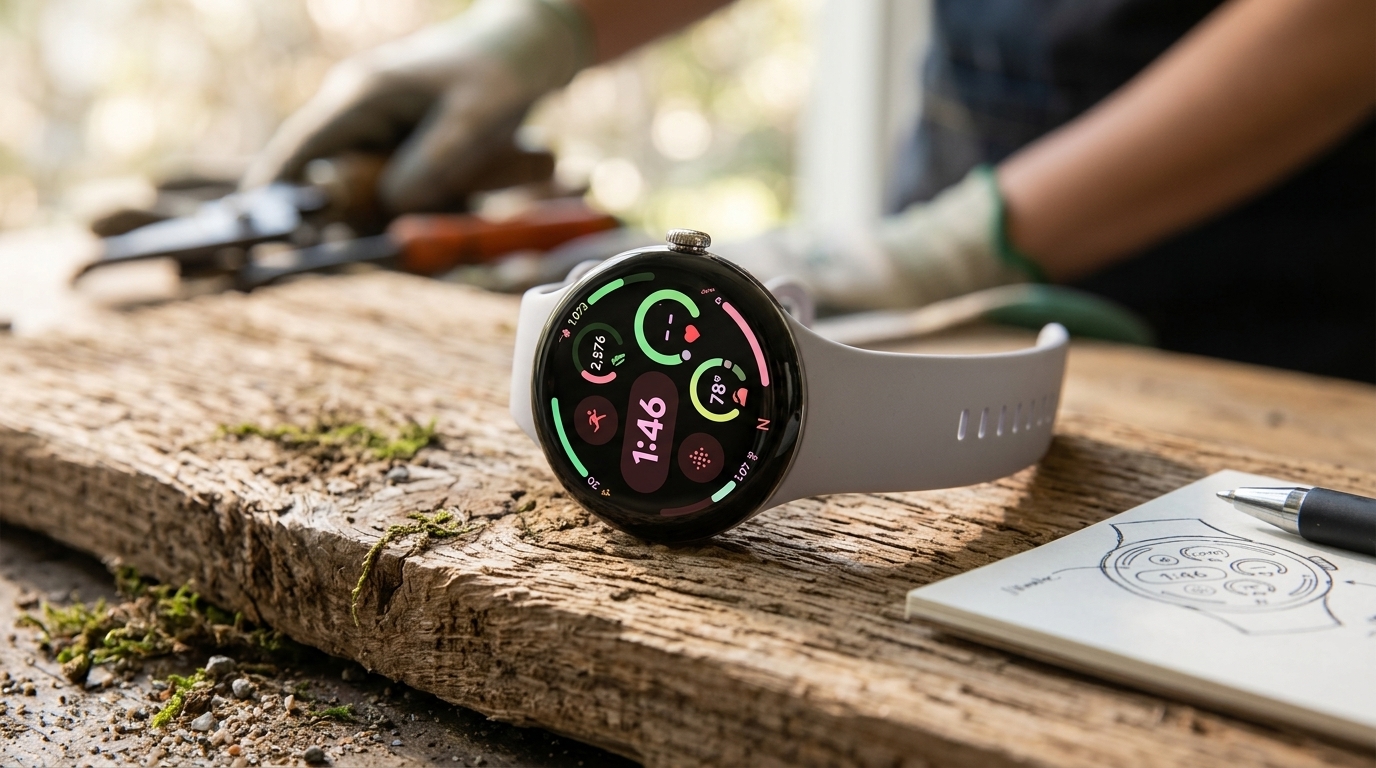
The era when the smartwatch was merely a mirror for our phone notifications seems to be coming to a definitive end. At the Google I/O 2026 conference, Google unveiled Wear OS 7, an update that focuses not just on speed, but on substantive utility. The core feature, borrowing the successful recipe of Android's Live Activities, promises to change how we interact with the world around us without ever needing to pull our phones out of our pockets.
The Rise of Live Updates: Information at a Glance
Wear OS 7 introduces 'Live Updates,' a feature that allows applications to display dynamic, real-time content directly on the home screen or in dedicated widgets. Imagine waiting for a food delivery. Instead of unlocking your phone every five minutes, a small indicator on your wrist shows the courier's progress on a map. The same applies to sports scores: the progress of a basketball or football game updates automatically, allowing the user to stay informed while performing other tasks.
This approach solves one of the biggest problems of smartwatches: notification noise. Instead of dozens of separate 'pings,' the user has a continuous, discreet stream of information. Google has worked closely with major platforms like Uber, DoorDash, and ESPN to ensure the experience is seamless from day one of release.
Battery Life: The Achilles' Heel Becomes a Strength
No feature is valuable if the watch dies before the end of the day. With Wear OS 7, Google is introducing a new power management architecture called 'Hybrid Stream 2.0.' In collaboration with the latest processors from Qualcomm and Samsung, the operating system can now offload most Live Update processes to the low-power co-processor (MCU).
This means the watch can refresh score data or courier location using minimal power, without 'waking up' the main application processor. Early benchmarks show a battery life improvement of up to 25% compared to Wear OS 6, finally bringing many high-end smartwatches closer to the three-day usage milestone on a single charge.
Design and User Experience
Beyond technical improvements, Wear OS 7 brings an aesthetic refresh. Wear Widgets are now more interactive. Users can perform micro-actions—such as adding a tip for a driver or adjusting the home temperature via Google Home—directly from the widget without opening the full app. Google is also placing greater emphasis on the Watch Face Format, encouraging creators to build faces that are lighter and more efficient.
'Our goal with Wear OS 7 is to make technology invisible. The watch should give you what you need in less than a second, so you can get back to your life,' said Google’s Head of Wearables.
The Future of the Ecosystem
This move by Google is no coincidence. With the Apple Watch dominating the market through watchOS, Google needed to offer something that connects the convenience of Android with the elegance of modern hardware. The integration of Live Updates is the key to making the smartwatch an essential tool in the daily 'economy of speed.' Furthermore, improved support for health and fitness, with deeper integration of Fitbit algorithms, makes Wear OS 7 a comprehensive proposition for both tech enthusiasts and average consumers.
In conclusion, Wear OS 7 is not just an incremental update. It is proof that Google now has a clear strategy for our wrists: less screen time, more meaningful information.