In the final of the first World Cup in 1930, Argentina and Uruguay could not agree on which ball to use. Ultimately, they played the first half with an Argentine ball and the second with a Uruguayan one. Today, nearly a century later, the ball is no longer a simple object of contention but a sophisticated precision instrument, packed with sensors that communicate in real-time with satellites and the VAR system. The journey from heavy, handcrafted leather to the microchips of Trionda and Kinexon is the ultimate chronicle of sports converging with cutting-edge technology.
The Era of Leather and Laces (1930-1966)
In the tournament's infancy, footballs were primitive. Constructed from 12 or more panels of natural leather, they featured external laces (similar to shoe laces) to close the opening through which the inner bladder was inflated. These balls had a significant drawback: weight. When it rained, the leather absorbed water, causing the ball to double in weight, making headers dangerous for the players' physical safety. Furthermore, their shape was never perfectly spherical, making their trajectory unpredictable.
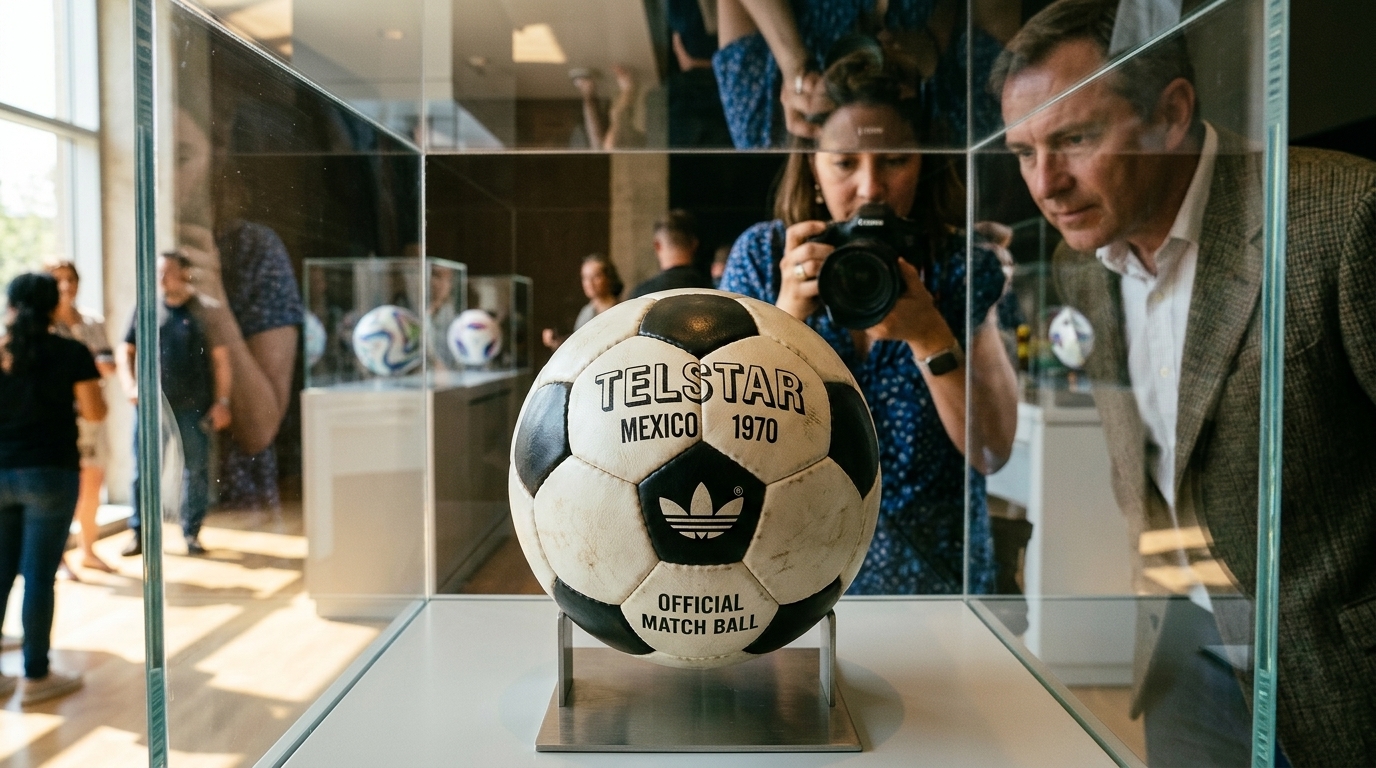
The revolution began in the 1960s when material science started offering alternatives to natural leather. However, the real breakthrough came in 1970 in Mexico. Adidas introduced the Telstar, the iconic black-and-white ball with 32 pentagonal and hexagonal panels. This design, known as a 'truncated icosahedron,' was not accidental. The black-and-white panels were chosen to make the ball more visible on the black-and-white televisions of the era. It was the first time imaging technology dictated the design of sports equipment.
Aerodynamics and the 'Curse' of the Jabulani
Over the years, the number of panels began to decrease. From 32, we moved to the 14 of the Teamgeist (2006) and the 8 of the Jabulani (2010). Here, technology faced the laws of physics. The Jabulani, used in South Africa, became notorious for its 'unpredictable' behavior. Goalkeepers compared it to a beach volleyball. NASA had to intervene with wind tunnel studies to explain that the ball's excessively smooth surface caused 'knuckling' at lower speeds than expected.
This lesson led to the Brazuca (2014) and the Al Rihla (2022). Engineers realized that perfection does not lie in absolute smoothness but in controlled roughness. The Al Rihla introduced the 'Speedshell' skin, with micro-textures and embossed patterns that stabilize the ball's flight through the air. Aerodynamics was no longer a matter of luck but of Computational Fluid Dynamics (CFD).
The Digital Revolution: Microchips and VAR
The biggest change in the history of the ball occurred on its inside. In the Qatar World Cup and subsequent tournaments, the ball ceased to be a passive object. It was equipped with Connected Ball Technology. At the center of the ball, suspended by a specialized tension system, lies a 500Hz IMU (Inertial Measurement Unit) motion sensor.
- Temporal Precision: The sensor transmits data 500 times per second, allowing referees to know the exact moment the ball made contact with a player's foot.
- Semi-Automated Offside: The ball's data is combined with 12 tracking cameras that record 29 points on each player's body. The result is an offside decision issued in seconds.
- Trionda and Data: Trionda’s technology allows for the full mapping of speed, spin, and distance, turning every shot into a set of big data for analysts.
"The ball is no longer just the means to score; it is the brain of the pitch. Every vibration, every touch is transformed into digital information that ensures the fairness of the game," state Adidas technicians.
The Future: The Ball as an IoT Device
As we head toward the 2026 World Cup and beyond, evolution does not stop. New balls are being tested to withstand extreme climatic conditions, while the battery life of the sensors (which are inductively charged before the match) is constantly improving. The next step is the integration of Artificial Intelligence within the ball itself, which could predict injuries based on impact force or provide instant statistical analysis to spectators via Augmented Reality (AR) applications.
In conclusion, the World Cup ball reflects the very trajectory of humanity. From raw materials and manual labor, we moved to the era of industrial design and now to digital dominance. Despite the technology, however, the essence remains the same: the moment the ball hits the net and the thrill it provides to billions of people, whether it contains microchips or leather laces.