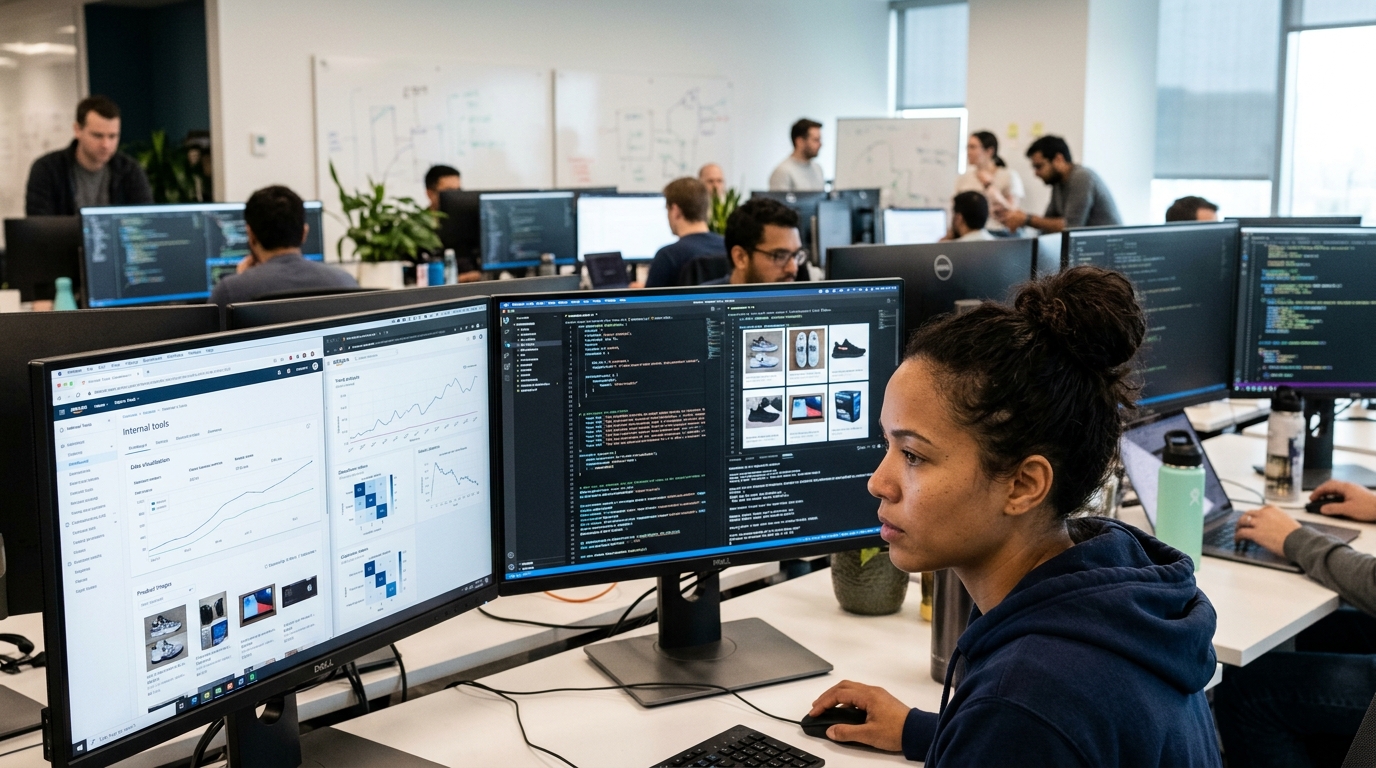
In an era where technological evolution is no longer linear but exponential, the announcement from Synaryverse, a premier digital agency based in New Jersey, to fully integrate Artificial Intelligence (AI) across its marketing, development, and creative services, marks a critical turning point for the professional services industry. This is not merely the adoption of a new tool; it is a fundamental restructuring of how businesses perceive creativity and productivity in the digital landscape of 2026.
The Convergence of Technology and Creativity
Synaryverse’s strategy is rooted in the belief that AI is not a threat to human talent but a force multiplier. In the marketing sector, the agency now employs advanced machine learning algorithms for real-time data analysis, enabling the prediction of consumer trends before they become mainstream. This proactive approach allows their clients to position themselves strategically in the market with a degree of precision that was previously unattainable.
On the development front, the integration of AI tools into code writing and quality assurance (QA) has reduced project delivery times by nearly 40%. Synaryverse’s developers now focus on high-level architecture and complex problem-solving, leaving repetitive coding tasks to their digital assistants. This 'hybrid development' model promises to revolutionize how startups and large organizations alike build their digital infrastructures.
The Transformation of Creative Services
Perhaps the most striking change is found in the realm of creative design. The use of generative AI for visual content creation and copywriting is not limited to simple production. Synaryverse has developed internal models trained on each brand's identity, ensuring that the generated content is consistent, authentic, and tailored to the needs of the respective audience. The capability for hyper-personalization at scale is now a reality, allowing a single campaign to have thousands of variations, each targeting a specific user persona.
"Artificial intelligence allows us to unlock levels of creativity that were previously constrained by time and resources," company executives stated.
Economic and Social Implications
This move by Synaryverse is not an isolated incident but reflects a broader trend in the global market. As businesses are pressured for greater efficiency, the shift toward AI-first operating models becomes inevitable. However, this raises significant questions about the future of work in the digital sector. Synaryverse’s response is to invest in staff retraining, transforming copywriters into prompt engineers and graphic designers into creative directors who oversee entire content production ecosystems.
In conclusion, Synaryverse’s integration of AI represents a bold step into the future. It demonstrates that the digital agencies that will survive and dominate in the coming years are those that will not fear embracing automation but will use it to offer superior value to their clients. The challenge now shifts from execution to strategic thinking and the ethical management of technology.