The visual is almost jarring in its immediacy: a young man in a chiton stands before a partially completed Parthenon, holding what looks like a primitive camera, describing the city's excitement for the temple's inauguration. This isn't a scene from a Hollywood blockbuster, but a 'historical vlog' created entirely with Artificial Intelligence tools. The new trend of 'AI time travelers' is flooding social networks, offering an illusory yet immersive glimpse into eras that until now lived only in our imagination and the black-and-white texts of history books.
This digital revival of the past is not merely a technical display of power. It represents a fundamental shift in how we consume historical information. Using video generation models like OpenAI's Sora, Kling, or Luma Dream Machine, content creators are managing to bridge the gap of centuries, presenting history not as a collection of dates, but as a lived reality with color, sound, and emotion.
The Technology Behind the 'Time Machine'
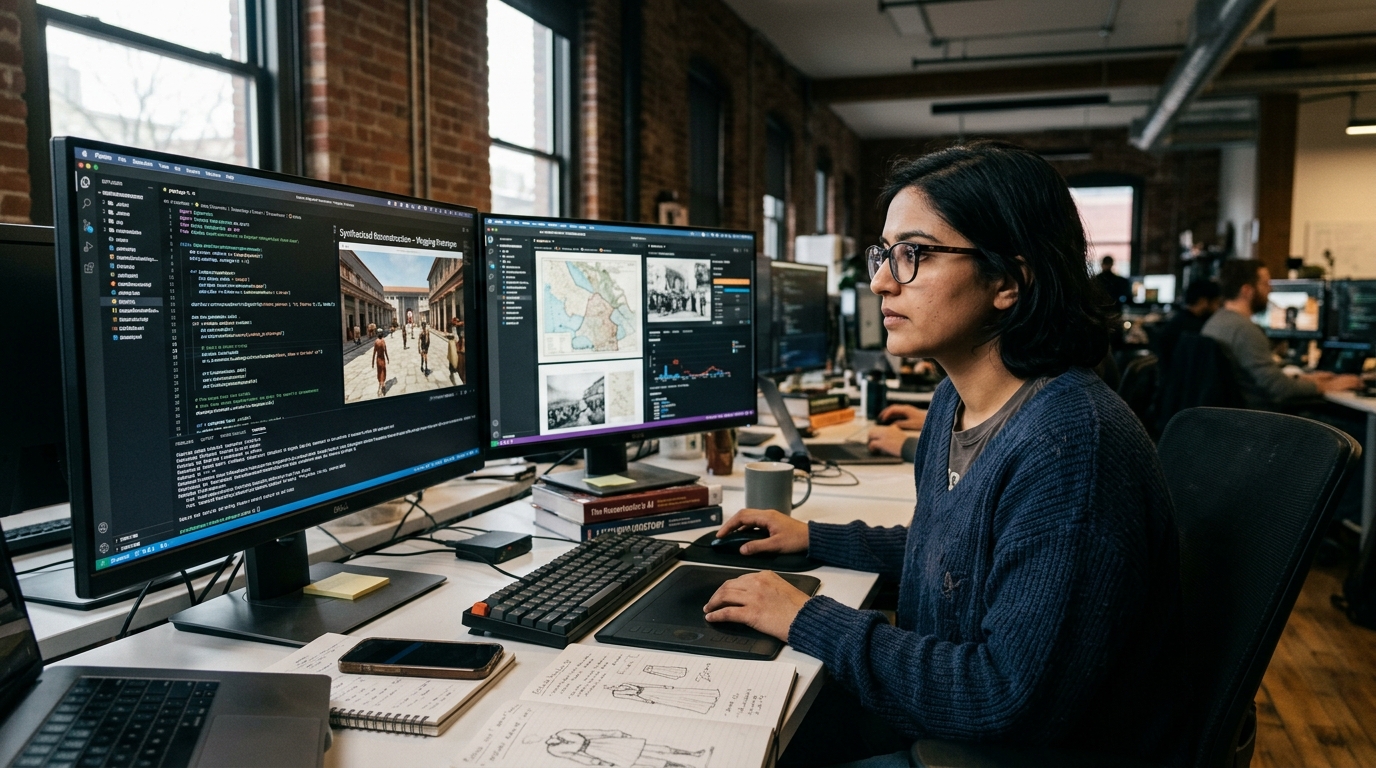
Creating these videos relies on a complex chain of AI tools. It all starts with research and scripting, where models like GPT-4o help identify historical details—from the fashion of the era to linguistic idiosyncrasies. Subsequently, generative AI takes over image creation (Midjourney, DALL-E 3), which serves as the foundation for video-to-video or text-to-video models. The final result is enriched with synthetic voices (ElevenLabs) that render ancient dialects or accents lost to time.
The result is what experts call 'hyper-real nostalgia.' Although the viewer knows the video is a product of algorithms, the brain's response to the motion and image fidelity creates a sense of intimacy. AI 'time travelers' don't just show us the past; they present it through the lens of modern social media aesthetics, making Alexander the Great or Napoleon look like influencers of their time.
Educational Revolution or Historical Forgery?
Like every technological breakthrough, the rise of AI historical vlogs brings serious questions. On one hand, educators see a massive opportunity. The ability for a student to 'visit' the Agora of Ancient Athens or watch the construction of the Pyramids in 4K resolution can spark interest in history in ways that traditional media cannot. Visualizing knowledge makes learning more inclusive and engaging for younger generations.
On the other hand, the risk of anachronisms and cultural biases is real. AI models are trained on data that often reflects Western-centric views or cinematic stereotypes. If an algorithm 'imagines' life in the Byzantine Empire based on fantasy films instead of archaeological findings, then the result is not history, but a digital hallucination. The 'illusion of truth' provided by video can lead to a distorted perception of the past, where aesthetics override accuracy.
The Ethical Question of Digital Resurrection
Beyond accuracy, there is the ethical weight of 'resurrecting' historical figures. Is it legitimate to put words into the mouths of Socrates or Abraham Lincoln via Deepfakes? While the debate is more relaxed for figures who lived centuries ago, for personalities of the recent past, the boundaries become blurred. Using AI to create content from the past requires a new ethical framework, where creativity does not offend memory and historical truth.
In conclusion, AI historical vlogs are here to stay. They represent the next stage of storytelling, turning the past into an interactive playground. As technology evolves, the challenge for us will be to remain critical viewers, enjoying the spectacle without forgetting that real history lies beneath the pixels, in the sources and findings that don't need algorithms to witness their truth.