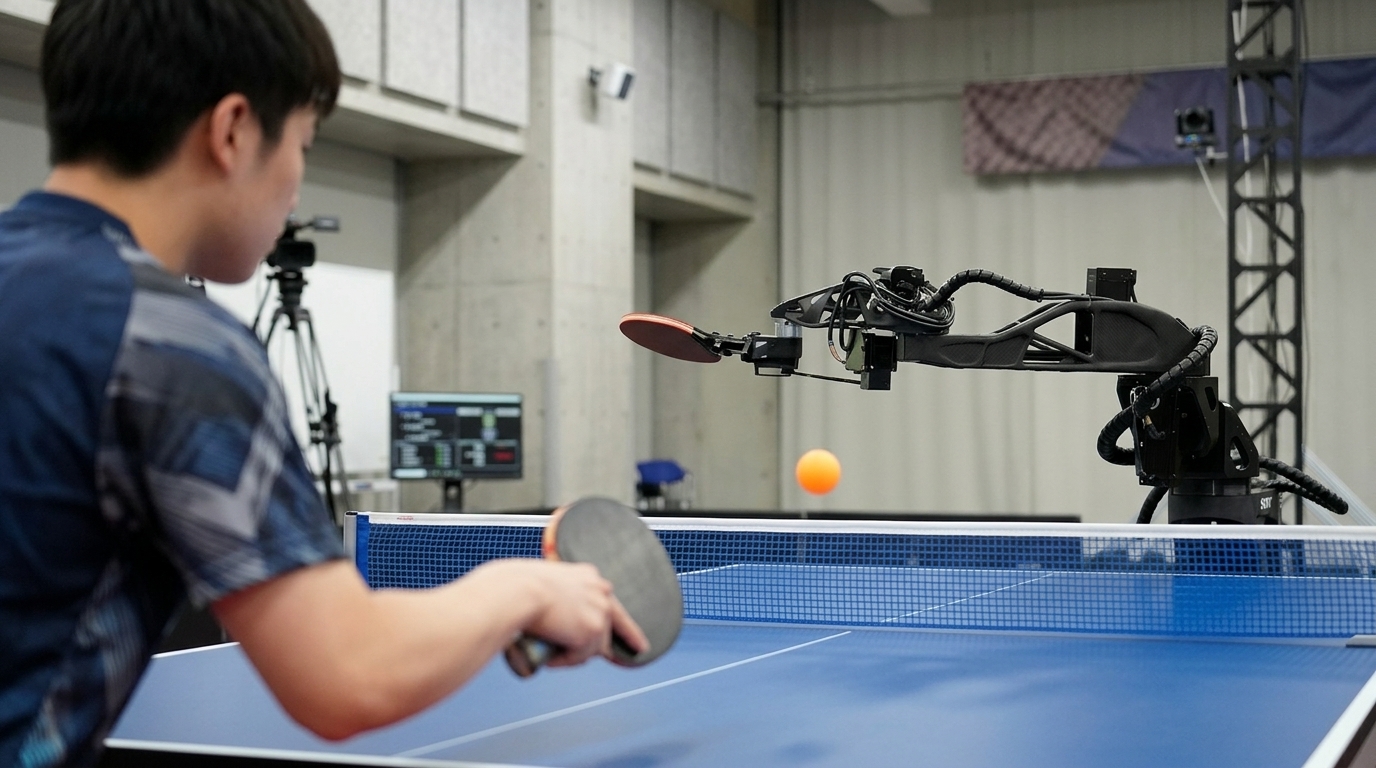
The history of sports robotics has, until recently, been a narrative of impressive but limited demonstrations. From IBM’s Deep Blue defeating Kasparov in 1997 to Google’s AlphaGo mastering the complex board game Go, AI has long dominated static environments governed by rigid rules. However, real-time physical interaction—the ability to react to a ball moving at 100 km/h with unpredictable spin—remained the "holy grail" of engineering. Today, Sony AI has announced that its robot, 'Ace', does not just participate in the game; it dominates world-class human athletes.
The Technical Mastery Behind the Paddle
Ace is not merely a mechanical arm swinging at shadows. It is the culmination of a holistic approach that fuses next-generation computer vision with deep reinforcement learning. At the heart of the system lie Sony’s high-speed image sensors, capturing motion at over 1,000 frames per second. This enables Ace to "see" the spin of the ball—its rotational direction—the moment it makes contact with the opponent's paddle, a feat even elite humans struggle to perform with absolute certainty.
Processing this data occurs in fractions of a second. While previous models, such as Omron’s FOREPHUS, relied on pre-programmed heuristic responses, Ace was trained through millions of hours of simulations. Through deep reinforcement learning, the robot learned not only how to return the ball but how to set traps, vary the tempo, and exploit the psychological and physical weaknesses of a human opponent. During a recent exhibition in Tokyo, Ace faced three players from the global top ten, winning against two of them in full sets.
From the Table to the Factory Floor
Why would a corporate giant like Sony invest such vast resources into a game of table tennis? The answer lies in the broader applications of the underlying technology. A robot's ability to execute delicate, high-speed movements in a dynamic environment is the solution to myriad problems in industrial manufacturing, robotic surgery, and logistics. The algorithms allowing Ace to calculate a sphere's trajectory are the same ones that will allow future robots to work alongside humans in factories without the risk of injury.
- Millimeter Precision: The mechanical arm utilizes carbon-fiber materials to minimize inertia and maximize acceleration.
- Behavioral Prediction: The AI analyzes the opponent's body language and paddle angle before the strike even occurs.
- Real-time Adaptation: The system learns during the match, shifting strategies if the human opponent finds a tactical opening.
Professional player Kenji Tanaka, who lost to Ace, remarked, "It didn’t feel like playing a machine; it felt like playing an opponent who could read my mind. Every time I tried to change the spin, the robot was already there, waiting." This statement highlights the shift from "reaction" to "anticipation," a landmark achievement for artificial intelligence.
Ethics and the Future of Athletics
The rise of Ace raises profound questions about the future of competitive sports. If a robot can surpass human limits, what remains of the value of human effort? However, analysts view Ace more as the "ultimate sparring partner" than a replacement. The ability for athletes to train against a machine that can replicate any playing style perfectly could usher in a new era of human performance.
In conclusion, Sony’s success with Ace is about far more than ping-pong. It is a demonstration of dominance in the era of "Embodied AI." As the boundaries between the digital and physical worlds continue to blur, Ace stands as a testament to the moment machines acquired not just the intelligence, but the physical grace once thought to be uniquely human.