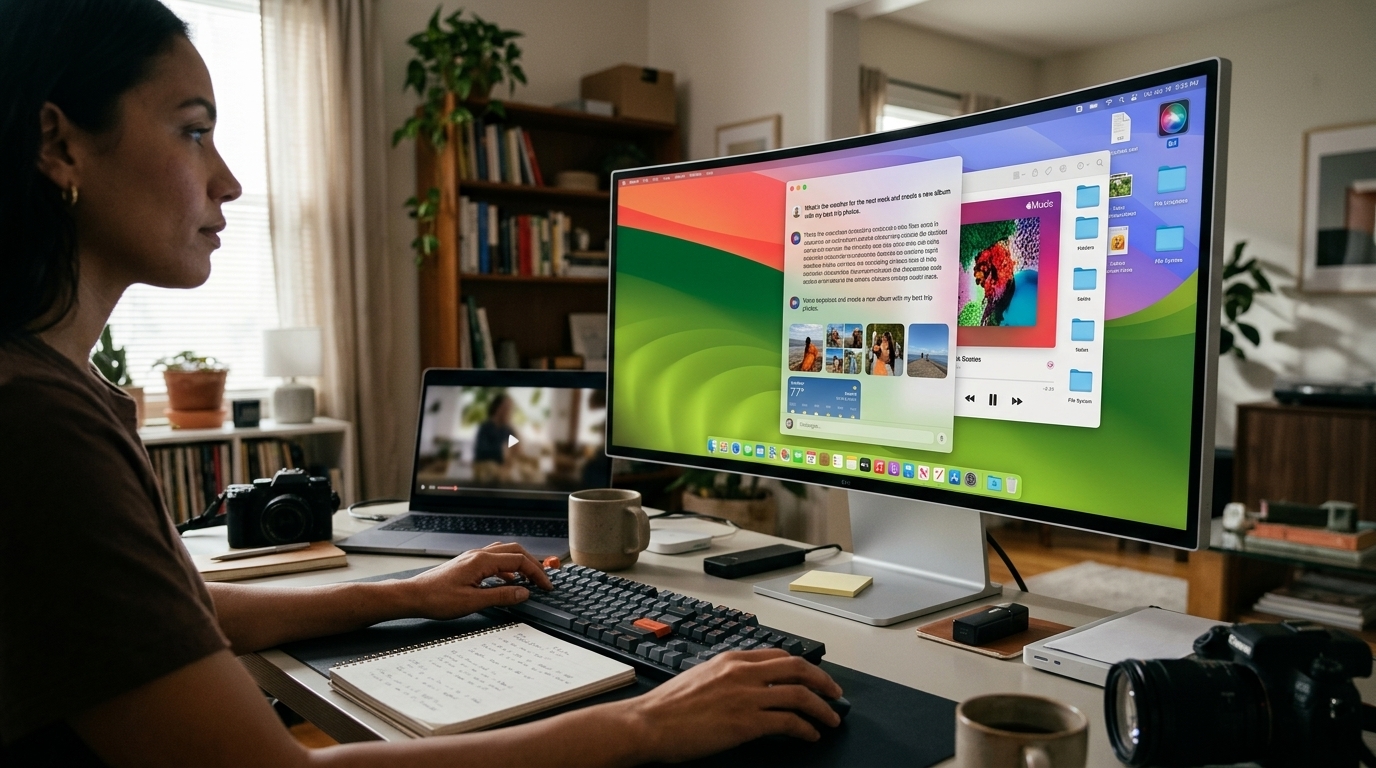
For more than a decade, Siri on the Mac was Apple’s poster child for missed opportunities. It was a feature most power users disabled immediately after setting up a new machine, viewing it as intrusive and, frankly, incompetent. However, the arrival of macOS 27 Golden Gate in June 2026 seems to have fundamentally shifted the landscape. Apple Intelligence is no longer a collection of disparate writing tools; it is a deeply integrated AI agent that finally seems to have gained an awareness of what is happening on our screens.
From Commands to Intent: A Paradigm Shift
The first interaction with the new Siri AI is aesthetically distinct. The classic glowing sphere at the bottom of the screen has been replaced by a subtle, multi-layered shimmer that wraps around the window you are currently working in. But the real difference lies in the substance. During the first 24 hours of testing, what stands out most is Siri’s ability to understand context. Instead of asking to "open the PDF file," you can simply say, "send the invoice I’m looking at to George," and the system automatically identifies the open document, finds the contact, and drafts the email.
This "on-screen awareness" is the holy grail Apple has been chasing for years. In Golden Gate, Siri utilizes local machine learning models to analyze real-time data displayed on the screen without ever sending it to the cloud, maintaining the privacy promise that is the brand's hallmark. The experience feels less like talking to a computer and more like having an assistant looking over your shoulder, ready to intervene only when prompted.
App Orchestration: Ending the App-Hopping Cycle
One of the biggest friction points in digital productivity is the constant need to jump between different applications to complete a single task. Siri AI in macOS 27 acts as an orchestrator. During my first day, I used it to plan a business trip. With a single prompt, Siri extracted flight details from my Mail, added them to my Calendar, located the hotel in Maps, and curated a list of recommended restaurants in Notes.
- Automatic file organization based on semantic content rather than just filenames.
- Drafting message replies that account for previous conversations across different platforms (Slack, iMessage, Mail).
- The ability to perform complex actions within third-party apps via the upgraded App Intents framework.
Apple seems to have solved the problem of fragmentation. Siri is no longer an app; it is the connective tissue of the operating system. Nevertheless, there are still moments of friction. Occasionally, the AI hesitates or asks for confirmation on actions that should be intuitive—a reminder that we are still in the early stages of this technological epoch.
Privacy and Local Processing: The Apple Fortress
The question that always arises with such technology is: "How much of my personal life is Apple seeing?" The answer in Golden Gate lies in Private Cloud Compute (PCC). Most processes occur locally on M5 and M6 chips. When higher computational power is required, data is sent encrypted to Apple’s servers, which operate in a "black box" environment. During my initial 24-hour window, resource consumption was remarkably low, suggesting extraordinary code optimization.
"Artificial intelligence should not be a product that consumes your data, but a tool that enhances your creativity without violating the sanctuary of your digital space."
In conclusion, the first 24 hours with Siri AI on macOS 27 leave a positive impression. It isn't perfect, and it certainly won't replace the way we think by tomorrow morning. However, for the first time in years, Siri isn't the joke of Silicon Valley; it's a compelling reason to stay within the Apple ecosystem. 'Golden Gate' might truly be the golden bridge to the future of personal computing.