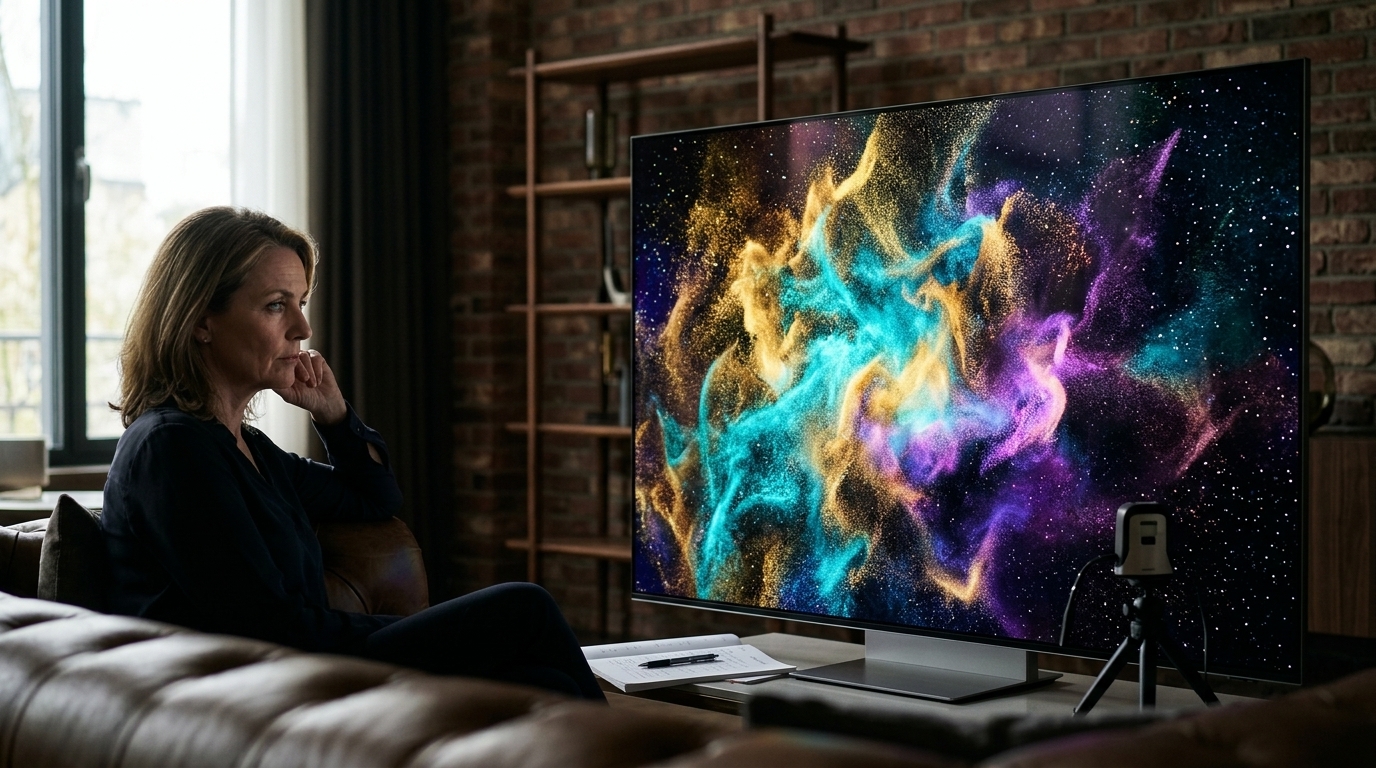
In the twilight of 2026, the television industry finds itself at a critical crossroads. After a decade of dominance by OLED and Mini LED, Micro RGB technology (an evolution of MicroLED) was hailed as the "Holy Grail" of visual reproduction. Samsung, the undisputed market leader for nearly two decades, launched the R95H model with great fanfare. However, the first in-depth reviews, led by Wired magazine, reveal a reality that falls far short of the marketing promises.
The Technological Trap of Micro RGB
Micro RGB technology relies on millions of self-emissive inorganic LEDs, which theoretically offer the benefits of OLED (perfect blacks, infinite contrast) without its drawbacks (burn-in, lower brightness). Samsung's R95H was designed to be the ultimate entertainment tool, capable of reproducing HDR content with unprecedented precision. Yet, Wired highlights a paradox: despite its technological superiority on paper, the screen's actual brightness is significantly lower than competing 2026 models from Sony and TCL.
The problem appears to lie in heat management and power consumption. As the European Union and the United States implemented stricter energy efficiency standards for displays in 2025, Samsung was forced to throttle the power of its Micro RGB panels. This results in an image that, while extremely sharp, lacks the "impact" one expects from a device that costs as much as a mid-range car.
Competition and Samsung's Strategy
While Samsung insisted on perfecting its own Micro RGB production line, Chinese manufacturers like Hisense and TCL managed to find more efficient mass-transfer methods for the microscopic LEDs. This allowed them to offer displays with higher peak brightness at a lower cost. The R95H seems to be a victim of its own ambition: it tries to be a "civilized" Micro RGB TV for the living room but ends up losing the raw power edge that established Samsung at the top.
Furthermore, software remains a thorn in the side. Tizen OS, in its 2026 iteration, is bloated with advertisements and unnecessary AI features, slowing down the user experience. Wired reports that navigating the R95H's menus is often slower than on budget models, which is unacceptable for a premium device. The integration of "AI Upscaling 8.0" promises wonders, but in practice, it often creates artificial artifacts in older content, distorting the artistic intent of the creators.
Ethical and Environmental Dimensions
Beyond technical specs, the R95H raises questions about sustainability. Micro RGB panel production remains an extremely energy-intensive process with high waste rates. In an era where the climate crisis dictates consumer choices, the insistence on 110-inch screens that consume vast amounts of energy feels anachronistic. Samsung attempts to offset this by using recycled plastics in the chassis, but the core issue remains: the R95H is an energy hog that doesn't deliver the expected performance.
"The Samsung R95H is like a supercar with a 60mph speed limiter: it has the engine, it has the design, but regulations and poor tuning prevent it from truly shining," the Wired review notes.
In conclusion, the R95H serves as a reminder that technological leadership does not always translate into a better user experience. For the discerning consumer of 2026, choosing a high-end OLED or a brighter Mini LED panel from the competition might be the wiser move, at least until Samsung resolves the brightness issues of its Micro RGB lineup.