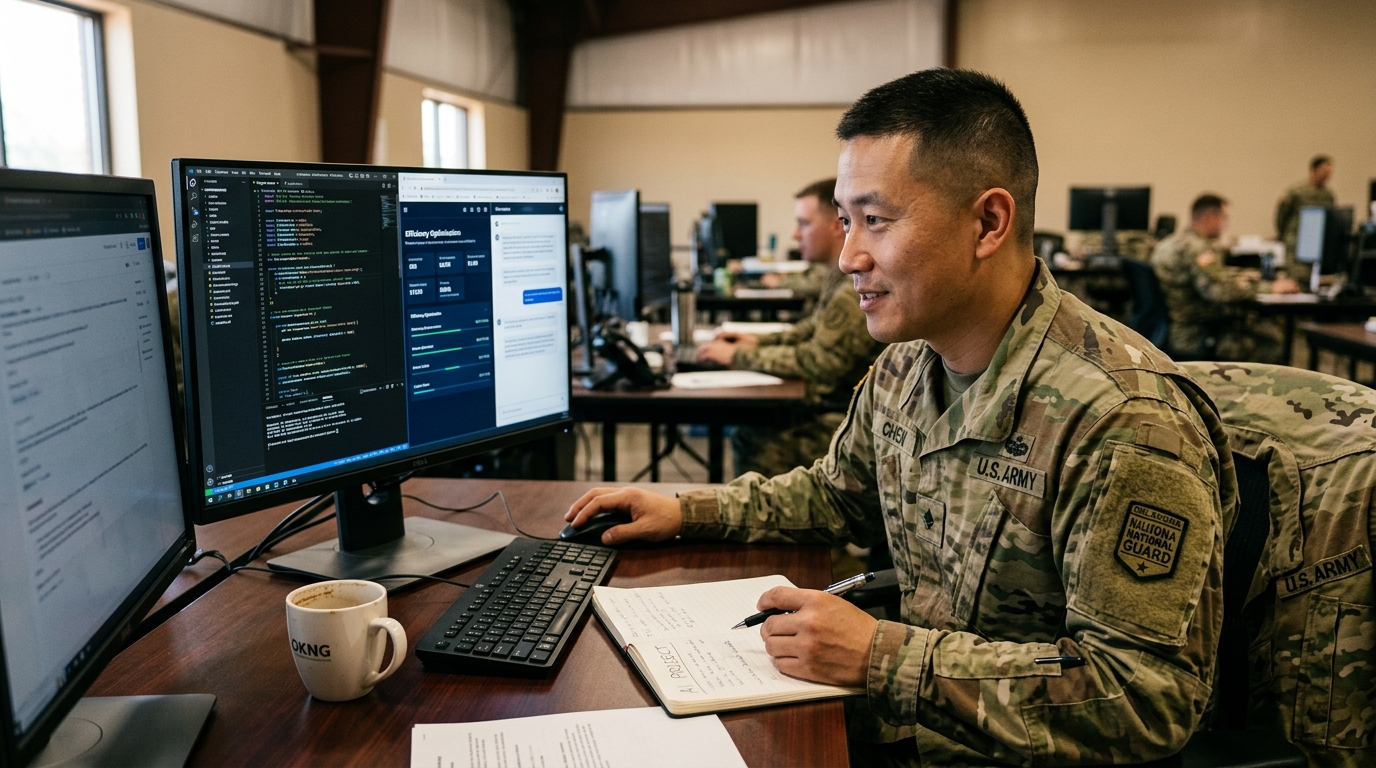
In the labyrinthine corridors of military administration, paperwork is often an adversary as relentless as any battlefield opponent. Yet, in the Oklahoma National Guard, Sgt. 1st Class Robert "Bobby" Jones has achieved what years of top-down military reform failed to do: he has effectively dismantled the administrative quagmire. By harnessing Artificial Intelligence, Jones has not merely improved his workflow; he has redefined operational efficacy for the 21st-century soldier.
Winning the War Against Bureaucracy
For those outside the military sphere, the weight of administrative tasks might seem incidental. However, for Non-Commissioned Officers (NCOs) and officers, the drafting of Evaluation Reports (NCOERs), award citations, and training schedules consumes hundreds of hours that could otherwise be spent on tactical proficiency and readiness. Recognizing that traditional methods were a drain on human capital, Jones turned to Large Language Models (LLMs) like ChatGPT to bridge the gap.
His approach was characterized by a sophisticated understanding of AI as a "digital co-pilot" rather than a replacement for human judgment. By engineering specific prompts tailored to the Army's stringent Writing Program standards, he reduced the time required for complex drafting from hours to mere minutes. The Oklahoma National Guard estimates that this initiative saved over 2,000 man-hours in a single year within his unit alone. This efficiency directly translates to increased lethality and readiness, as soldiers spend more time in the field and less time tethered to a desk.
Security, Ethics, and the AI Frontier
Integrating AI into a security-conscious organization like the National Guard is fraught with potential pitfalls. Jones was acutely aware of Operational Security (OPSEC) concerns. His methodology followed a strict protocol: never input Personally Identifiable Information (PII), sensitive tactical data, or classified material into public AI models. Instead, he utilized the technology to provide structural frameworks, grammatical refinement, and stylistic consistency, ensuring the final output met military standards while remaining secure.
This bottom-up innovation highlights a significant disparity in current military technology adoption. While the Department of Defense (DoD) allocates billions toward AI-driven weaponry and autonomous platforms, the mundane but essential tasks of daily administration often remain relics of the late 20th century. Jones’ success story serves as a proof of concept that the most immediate and profound impacts of AI may not be found in "smart" munitions, but in the optimization of the human processes that sustain the force.
The Future of Military Leadership
The success in Oklahoma is already reverberating through higher echelons of command. There is a growing consensus on the need for "walled-garden" AI environments—secure, internal networks where soldiers can utilize LLMs without the risk of data leakage. Such a system would act as a comprehensive institutional memory, capable of referencing every Army Regulation (AR) and Field Manual (FM) to provide instant, accurate administrative guidance.
- Report Automation: Reducing the administrative burden of evaluations by up to 80%.
- Logistical Optimization: Enhancing the precision of movement and supply chain planning.
- Adaptive Training: Generating customized training scenarios based on unit-specific needs.
As we move further into the 2020s, an organization's ability to pivot toward technological fluency will define its strategic advantage. Sgt. Jones did more than just save time; he demonstrated that innovation does not always require a directive from the Pentagon. It requires individuals who possess the foresight to bridge the gap between rigid tradition and the fluid possibilities of the digital age.
"AI will not replace the leader, but the leader who uses AI will inevitably replace the leader who does not," a sentiment that is becoming the new mantra for modern military command.