The news that Midjourney, a company synonymous with AI-driven artistic creation, is entering the medical imaging sector has sent shockwaves through the global healthcare community. With the announcement of a full-body scan system that completes in just 60 seconds, the company promises to transform the diagnostic process, making it more accessible, faster, and less invasive than ever before.
From Pixels to Pathology: The Great Pivot
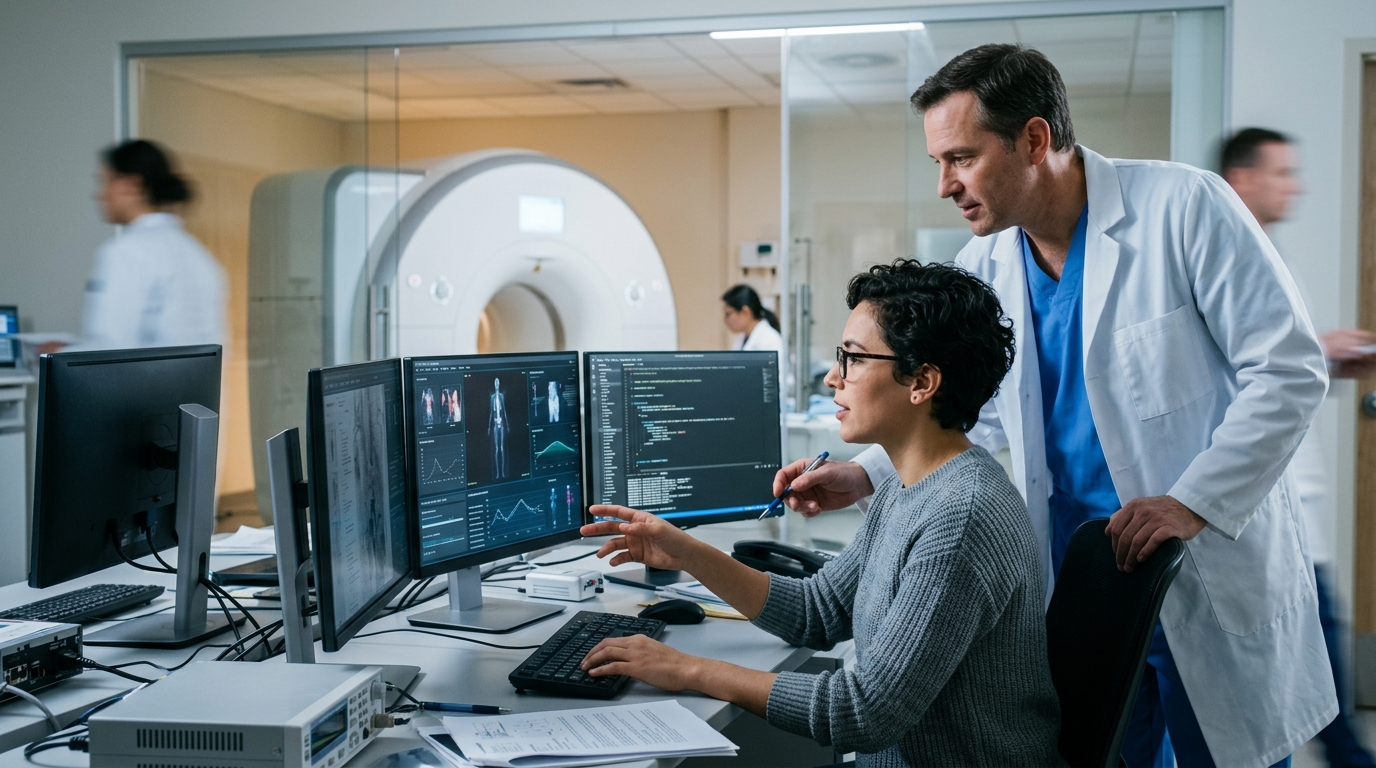
For years, Midjourney dominated the generative art space, training its models on billions of images to understand structure, light, and composition. Today, in 2026, this expertise is being applied to human anatomy. The new platform, tentatively named 'Midjourney Medical,' does not use the traditional approach of X-rays or Magnetic Resonance Imaging (MRI) as we know it. Instead, it utilizes a hybrid method combining low-radiation sensors with advanced diffusion models to 'fill in' and reconstruct 3D models of the human body with incredible precision.
The challenge in medical imaging has always been the balance between image quality and patient exposure to radiation or waiting times. Traditional MRI scans can take anywhere from 30 to 90 minutes, often causing discomfort and claustrophobia. Midjourney’s proposal cuts this time to a single minute, potentially allowing hospitals to see ten times more patients daily.
The Technology Behind the Scan
The system is based on what the company’s engineers call 'Neural Anatomical Reconstruction.' By leveraging a massive dataset of anonymized medical scans, the AI has learned to recognize the subtle variations in human physiology. When a patient enters the scanning booth, the system receives fragmented data and, through generative models, 'predicts' and reconstructs the full image of internal organs, bones, and vessels.
- Reduction of per-exam costs by up to 70%.
- Elimination of the need for contrast dyes in many scenarios.
- Ability to detect millimeter-sized anomalies that the human eye might overlook.
- Instant comparison with the patient’s historical data in real-time.
However, the use of generative AI in medicine brings with it the fear of 'hallucinations.' What happens if the AI 'imagines' a tumor that doesn't exist, or worse, 'erases' a pathology by mistaking it for noise in the image? Midjourney claims to have developed a dual-verification system where a second, more conservative algorithm checks the validity of the generated image against the raw sensor data.
Economic and Social Implications
The entry of a tech-native player into a market traditionally controlled by giants like GE Healthcare and Siemens Healthineers is expected to cause significant disruption. The potential for the 'democratization' of diagnosis is immense. In developing nations or remote areas where access to expensive MRI machines is impossible, a portable and rapid AI solution could save millions of lives through early prevention.
"We aren't just making images; we are building a mirror of human health that is accessible to everyone," stated a Midjourney spokesperson during the unveiling in San Francisco.
In conclusion, Midjourney’s move marks a new era where the boundaries between digital creativity and biomedical science become blurred. If the technology proves to be as accurate as promised, a routine check-up could soon be as simple as taking a photograph.