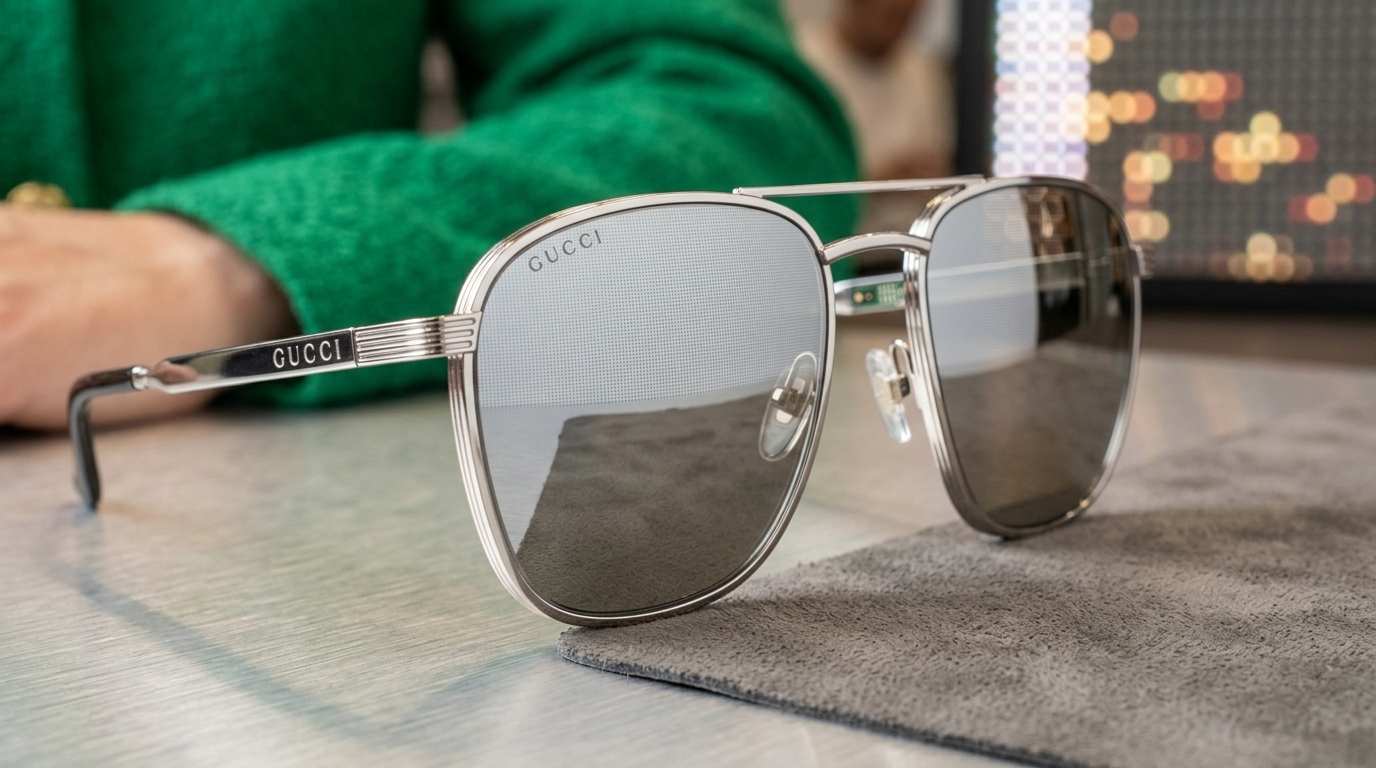
The history of technology is littered with ambitious products that failed because they ignored a fundamental rule of human nature: aesthetics. In 2013, Google Glass promised to bring the future to our eyes but ended up becoming a symbol of social awkwardness and technological elitism. Today, Google seems to have learned its lesson. The announcement of its partnership with the Kering Group, the powerhouse behind brands like Gucci and Saint Laurent, marks a new era where artificial intelligence will not just be worn, but will be an integral part of personal style.
From Google Glass to 'Smart' Luxury
The failure of Google's first foray into smart eyewear wasn't due to a lack of innovation, but a lack of elegance. The original Google Glass looked like medical equipment or a prop from a low-budget sci-fi movie. The market, however, has shifted dramatically. The success of Ray-Ban Meta proved that consumers are willing to adopt technology on their faces, provided it doesn't sacrifice their appearance. Seeing Meta dominate this emerging sector, Google decided to align itself with the best possible player in the fashion world.
The new smart glasses, expected in 2027, won't just be a frame with a camera. They will integrate Gemini, Google's advanced AI model, offering a multimodal experience. This means the glasses will be able to 'see' what the user sees, translate signs in real-time, recognize objects, and provide information via audio, without the need for an intrusive screen that distracts from the real world.
Kering’s Strategy and the Future of Retail
For the Kering Group, this move is more than just an experiment. It is a strategic positioning in the 'luxury tech' market. Gucci, in particular, has repeatedly shown it is not afraid to experiment with the digital realm, from gaming to NFTs. Creating a product that combines haute couture with AI allows the group to reach a younger, tech-savvy clientele looking for the next status symbol.
- Integration of Google Gemini for voice commands and visual recognition.
- Design curated by Gucci's leading creative directors.
- Focus on privacy with visible indicators for camera operation.
- Seamless connectivity with the Android ecosystem.
The big gamble for Google lies in battery life and weight. The engineering challenges remain immense: how do you fit an all-day battery, an AI processor, and sensors into a frame that must remain lightweight and comfortable? The partnership with Kering suggests that Google is now focusing more on the 'wearable' than the 'tech.' If the weight exceeds 50-60 grams, failure is almost certain. However, rumors suggest Google has developed new low-power chips specifically for this device.
Social Implications and Privacy Concerns
Beyond fashion, the return of smart glasses reignites the privacy debate. Back in 2013, the term 'Glasshole' described those who recorded others without permission. Today, in a world saturated with smartphones and security cameras, social tolerance has increased, but the risks remain. Google promises strict security protocols, but using AI to analyze the environment in real-time raises new questions about where this data is stored and who has access to it.
"Technology is most powerful when it disappears into the objects we love," a Silicon Valley analyst once remarked.
This seems to be the core philosophy of the Google-Gucci collaboration. If the glasses look like a classic pair of Gucci frames, the technology becomes invisible, and therefore, more easily accepted. The challenge will be to convince consumers they aren't just buying an expensive gadget, but a necessary tool for their daily lives that happens to be beautiful.
Conclusion: The Battle for the User's Face
With Apple focusing on 'spatial computing' with the Vision Pro and Meta investing billions in AR glasses, Google had no choice but to strike back. By choosing the path of fashion, Google admits that technology alone isn't enough to win over the general public. The success of this partnership will be judged by whether, in 2027, we see people on the streets of Athens, Paris, and New York wearing Gucci glasses, with no one suspecting that behind the lenses lies one of the most powerful algorithms in the world.