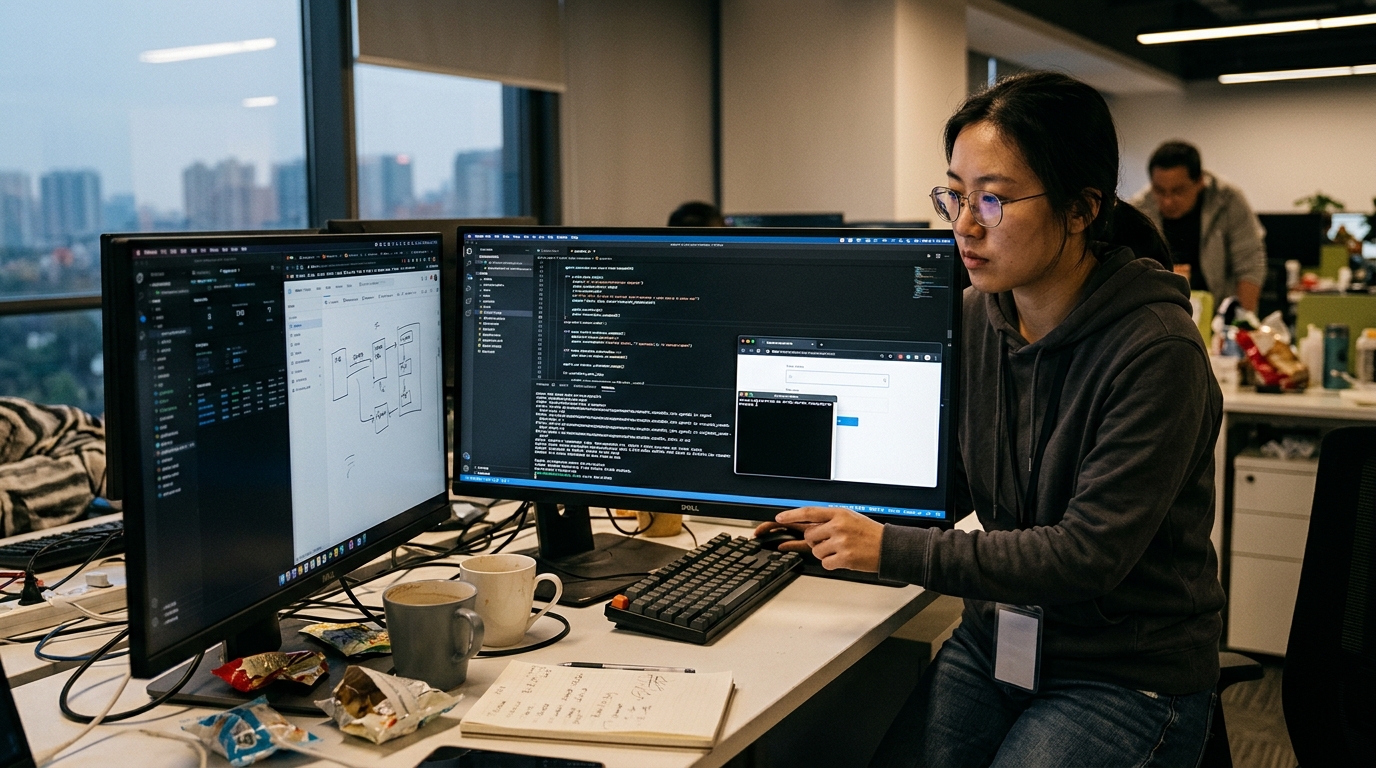
In an era where the lines between human intent and code execution are becoming increasingly blurred, Google and the Kaggle platform have announced the return of the highly successful 'AI Agents Intensive Course.' This initiative, scheduled for June 2026, comes at a critical juncture for the tech industry as focus shifts from simple Large Language Models (LLMs) toward autonomous AI Agents—systems capable of planning, decision-making, and executing complex tasks with minimal human intervention.
The course introduces the concept of 'Vibe Coding'—a term that gained traction in early 2025 to describe a software development process where the programmer acts more as a 'conductor of intent' rather than a traditional code writer. Using tools like Vertex AI and Gemini 2.0, participants will be challenged to build systems that don't just answer questions but interact with external APIs, manage databases, and solve problems in real-time.
The Shift from Syntax to Intent
For decades, learning to program meant memorizing syntax, data structures, and algorithms. However, the rise of generative AI has fundamentally altered this paradigm. 'Vibe Coding' does not mean the abolition of logic, but its migration to a higher level of abstraction. Developers now 'describe' the vibe, functionality, and constraints of a system, and the AI takes over the heavy lifting of implementation.
The Google and Kaggle course focuses precisely on this transition. Over five days, participants will move from the theory of agentic workflows to practical application. The curriculum covers critical areas such as ReAct (Reasoning and Acting), function calling, and the use of memory in agents. The significance of these technologies lies in their ability to reduce model 'hallucinations,' as agents can verify information via external sources before reaching a conclusion.
Structure of the Intensive Course
The program is structured to serve both seasoned software engineers and newcomers to the AI space. Each day is dedicated to a specific aspect of agent development:
- Day 1: Introduction to Agentic Workflows and the Vibe Coding philosophy.
- Day 2: Agent Planning and decomposing complex problems into smaller steps.
- Day 3: Tools and Function Calling—How agents use the web and APIs.
- Day 4: Multi-agent systems and orchestrating collaboration between AIs.
- Day 5: Deployment and performance evaluation in real-world scenarios.
Using Kaggle as a hosting platform offers a unique advantage: community. Participants don't just watch videos; they participate in coding competitions, share their notebooks, and receive direct feedback from Google DeepMind experts.
Social and Professional Implications
Google's move is not merely an educational offering; it is a strategic positioning in the labor market of the future. As demand for traditional junior-level developers may decline, the need for 'Agent Architects'—people who can design and oversee AI ecosystems—is skyrocketing. This creates a new digital divide: on one side, those who can leverage new tools to multiply their productivity, and on the other, those who remain tethered to obsolete methods.
"AI will not replace the programmer, but the programmer using AI will replace the one who does not," a Google executive noted in the announcement.
In the global market, such programs offer a unique opportunity for reskilling. The ability to access cutting-edge expertise from Google at no cost democratizes high-level education, allowing talent from every corner of the globe to compete on equal terms on the international stage.
Conclusion and Outlook
The AI Agents Intensive Course is the prelude to a new era in software creation. 'Vibe Coding' might sound like a superficial term, but it hides a profound truth: creativity and strategic thinking are becoming the dominant currencies in the tech economy. As agents become more capable, the human role shifts from 'execution' to 'oversight' and the 'definition of ethical and operational frameworks.'
Registration is already open, and participation is expected to exceed all previous records, confirming that the thirst for knowledge in the field of AI remains the driving force of modern innovation.