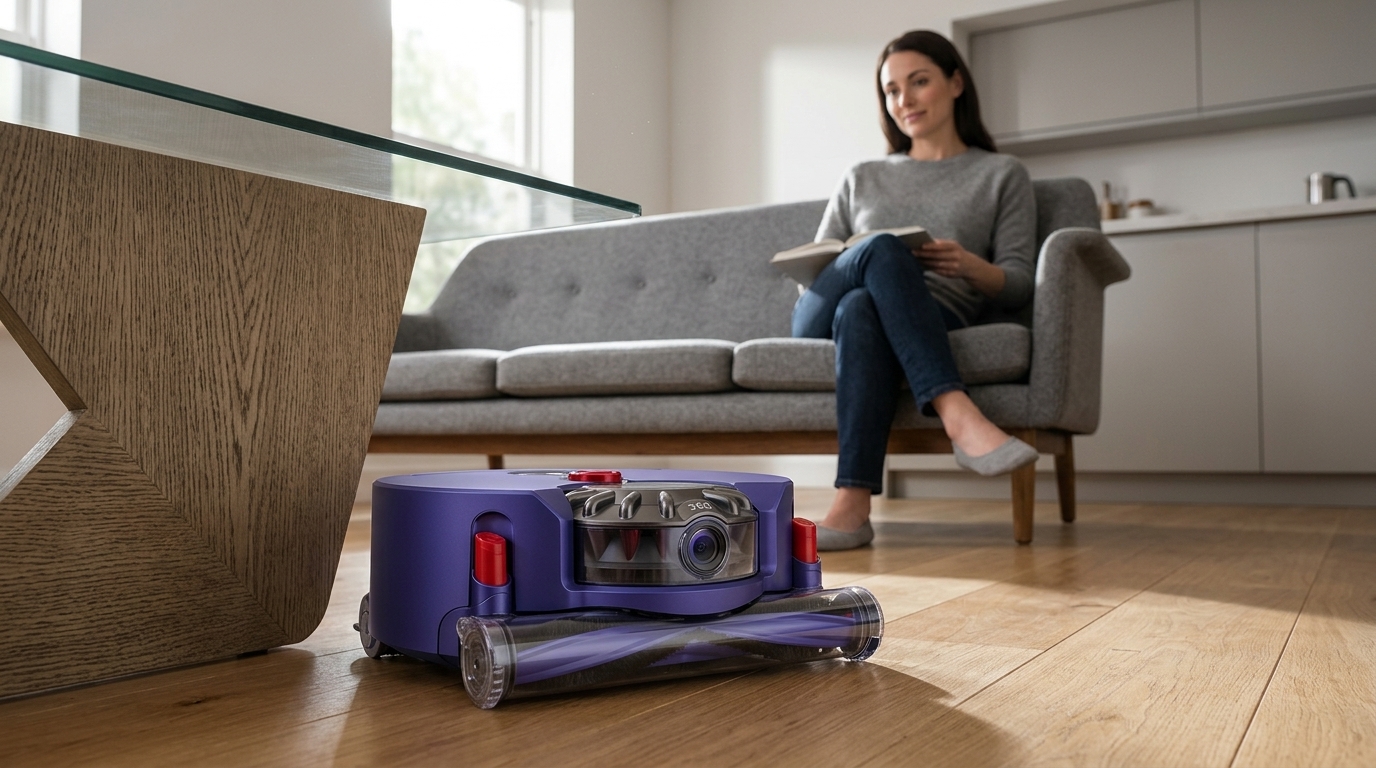
The home robotics market is experiencing one of its most unexpected tremors. Dyson, a name synonymous with premium engineering and aerodynamic excellence, has enacted a drastic price cut for its flagship robot vacuum, the 360 Vis Nav. Originally retailing for nearly $1,200, the device is now available via Woot (an Amazon subsidiary) for a staggering $279.99. This move is not merely a bargain for consumers; it is a strategic statement in a market increasingly dominated by Chinese manufacturers and established incumbents like iRobot.
The Engineering of Superiority: What Sets the 360 Vis Nav Apart
For decades, Dyson hesitated to enter the robot vacuum category, focusing instead on upright and cordless models. The reason was simple: James Dyson believed no robot vacuum possessed sufficient suction power. The 360 Vis Nav was engineered to shatter that taboo. Equipped with the Hyperdymium motor, spinning at up to 110,000 rpm, the device promises six times the suction of any other robot vacuum on the market.
The unit's 'D' shape is no accident. While most competitors cling to a circular design, Dyson opted for the D-shape to reach deep into corners. Furthermore, it features a side duct that automatically extends when the vacuum detects a wall, directing suction exactly where dust accumulates. This obsession with detail is what theoretically justified its high initial price point.
360-Degree Vision and the Software Conundrum
Navigation is the 'holy grail' of robotics. While Roborock and Dreame utilize Lidar sensors (reminiscent of autonomous vehicle systems), Dyson chose a 360-degree computer vision system. A fish-eye lens on top of the device maps the room in real-time, allowing the vacuum to know precisely where it is and where it needs to go. However, this approach requires adequate lighting, which is why Dyson integrated an LED light ring that activates in dark areas.
Despite its technical prowess, the 360 Vis Nav faced criticism regarding its software upon launch. Users reported difficulties connecting to the MyDyson app and occasional navigation hiccups. The current offer, however, arrives at a time when software updates have smoothed out most of these issues, making the device far more attractive than it was a year ago.
The Strategy Behind the Discount: Inventory Clearing or Pivot?
Why would a company like Dyson slash the price of a product by nearly 75%? There are two likely interpretations. The first involves clearing inventory ahead of a new model. Artificial Intelligence (AI) is evolving at a breakneck pace, and it is probable that Dyson is preparing a new iteration with advanced AI-driven object recognition—a feature lacking in the current Vis Nav.
The second interpretation is more strategic. The robot vacuum market has become hyper-competitive. Consumers now seek devices that not only vacuum but also mop and self-clean in dedicated docking stations. The 360 Vis Nav focuses exclusively on vacuuming. By offering it at this price point, Dyson is attempting to 'steal' market share from mid-range vacuums, proving that raw suction power remains the most vital attribute for a clean home.
"Robotics is not just about autonomy; it’s about efficacy. A vacuum that navigates perfectly but doesn't clean is just an expensive toy," James Dyson once remarked, and the 360 Vis Nav is the embodiment of that philosophy.
The Future of Automated Cleaning
This offer, ending May 11th, represents a milestone. It demonstrates that high technology is becoming more accessible, but also that traditional engineering giants must adapt to the rules of the digital age. For the average consumer, acquiring a Dyson device for under $300 was once unthinkable. Today, it is a reality that highlights the maturation of the market. Whether this is a move of desperation or a brilliant penetration strategy, the result is the same: high-level robotic cleaning is no longer the privilege of the few.