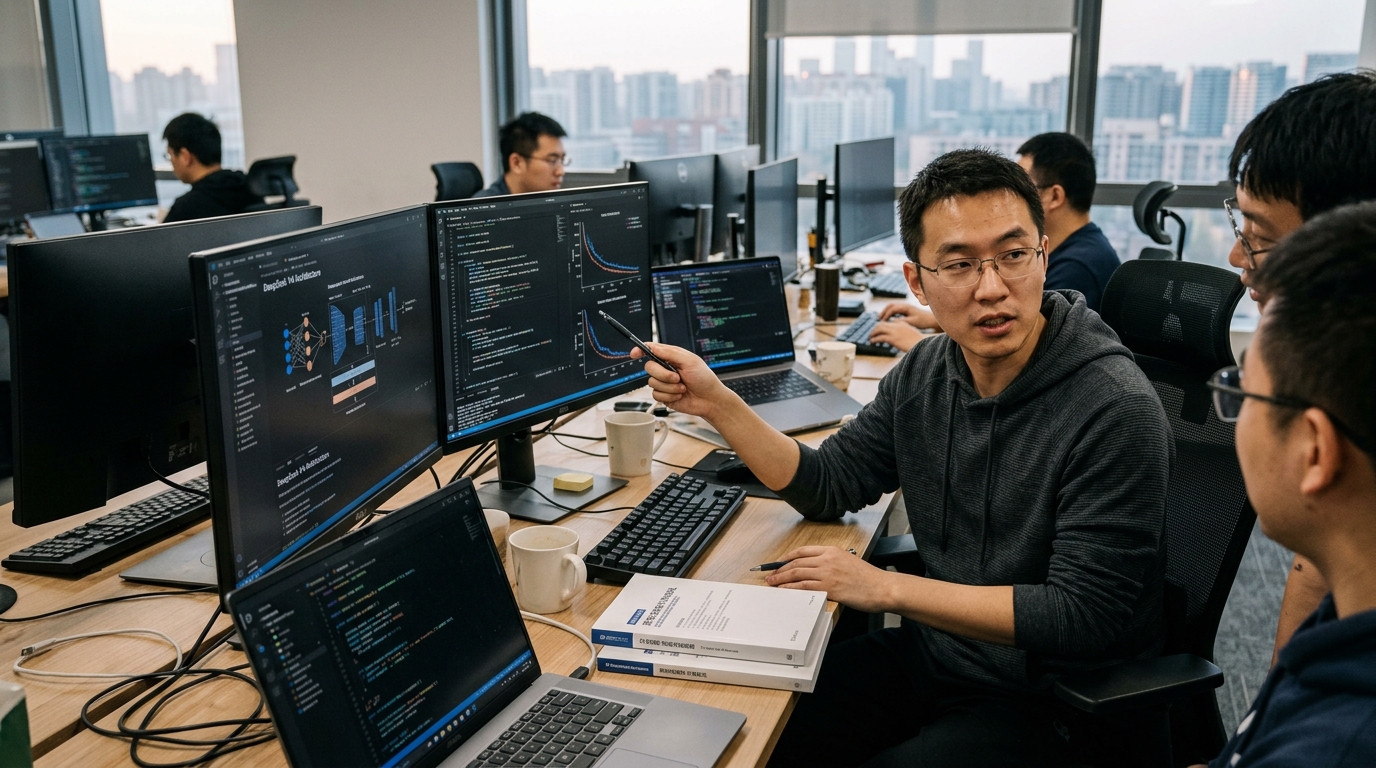
The global AI landscape is no longer an exclusive club for Silicon Valley. With the official release of DeepSeek V4, the Chinese lab DeepSeek AI (a subsidiary of High-Flyer Quant) has proven that the race for Large Language Model (LLM) supremacy has shifted from data quantity to architectural brilliance. V4 is not merely an incremental update; it is a strategic statement of intent that directly challenges the dominance of OpenAI’s ChatGPT, Anthropic’s Claude, and Google’s Gemini.
The Architecture of Efficiency: MoE and MLA
The defining characteristic that makes DeepSeek V4 a technological landmark is its masterful implementation of the Mixture-of-Experts (MoE) architecture. Unlike traditional "dense" models that activate all their parameters for every query, MoE utilizes only a specific subset based on the context. This allows the model to retain a vast knowledge base without requiring the compute power of a supercomputer for every simple interaction.
Furthermore, the introduction of Multi-head Latent Attention (MLA) enables DeepSeek V4 to manage expansive context windows with significantly reduced VRAM consumption. For developers and enterprises, this translates to a model that is faster, cheaper to run, and exceptionally capable at complex reasoning tasks. In fact, DeepSeek has managed to achieve performance parity with GPT-4o while using a fraction of the training and inference resources—a direct challenge to the notion that only US tech giants with endless supplies of Nvidia H100s can lead the field.
Comparative Analysis: DeepSeek vs. The Giants
When placing DeepSeek V4 alongside ChatGPT (OpenAI), Claude (Anthropic), and Gemini (Google), the distinctions become clear, particularly in STEM fields and programming. In benchmarks such as HumanEval and GSM8K, DeepSeek V4 frequently outpaces Claude 3.5 Sonnet and GPT-4o, delivering more precise solutions to intricate algorithmic problems.
- DeepSeek V4 vs. ChatGPT: While ChatGPT remains the leader in general-purpose utility and multimodality (voice, vision), DeepSeek V4 offers a superior experience for technical tasks, featuring less restrictive guardrails on technical inquiries and a much lower API cost structure.
- DeepSeek V4 vs. Claude: Claude is renowned for its nuanced, literary prose and safety-first approach. DeepSeek V4, however, appears more decisive in logical leaps, though its English syntax—while excellent—occasionally lacks the natural flow found in Anthropic’s models.
- DeepSeek V4 vs. Gemini: Google’s Gemini excels in ecosystem integration and its massive context window (up to 2 million tokens). DeepSeek V4 counters with a more flexible open-weights approach, allowing enterprises to host the model on their own infrastructure for privacy and control.
Geopolitical Implications: Bypassing the Sanctions
The success of DeepSeek V4 brings a critical question to the forefront: Can US chip export sanctions truly stifle Chinese AI development? The evidence suggests otherwise. DeepSeek AI has demonstrated that when hardware is constrained, software innovation flourishes. Their algorithmic optimization is so refined that it allows high-tier AI results to be generated on hardware that the West considers "obsolete" or restricted.
"DeepSeek isn't just competing on software; they are redefining the economics of intelligence," industry analysts note.
This creates a new dynamic in the "Tech Cold War." If China can produce high-level AI at a significantly lower price point, the adoption of Chinese models across the Global South could be rapid, leaving American companies to cater primarily to those who can afford the Silicon Valley premium.
The Future: Open Weights and Accessibility
DeepSeek V4 continues the company's tradition of releasing model weights to the community. This open-weights strategy fosters a massive support ecosystem. Developers worldwide are already building specialized versions of V4 for medical diagnostics, legal analysis, and local automation. In a world where OpenAI is becoming increasingly "closed," DeepSeek is choosing a path of transparency to gain the trust of the global open-source community.
In conclusion, DeepSeek V4 is more than just another tool. It is the harbinger of an era where artificial intelligence becomes a commodity—accessible to everyone, regardless of geopolitical borders or economic might. The battle for AI supremacy has a new, highly formidable contender that isn't afraid to take on the giants on their own turf.