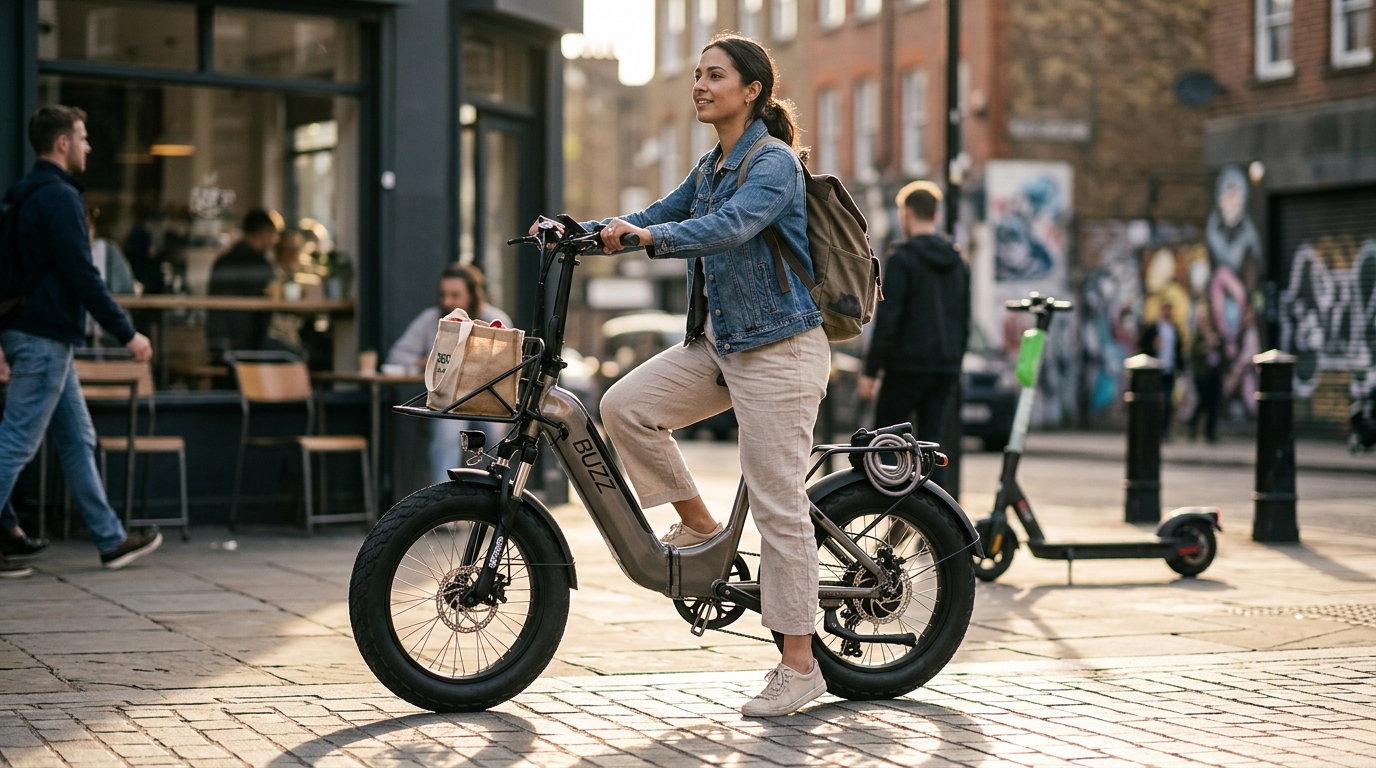
As we navigate the mid-point of 2026, urban mobility has transcended being a mere logistical challenge; it is now a statement of cultural shift and environmental responsibility. The Buzz Centris 2 positions itself precisely at this intersection: the demand for affordable, reliable, and, above all, practical electric transportation. In a market often saturated with overpriced models boasting redundant high-tech features, the Centris 2 chooses the path of utility and substance.
Design and Sturdiness: A Build That Inspires Confidence
The first thing one notices about the Centris 2 is its inherent sense of solidity. Despite its folding nature—a characteristic frequently associated with creaks and structural flex—the aluminum alloy frame remains remarkably steadfast. Buzz Bicycles appears to have prioritized the locking mechanisms, which operate with a precision that allows the bike to be tucked into a car trunk or a cramped apartment corner without feeling like a fragile toy.
The narrow handlebars are an intriguing design choice. While they provide exceptional maneuverability through congested city traffic, they might feel restrictive to riders accustomed to wider, mountain-bike geometries. In practice, however, this choice reinforces its identity as a 'city tool,' allowing passage through tight spots where broader bikes would struggle.
- Frame: High-strength folding aluminum.
- Wheels: 20-inch wheels with fat tires for natural shock absorption.
- Weight: Approximately 65 lbs (29 kg), making it sturdy but demanding during manual transport.
Performance and the Range Challenge
At the heart of the Centris 2 lies a 500W rear-hub motor. The power delivery is linear and more than sufficient for most urban gradients, providing the necessary torque when the light turns green. The Pedal Assist System (PAS) is responsive, though it lacks the sophisticated torque-sensing refinement found in premium models costing upwards of $3,000.
"The true test of a budget ebike isn't its top speed, but how often it forces the rider to anxiously glance at the battery indicator."
This is where the Centris 2 meets its primary challenge. The 48V battery offers a respectable range for standard daily commutes of 20-25 miles. However, if a rider relies heavily on the throttle or operates in hilly terrain, the need for a recharge arrives sooner than one might hope. For the urban commuter, this necessitates a disciplined charging strategy as part of their daily routine.
Economic Value and Market Position
The Centris 2 does not attempt to dazzle with OLED touchscreens or 5G connectivity. Instead, it invests in components that stand the test of time, such as the Shimano drivetrain and reliable mechanical disc brakes. While hydraulic brakes would have been a welcome addition given the bike's weight, the mechanical units provided offer adequate stopping power with the added benefit of easier, more affordable maintenance for the DIY user.
When measured against competitors like Lectric or Rad Power, the Buzz Centris 2 stands out for its balance. It isn't the cheapest on the market, nor the fastest. However, it is one of the most 'honest' propositions for someone looking to enter the e-mobility space without compromising safety on questionable, unbranded imports. It represents a pragmatic middle ground.
Conclusion: A Tool for the New Era
The Buzz Centris 2 is the type of vehicle the middle class requires to make the transition to green mobility feasible. Despite its range limitations and significant weight, the ride quality and storage convenience make it a powerful ally in the daily struggle against urban gridlock. It serves as a reminder that technology does not always need to be expensive to be profoundly effective.