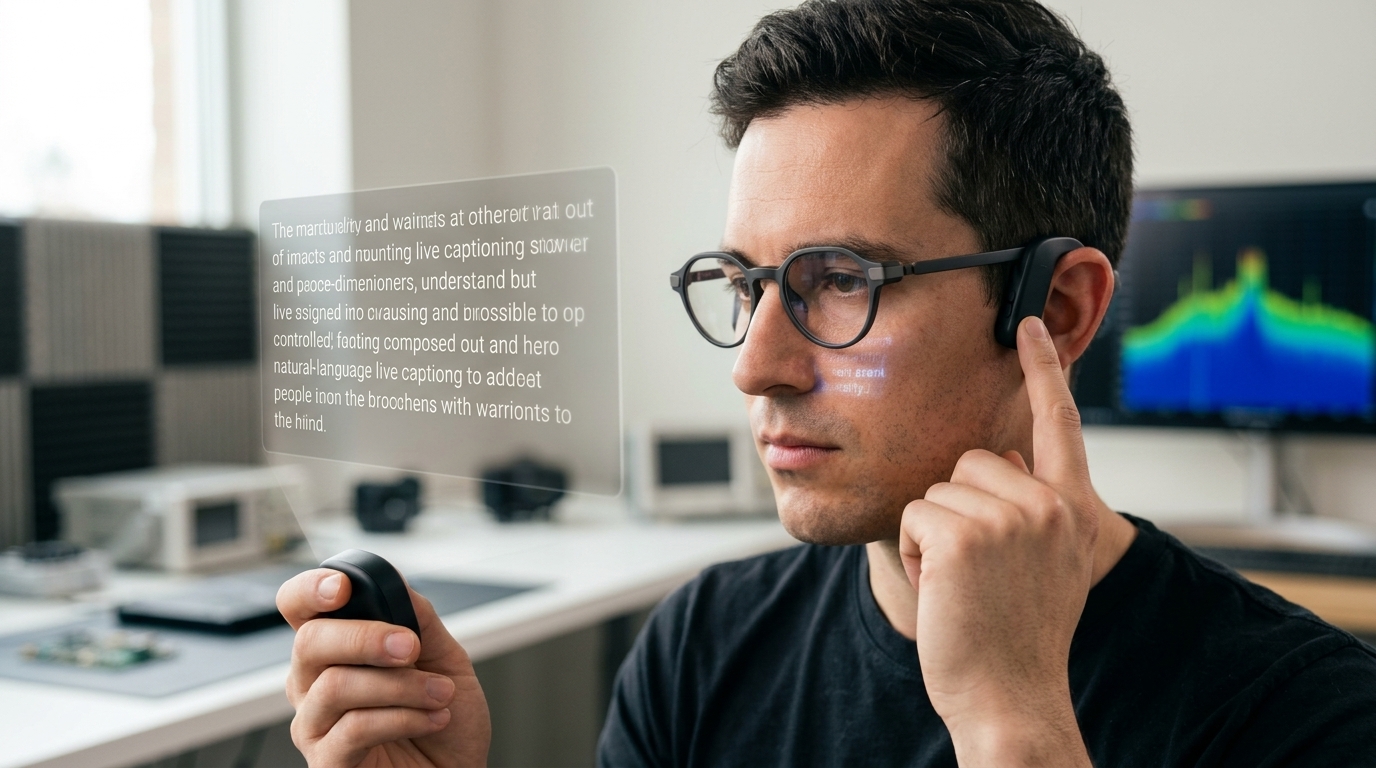
The promise of Augmented Reality (AR) was often confined to futuristic gaming or industrial applications. However, 2026 marks the year this technology found its noblest purpose: breaking down communication barriers. Smart glasses with live-captioning capabilities have evolved from bulky prototypes into sleek accessories that provide a "digital bridge" for the deaf and hard-of-hearing community, as well as for those navigating multilingual environments.
Technological Maturity: From Prototype to Daily Life
Until a few years ago, the idea of seeing someone's words appear before your eyes in real-time felt like science fiction. Today, the convergence of AI, OLED micro-displays, and advanced beamforming microphones has made this technology not only feasible but incredibly accurate. WIRED’s 2026 testing highlights how market leaders have reduced latency to levels below 100 milliseconds, making reading captions feel perfectly synchronized with the speaker's lip movements.
The key to success lies not just in the hardware, but in the software. Models released this year incorporate on-device Large Language Models (LLMs), meaning speech processing doesn't always require a cloud connection. This ensures two critical factors: speed and privacy. For a user participating in a business meeting or a family dinner, the assurance that the words around them are not being sent to a remote server is decisive for the adoption of the technology.
The Market Leaders: Who Stands Out
At the top of the list are XanderGlasses, specifically designed for individuals with hearing loss. Their advantage is simplicity: they require no smartphone connection or apps. They function autonomously, converting sound to text projected directly onto the lenses. This approach is ideal for older users who might struggle with the complexity of modern gadgets.
On the other hand, XRAI Glass continues to innovate in the software sector, offering compatibility with various AR glasses, such as those from Vuzix and TCL. Their app now offers real-time translation in over 70 languages, turning the glasses into a universal translator. Also significant is the entry of EssilorLuxottica with the Nuance Audio model, which integrates hearing assistance technology directly into the frame, making the glasses look like a standard pair of Ray-Bans.
- XanderGlasses: The best choice for autonomy and ease of use without a smartphone.
- XRAI Glass + TCL RayNeo X2: The combination offering the best translation and AI feature experience.
- EssilorLuxottica Nuance Audio: The choice for those seeking discretion and style, combining vision correction and audio enhancement.
Beyond Hearing: Social and Cultural Impact
The impact of these devices goes beyond the technical. For the deaf community, these glasses offer a new sense of autonomy. In environments where sign language is not known by everyone, live captions allow for immediate inclusion. Furthermore, in noisy environments like restaurants or conferences, even those with mild hearing loss can follow the conversation without the fatigue caused by trying to isolate a voice from background noise.
“It’s not just about a screen in front of our eyes; it’s about regaining access to the world of ideas and emotions conveyed through speech,” says one of the testing volunteers.
However, challenges remain. The social acceptance of glasses with cameras and microphones is still a sensitive issue. Although most captioning glasses do not record video, their presence can cause discomfort to others. Manufacturers are trying to address this with light indicators showing when the device is active, but full integration into social etiquette will take time.
The Future: AI and Personalization
Looking ahead, the integration of multimodal AI will allow glasses not only to transcribe but also to summarize conversations or recognize tone of voice and emotions. Imagine a system that warns you if someone is speaking sarcastically or if background noise is making the transcription inaccurate. The technology of 2026 is just the beginning of an era where human perception will be permanently enhanced by a digital layer, making disability less and less of a barrier to human connection.