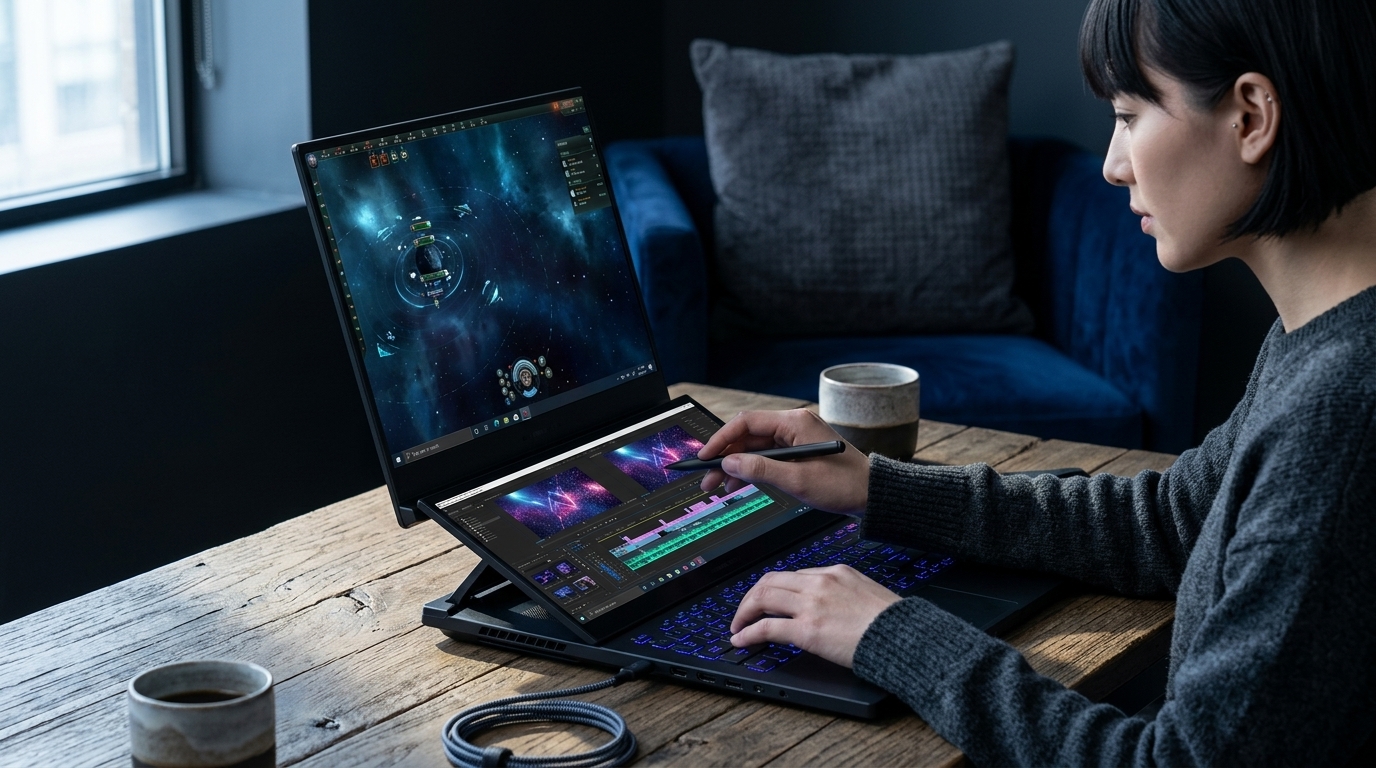
In the world of high-end technology, there is a very fine line between innovation and pure displays of dominance. The 2026 Asus ROG Zephyrus Duo doesn't just walk that line; it obliterates it. As we move through the first half of 2026, the gaming laptop market is saturated with devices promising "desktop-class experiences," but Asus seems to be the only manufacturer taking that literally. They have delivered a machine that feels like it arrived from five years in the future, bearing a price tag that would make even a seasoned venture capitalist blink twice.
The Architecture of Excess: RTX 5090 and 16th Gen Intel
The heart of this beast beats with NVIDIA’s new Blackwell mobile architecture. The GeForce RTX 5090 Mobile is not merely a generational bump; it’s a paradigm shift in performance-per-watt, though "wattage" remains a serious consideration here, as the laptop demands significant power to reach its full potential. Equipped with 24GB of VRAM and DLSS 4.5 technology, the Zephyrus Duo shreds through 4K titles with full Path Tracing enabled without breaking a sweat. Paired with Intel’s flagship 2026 silicon, the system offers processing speeds that, until last year, required liquid-cooled desktop towers the size of a small refrigerator.
However, raw power isn't the only story. Asus has doubled down on its AAS Plus 2.0 cooling system. When you lift the lid, the secondary screen tilts up by 13 degrees, revealing massive air intakes that allow the internal components to breathe. In an era where thin-and-light laptops often suffer from aggressive thermal throttling, the Duo remains impressively cool under load, though its fans at maximum RPM do sound like a private jet preparing for takeoff.
Two Screens, One Uncompromising Vision
The series' signature feature remains the ScreenPad Plus. In the 2026 iteration, the primary display is a stunning 18-inch Mini-LED panel with a 300Hz refresh rate and a peak brightness of 1600 nits. The color accuracy is so precise that the laptop transitions seamlessly from a gaming rig to a professional-grade workstation for color grading and high-end video editing. But the real magic happens below the main hinge. The secondary touchscreen now shares almost the same pixel density as the primary one, eliminating the slightly "fuzzy" texture that plagued earlier generations.
For the gamer, the second screen is a sanctuary for Discord, system telemetry, or in-game maps. For the professional, it’s where the Premiere Pro timeline or Photoshop layers live. It is a solution that, while once dismissed as a gimmick, has matured into an essential tool for those accustomed to dual-monitor setups at home who refuse to sacrifice productivity while traveling. Touch responsiveness is instantaneous, and integration with Windows 12—which finally handles multi-monitor layouts with grace—is flawless.
The Cost of Luxury and the Social Imprint
It is impossible to discuss the Zephyrus Duo without addressing the elephant in the room: the price. Retailing at nearly $5,000 in the US market, this device is not for the masses. It is a "halo product," a testament to Asus's engineering prowess designed for an elite tier of users: professional content creators, top-tier e-sports athletes, and tech enthusiasts who demand the absolute ceiling of mobile performance.
- Performance: Unrivaled, thanks to the RTX 5090 and Intel Core i9/Ultra 9 synergy.
- Display: The Mini-LED panel is arguably the best ever fitted into a portable chassis.
- Ergonomics: Typing requires the included wrist rest, as the keyboard is shifted to the very front edge.
- Portability: Weighing in at 2.7kg plus a massive power brick, "portable" is a generous term.
In conclusion, the 2026 Asus ROG Zephyrus Duo is a triumph of engineering. It is the answer to the question: "What happens if we ignore the budget and focus solely on what is possible?" Yet, its existence prompts a deeper reflection on the future of computing. Do we truly need this much power in a laptop? Or has the industry become trapped in a vanity race while cloud gaming and efficient ARM processors offer more sensible alternatives? For now, the Duo remains the undisputed king—a sleek, powerful, and outrageously expensive jewel in the Asus crown.