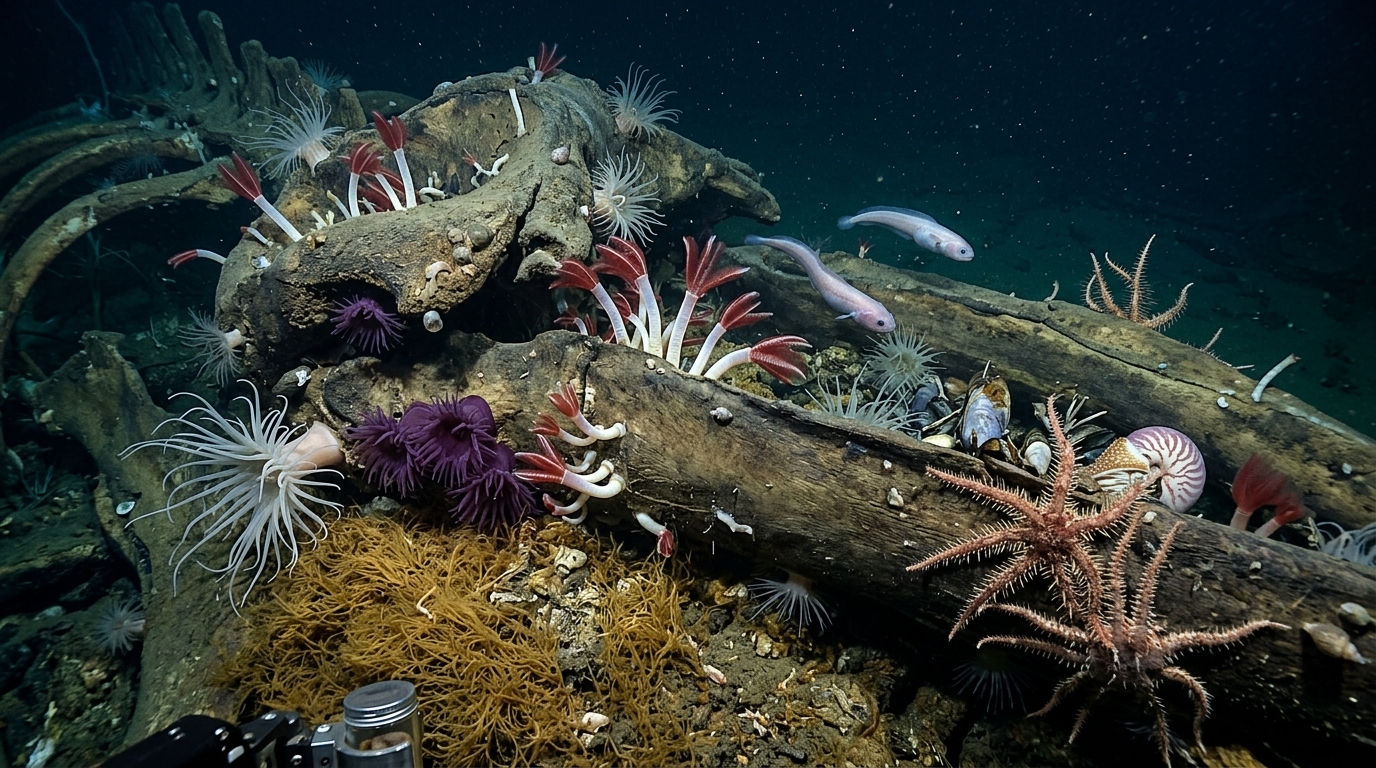
In the unmapped depths of our oceans, where sunlight never reaches and the pressure is enough to crush most human inventions, one of nature's most fascinating dramas unfolds. Recent research has brought to light an impressive ecosystem thriving on a "whale cemetery" millions of years old. This discovery is not merely a biological curiosity; it is a critical piece in the puzzle of understanding how life persists and flourishes under the most adverse conditions.
The Whale Fall Phenomenon: A Godsend for the Abyss
When a whale dies, its massive body sinks to the ocean floor. This event, known in the scientific community as a "whale fall," represents one of the most significant sources of nutrients for the deep-sea ecosystem. In an environment where food is scarce, a whale carcass provides an amount of organic carbon equivalent to the "marine snow" that would fall in the same area over thousands of years.
The decomposition process is divided into several stages. Initially, deep-sea scavengers like sharks and hagfish consume the soft tissue. Subsequently, smaller organisms, such as crustaceans and polychaetes, colonize the bones. The most striking stage, however, is the "sulfophilic" stage, where bacteria break down the lipids inside the bones, producing hydrogen sulfide. This chemical process supports entire colonies of tube worms and other creatures that rely on chemosynthesis rather than photosynthesis.
A Time Capsule of Millions of Years
What makes this specific discovery unique is the age of the findings. Researchers, using advanced remotely operated vehicles (ROVs), identified bones dating back millions of years. Despite the passage of time, biological activity around them remains intense. Jellyfish hovering like otherworldly ghosts, intricately shaped starfish, and rare species of lobsters have created a vibrant metropolis atop the fossilized remains.
Of particular interest are the worms of the genus Osedax, also known as "zombie worms." These creatures have no mouth or stomach. Instead, they use roots that penetrate the whale bones to absorb nutrients with the help of symbiotic bacteria. Their presence in such ancient samples suggests an evolutionary continuity spanning vast periods, linking today's species with their prehistoric ancestors.
Significance for Climate Change and Biodiversity
The study of these ecosystems offers valuable insights into the planet's carbon cycle. Whales act as "carbon pumps." During their lives, they accumulate vast amounts of carbon in their bodies, and when they die, this carbon is transported and "locked" onto the seabed for centuries. Understanding how whale graveyards manage this carbon is vital for our climate models.
- Biodiversity: These areas act as "islands" of life, allowing species to spread across vast distances on the otherwise desert-like ocean floor.
- Evolutionary Biology: DNA analysis of the organisms living there reveals how life adapts to extreme conditions of oxygen deprivation and high pressure.
- Pharmaceutical Research: Bacteria surviving in these environments produce unique chemical compounds that could lead to new antibiotics or medicines.
As humanity looks toward deep-sea mining for minerals, the protection of these fragile ecosystems becomes imperative. Each "cemetery" is a unique archive of Earth's history and a laboratory for our future survival. This discovery reminds us that even in death, nature finds a way to create life, weaving an eternal cycle that connects the surface to the abyss.