The intersection of cultural heritage and computational science is one of the most intriguing frontiers in modern research. A recent comprehensive quantitative analysis, highlighted by HuffPost Greece, has demonstrated how Artificial Intelligence (AI) can serve as a "digital musicologist," dissecting the monumental works of Mikis Theodorakis and Manos Hatzidakis. This study goes beyond simple archiving; it attempts to map the structural, harmonic, and emotional differences that defined the Greek 20th century.
The Methodology: When Notes Become Data
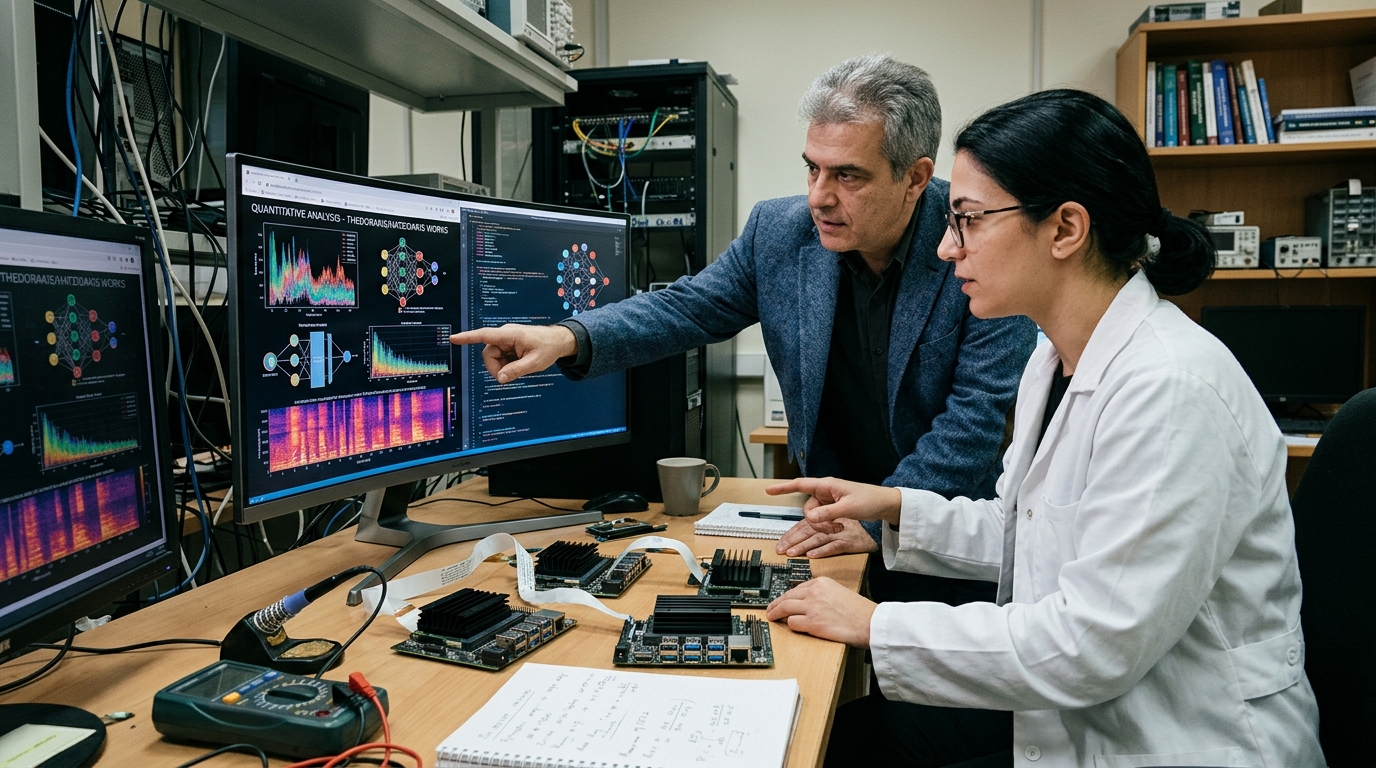
Using machine learning algorithms to analyze music is not entirely new, but applying it to the works of Theodorakis and Hatzidakis presents unique challenges. Researchers utilized feature extraction techniques to analyze thousands of audio files and scores. Parameters such as rhythmic complexity, spectral density, and harmonic transitions were converted into data vectors. The AI was tasked with "hearing" the distinction between the Doric dynamism of Theodorakis and the lyrical, almost dreamlike, elegance of Hatzidakis.
According to the findings, Theodorakis's work is characterized by a higher "energy level" and rhythmic repetition reminiscent of marches and ancient dances, aligning with the political and social nature of his music. Conversely, the AI identified a much more complex harmonic structure in Hatzidakis's work, featuring frequent modulations that provide the sense of interiority and melancholy prevalent in his compositions.
Dionysus vs. Apollo: Quantifying a Myth
The analysis confirms with mathematical precision the distinction often made by art critics: Theodorakis is the Dionysian, the extrovert, the composer of the masses. Hatzidakis is the Apollonian, the introvert, the architect of individual emotion. The AI analyzed the frequency of specific instrument usage, finding that while Theodorakis uses the bouzouki as a "weapon" of rhythmic imposition, Hatzidakis integrates it into a more Westernized, orchestral context, often smoothing out its "rough" edges.
- Rhythmic Analysis: Theodorakis displays 30% greater tempo stability, a factor that enhances the participatory nature of his songs.
- Harmonic Spectrum: Hatzidakis utilizes twice the number of secondary chords, creating richer chromatic palettes.
- Lyric-Melody Connection: The AI also analyzed the relationship between word and melody, showing how Theodorakis "subjugates" music to the rhythm of poetry (e.g., Ritsos), while Hatzidakis molds music around the aura of words (e.g., Gatsos).
The Significance for the Future of Cultural Memory
Why do we need AI to tell us what we already feel? The answer lies in objectivity and scale. The technology's ability to process an entire discography in minutes allows musicologists to see the "forest" rather than just the "trees." Furthermore, such tools can be used for the restoration of old recordings or even for training new composers on the techniques of the great masters.
However, the study also raises questions. Can an algorithm capture "Greekness" or "Duende"? Quantitative analysis gives us the materials, but not the spirit. The digital anatomy of "Epitaphios" or "Magnus Eroticus" shows us how these masterpieces were constructed, but the emotion they evoke remains a mystery that AI, for now, can only observe from a distance.
Conclusion
This research represents a milestone for digital humanities in Greece. It highlights that tradition is not something static but a living body of data that can teach us new things when examined with the right tools. Theodorakis and Hatzidakis, through these algorithms, continue their dialogue, proving that their music is so deeply rooted in mathematical and spiritual structures that it withstands even the most rigorous scientific scrutiny. As we move further into the 21st century, AI will likely become the bridge that keeps these 20th-century giants relevant for a data-driven generation.