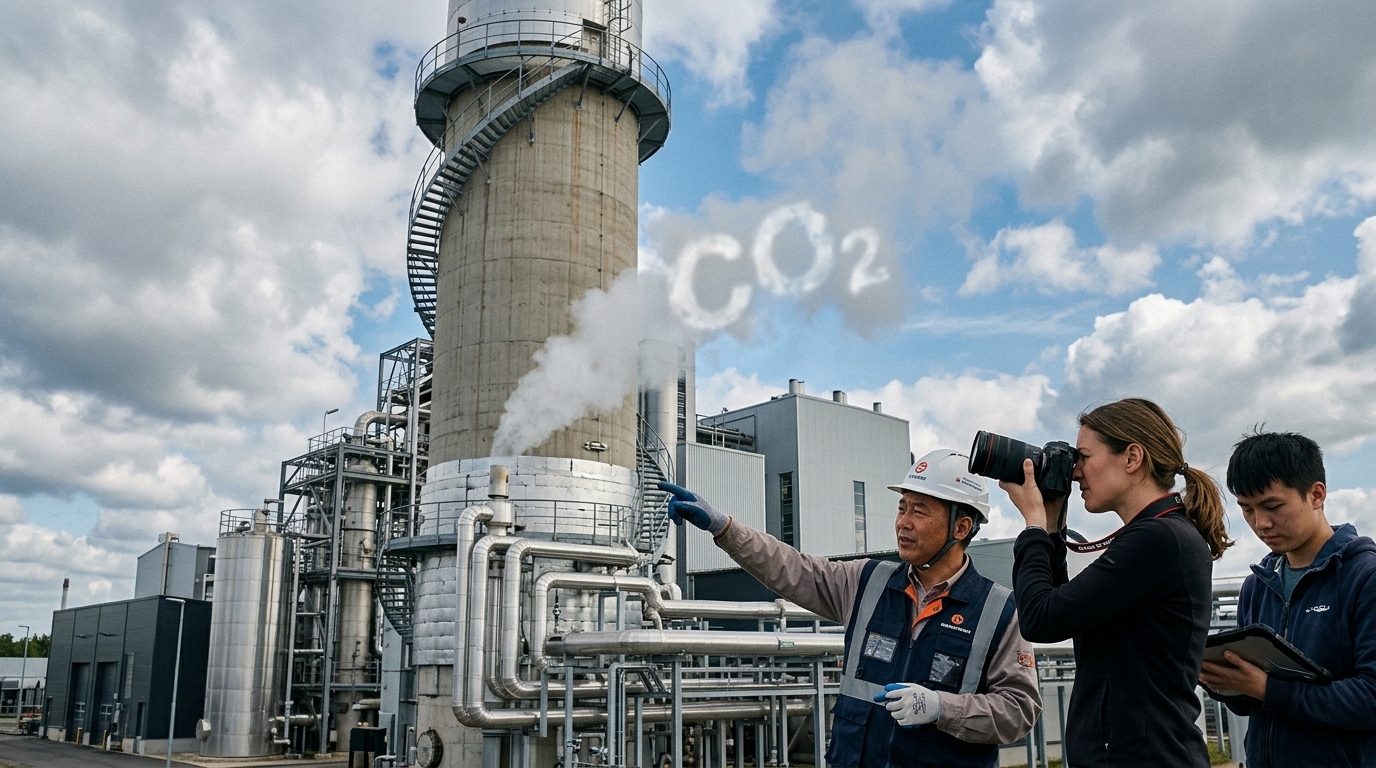
In an era where the global community is struggling to decouple from fossil fuels, news from China's laboratories is set to stir the waters of energy policy. Researchers have developed a groundbreaking Direct Carbon Fuel Cell (DCFC) that promises to convert the planet's 'dirtiest' fuel into a high-efficiency energy source with the potential for complete carbon emission capture. This development is not merely a technical refinement; it is an attempt to redefine our relationship with coal at a time when renewable energy sources (RES) face hurdles in storage and grid stability.
The Science Behind Electrochemical Conversion
Traditionally, coal is used for electricity generation through combustion. In a typical thermal power plant, coal is burned to heat water, the steam drives a turbine, and the turbine generates electricity. This process is inherently inefficient, with efficiencies rarely exceeding 35-40%, while simultaneously releasing massive amounts of CO2 and other pollutants into the atmosphere. The new technology developed by Chinese scientists bypasses the combustion stage entirely.
Direct Carbon Fuel Cells (DCFCs) operate via electrochemical reactions. Solid carbon reacts directly with oxygen inside the cell to produce an electric current. The theoretical efficiency of this method reaches 80% or even 90%, nearly double that of the best combustion units. The most significant advantage, however, is the resulting byproduct: instead of a mixture of gases containing nitrogen and other pollutants, the DCFC produces a pure, concentrated stream of carbon dioxide. This makes Carbon Capture and Storage (CCS) much easier and economically viable, as it eliminates the energy-intensive process of separating CO2 from flue gases.
Energy Geopolitics and China's Strategic Role
It is no coincidence that this breakthrough comes from China. The world's second-largest economy possesses vast coal reserves and, despite massive investments in solar and wind power, remains dependent on 'black gold' for its base-load electricity. For Beijing, DCFC technology represents the 'holy grail': a way to achieve its 'dual carbon' goals (peaking emissions by 2030 and carbon neutrality by 2060) without sacrificing energy security or devaluing existing mining infrastructure.
Globally, this technology could shift the balance of power. Countries with large coal reserves, such as India, Australia, and the US, are closely monitoring these developments. If coal can indeed be used without burdening the climate, then the green energy transition might take a different, more hybrid form. However, critics point out that focusing on coal, even in a 'clean' way, might slow down the deployment of truly renewable energy sources.
Challenges and the Path to Commercialization
Despite the optimism, the road from the lab to commercial scale remains steep. DCFCs operate at very high temperatures, which causes material degradation and limits their lifespan. The challenge for researchers is to find durable and cost-effective materials for electrodes and electrolytes that can withstand corrosion from carbon over time. Furthermore, the supply chain for feeding the cells with processed coal must be developed from scratch.
In conclusion, the Chinese discovery reminds us that technology is an evolving tool. While the future belongs to the sun and wind, the ability to manage existing energy sources in a way that does not destroy the ecosystem is vital. The 'green' conversion of coal may not be the final solution, but it could prove to be the necessary bridge leading us to a zero-emissions world without energy shortages.