The history of mathematics is punctuated by moments where human intuition took leaps into the unknown, transforming abstract concepts into the bedrock of civilization. One of the most significant achievements was the invention of 'zero'—a concept that does not merely represent absence but serves as an active numerical element. Today, as Large Language Models (LLMs) promise to push the boundaries of human knowledge, a critical question arises: Can a machine trained on existing data discover something truly new, or is it destined to recycle human wisdom? The recent research paper 'Nothing from Something: Can a Language Model Discover 0?' (ArXiv 2606.17289) seeks to provide answers.
The Ghost in the Machine: Beyond Pattern Matching
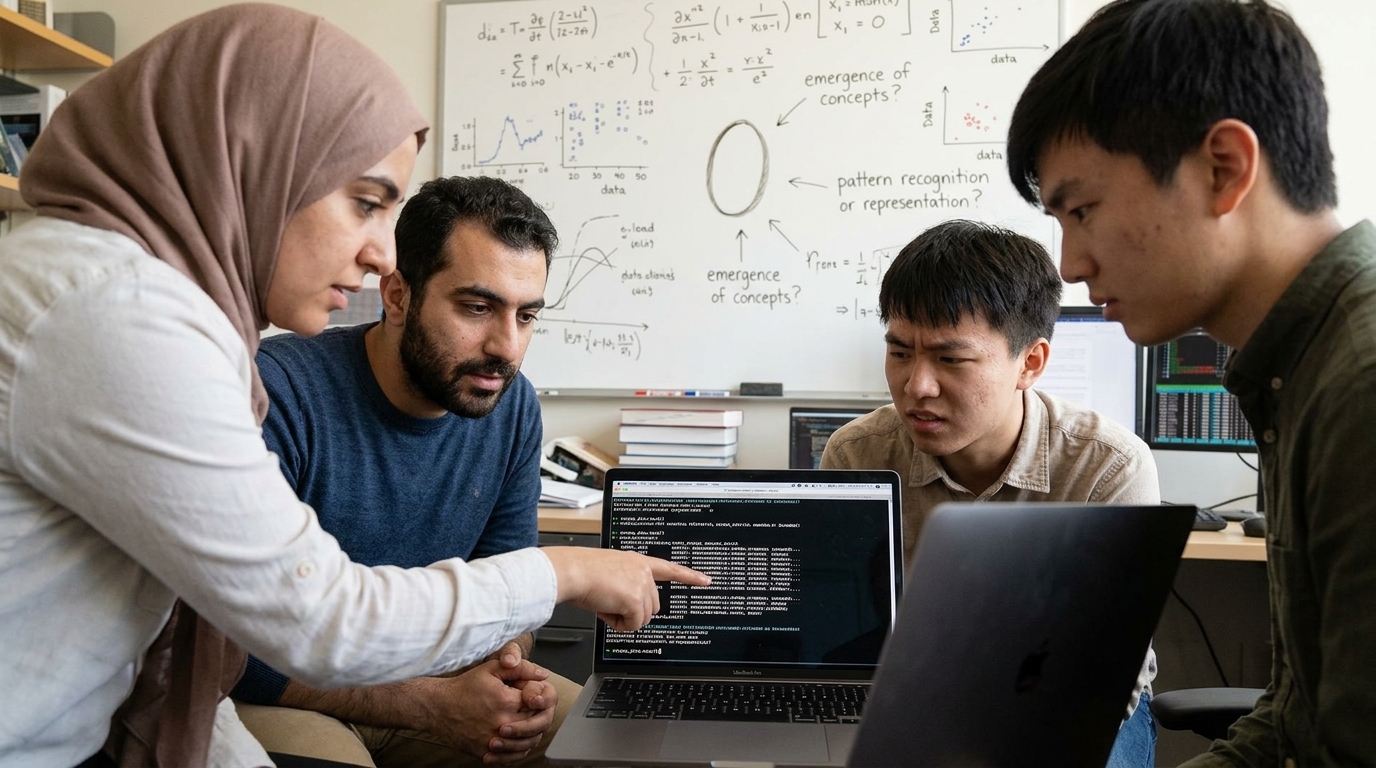
The study, published in mid-June 2026, employs a groundbreaking methodology to test the limits of 'emergent intelligence' in neural networks. Researchers created a controlled training environment—a 'synthetic mathematical universe'—from which any reference to zero and its properties was deliberately excised. The models were trained exclusively on positive integers and basic arithmetic operations that yielded only positive results.
The experiment focused on whether the model, when faced with problems requiring a null value (such as x + 5 = 5), could 'conceive' the necessity for an entity representing zero. The results were startling. Rather than collapsing or producing random errors, the most advanced models began to develop internal representations that functioned as placeholders for the void. This suggests that the Transformer architecture may possess a latent capacity for logical abstraction that transcends simple statistical word association.
The Historical Analogy and the Gamble of Originality
To understand the significance of this research, we must consider how difficult it was for humanity to accept zero. From the Babylonians to Indian mathematicians like Brahmagupta, the journey toward '0' spanned centuries. If an AI can traverse this distance in a few hours of training, we are standing on the threshold of a new era of scientific discovery.
However, the study also raises serious caveats. Skeptics argue that what we call 'discovery' in AI is actually a form of 'reverse engineering' of the structures already embedded in the language and logic of the training data. Even if the word 'zero' is absent, the logical relationships between other numbers imply its existence. In this case, the AI does not discover zero; it completes a puzzle where the shape of the missing piece is already predetermined by the surrounding pieces.
Implications for Artificial General Intelligence (AGI)
The ability of a model to generate Out-of-Distribution (OOD) knowledge—knowledge that lies outside the range of its training data—is considered the 'Holy Grail' for achieving AGI. If language models can discover mathematical concepts, they might soon propose new solutions to unsolved problems, such as the Riemann Hypothesis or the P vs NP problem.
- Synthetic Data: The research demonstrates that training in artificial, 'clean' environments can reveal capabilities that the noisy reality of the internet obscures.
- Internal Logic: Neural networks are not merely 'stochastic parrots'; they construct internal models of the world.
- Self-Taught Systems: The future of AI may rely on models that 'play' with mathematical concepts to discover new rules without human supervision.
In conclusion, paper 2606.17289 is not just an exercise in mathematics but a profound philosophical exploration of the nature of cognition. If Artificial Intelligence can see 'nothing' where we only gave it 'something,' then perhaps the distance between human and artificial creativity is much smaller than we care to admit.