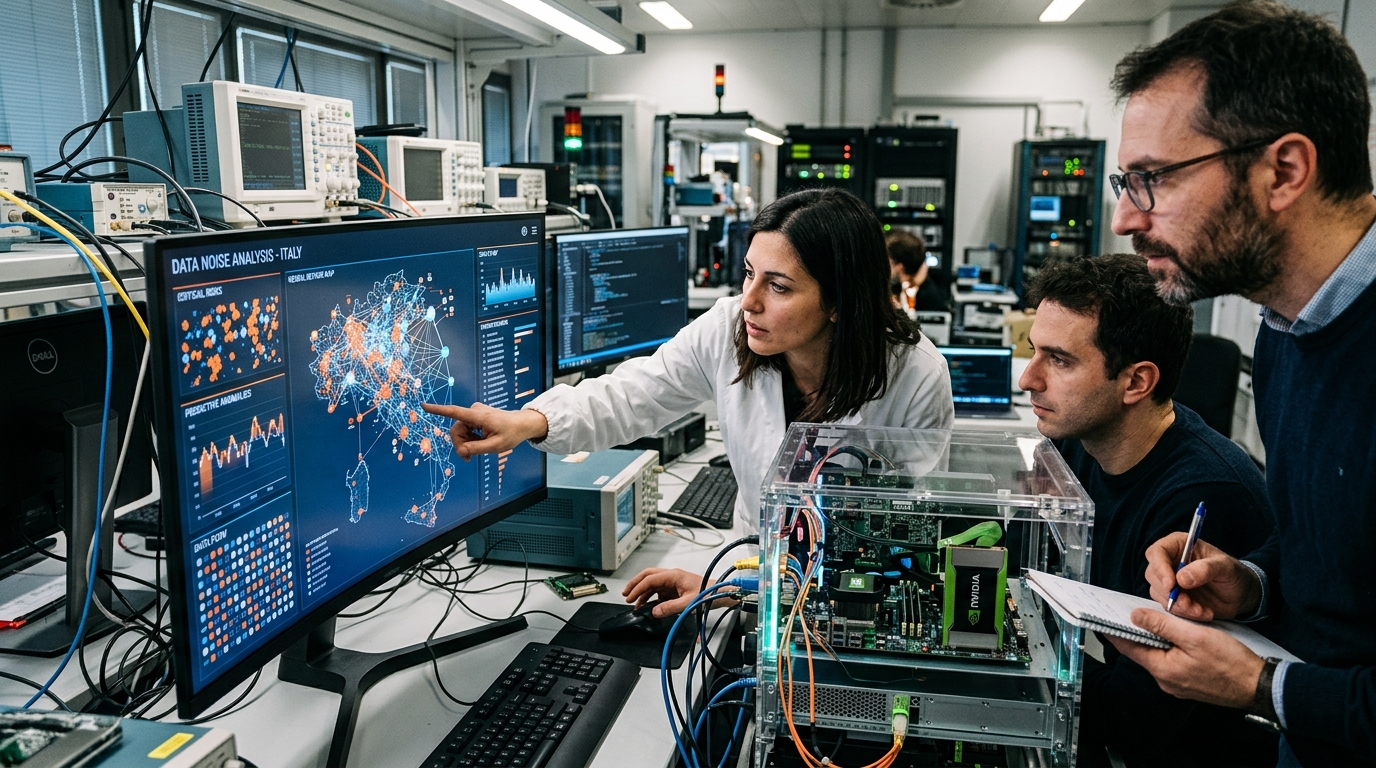
In the realm of data science, 'noise'—those random, seemingly insignificant fluctuations that accompany every measurement—has for decades been viewed as a nuisance. Scientists have historically exerted immense effort to filter it out, searching for the 'clean' signal beneath. However, a new scientific approach emerging from Italy is completely overturning this perception. Using advanced Artificial Intelligence models, researchers have discovered that within this chaotic noise lie the 'whispers' of the future: indicators that a system, whether an industrial machine, an ecosystem, or even human health, is approaching a critical tipping point.
The Science of 'Critical Slowing Down'
The core principle behind this research is based on the phenomenon of 'critical slowing down.' As a system nears a sudden transition or collapse, it loses its ability to recover quickly from small disturbances. This loss of resilience is expressed as a change in the statistical structure of the noise. The Italian research team, leveraging deep learning, trained neural networks to recognize these subtle patterns that the human eye—and traditional statistical methods—fail to detect.
The striking element of the Italian methodology is its ability to function in 'blind' environments, where the laws governing the system are not fully known. The AI does not need to understand the physics of the machine or the biology of a cell; it only needs access to the data stream. By analyzing the variance and autocorrelation of the noise, the algorithm can issue a warning for an impending failure long before visible symptoms appear.
Applications: From Heavy Industry to Climate Change
The applications of this technology are broad and multifaceted. In the industrial sector, predictive maintenance is moving to a new level. Instead of companies waiting for a sign of malfunction, AI can detect material fatigue through vibrations that were previously considered random. This translates into billions of euros in savings and, more importantly, the prevention of catastrophic accidents.
- Infrastructure Management: Monitoring the structural integrity of bridges and buildings through sensors that analyze environmental noise.
- Ecology and Climate: Identifying points of no return in local ecosystems, such as desertification or coral reef collapse.
- Medical Diagnosis: Analyzing heart rates or brain waves to predict seizures (e.g., epilepsy) before they manifest clinically.
Of particular interest is the use of this method in climatology. Italy, being on the front lines of the climate crisis in the Mediterranean, is investing in AI to predict extreme weather events. The 'noise' in atmospheric pressure and sea temperature measurements can reveal the impending formation of a Mediterranean cyclone (Medicane) several days earlier than existing forecast models.
Ethical Challenges and the Predictability Trap
Despite the technological promises, the ability to predict the 'inevitable' raises serious ethical and practical questions. If an algorithm predicts a financial crisis or social unrest with certainty by analyzing noise on social networks, the prediction itself might accelerate the event—a self-fulfilling prophecy. Furthermore, there is the risk of 'false positives,' where the AI's hypersensitivity to noise could lead to unnecessary panic or costly interventions.
"We are not just teaching AI to read data; we are teaching it to listen to the breath of systems. And like any living organism, systems emit signals of distress before they collapse," a member of the research team noted.
The Italian initiative highlights a new era in science, where Artificial Intelligence does not merely function as an automation tool but as an advanced sensor that extends human perception beyond the visible spectrum. The challenge for the future will be integrating these warnings into public policy and decision-making in a responsible and transparent manner.