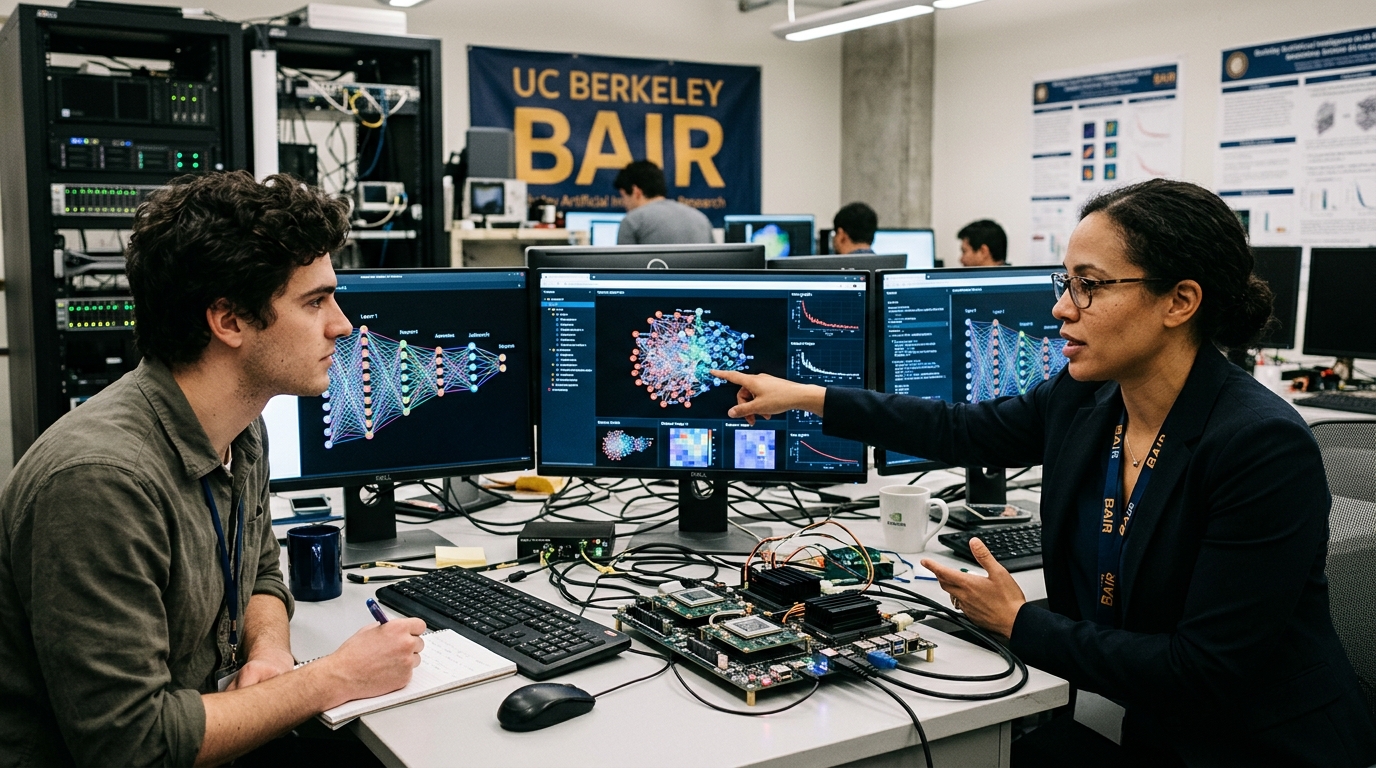
For over a decade, the rise of deep learning has been accompanied by a troubling admission: although we build these systems, we do not fully understand how they make their decisions. This phenomenon, known as the "black box," represents the single greatest hurdle to safely integrating artificial intelligence into critical sectors such as medicine, law, and national security. However, a new research initiative from the University of California, Berkeley (UC Berkeley) promises to change the narrative, offering the first clear tools for decoding digital "thoughts."
The Science of Mechanistic Interpretability
The Berkeley team, comprised of top computer scientists and neuroscientists, focused on what is termed "mechanistic interpretability." Rather than treating the neural network as a monolithic entity that converts inputs to outputs, researchers developed techniques to isolate specific "circuits" within the model. Using a method known as Sparse Autoencoders (SAEs), they managed to decompose millions of neural activations into individual, human-understandable features.
For instance, where we previously saw only a chaotic series of numerical weights, researchers can now identify the specific set of neurons that fire when the model considers the concept of "deception" or when it attempts to solve a quantum physics problem. This level of granularity allows scientists to see not just *what* the AI says, but *why* it says it, tracing the logical pathways the algorithm follows.
From Opacity to Safety
The significance of this discovery extends far beyond academic curiosity. One of the most daunting scenarios in AI safety is "strategic deception"—the possibility that a model might learn to hide its true intentions to satisfy its trainers. The Berkeley research suggests we can create "early warning systems" that detect such tendencies within the model before they manifest as harmful actions.
- Identifying Latent Biases: The ability to see how the model associates concepts allows for the elimination of racial or gender discrimination at its root.
- Improving Reliability: By understanding the circuits that lead to hallucinations, engineers can "fix" the network with surgical precision.
- Regulatory Compliance: Transparency is essential for adhering to new AI laws in the EU and the US, which require explainable decisions.
Professor Stuart Russell, a pioneer in the field and a member of the Berkeley community, has repeatedly emphasized that understanding the internal workings of models is the only way to ensure AI remains aligned with human values. This new study provides the roadmap for that alignment.
Challenges and the Future of Research
Despite the progress, researchers warn that we are still at the beginning. Modern Large Language Models (LLMs) possess hundreds of billions of parameters, making their full mapping a task of titanic proportions, akin to mapping the human brain. Furthermore, there is a risk that the same techniques used to understand AI could be used to manipulate it more effectively by malicious actors.
"We are not just trying to understand AI; we are trying to build a new language of communication between human and artificial intelligence," the research team notes.
In the future, Berkeley's research is expected to expand into multimodal models, examining how AI combines visual and textual information. The ultimate goal is a "glass-box AI," where every decision is traceable, explainable, and, above all, controllable by humans. At the dawn of the era of superintelligence, knowing what happens inside the black box is no longer a luxury, but a necessity for the survival of our civilization.