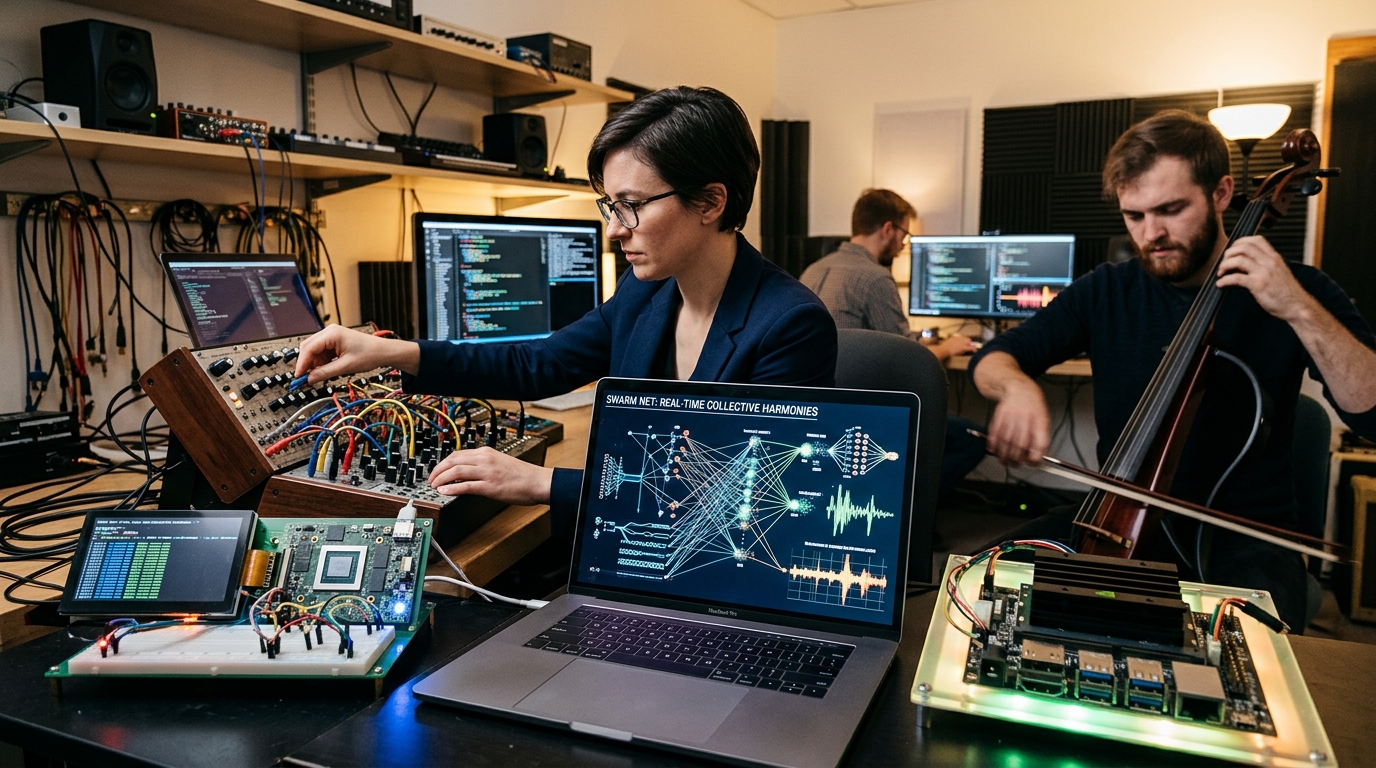
The stage is dimly lit, bathed in a low-key blue hue. A saxophonist lets a single, sustained note hang in the air. Seconds later, the response doesn't come from another human musician, but from a 'swarm' of digital entities. This is not a pre-recorded loop or a simple reverb effect. It is a manifestation of collective artificial intelligence that processes, analyzes, and synthesizes a response based on the principles of biological behavior. This experiment, recently highlighted via Tech Xplore, marks a radical shift in how we perceive the relationship between humans and machines in art.
Nature as a Mathematical Blueprint
Swarm intelligence (SI) is inspired by the way birds fly in formations or bees forage for food. In the world of computer science, this translates into many simple agents following basic rules, yet their collective behavior emerges as extraordinarily complex and intelligent. When this logic is applied to music, the result is an organic, unpredictable sound that feels more like a living organism than a cold algorithm.
In traditional AI applications in music, such as GPT-4 or specialized audio generation models, the process is usually linear: you provide a prompt and receive a result. In the 'swarm' model, the interaction is cyclic and continuous. Each agent in the swarm listens to the human musician, but also listens to the other digital agents. This creates a dynamic feedback loop where music is not 'performed' but 'emerges' through collective action.
The Challenge of Real-Time and Latency
One of the biggest hurdles in using AI for live performances has always been latency. For an improvisation to be convincing, the response must be instantaneous — under 20 milliseconds. Researchers have managed to overcome this hurdle by using decentralized networks. Instead of waiting for a central processor to make decisions for the entire ensemble, each member of the digital swarm operates semi-autonomously.
This approach allows for incredible nuance in expression. If the human musician increases intensity or speed, the swarm can react in various ways: some agents might follow, others might create a counterpoint, and others might drift away into more abstract soundscapes. This 'musical democracy' offers the artist a collaborator who is never boring and, most importantly, never fully predictable.
The Philosophical Renegotiation of Creativity
The emergence of such systems raises profound questions about authorship. Who composes the music in a human-swarm jam session? The programmer who set the rules, the musician who provides the spark, or the system itself that chooses the final note? The answer seems to lean toward a new form of 'symbiotic creativity.'
Historically, Iannis Xenakis was a pioneer in using mathematical probabilities and stochastic processes in musical composition. However, today's technology goes a step further, incorporating the machine's ability to 'learn' from its partner's style during the performance itself. It is no longer just an instrument played by a human, but an entity with which the human converses. This evolution could revolutionize not only concerts but also music therapy or education, where AI can adapt to the needs and abilities of each individual in real-time.
Conclusions and the Future of the Stage
As we head into the second half of the 2020s, artificial intelligence is ceasing to be a content generation tool 'in the cloud' and is becoming a physical player on the stage. Intelligence swarms offer a bridge between rigid mathematical structure and the chaotic beauty of human emotion. The challenge for the artists of the future will not be to compete with the machine, but to learn how to 'dance' with it in a perpetual, digital swarm of sounds.