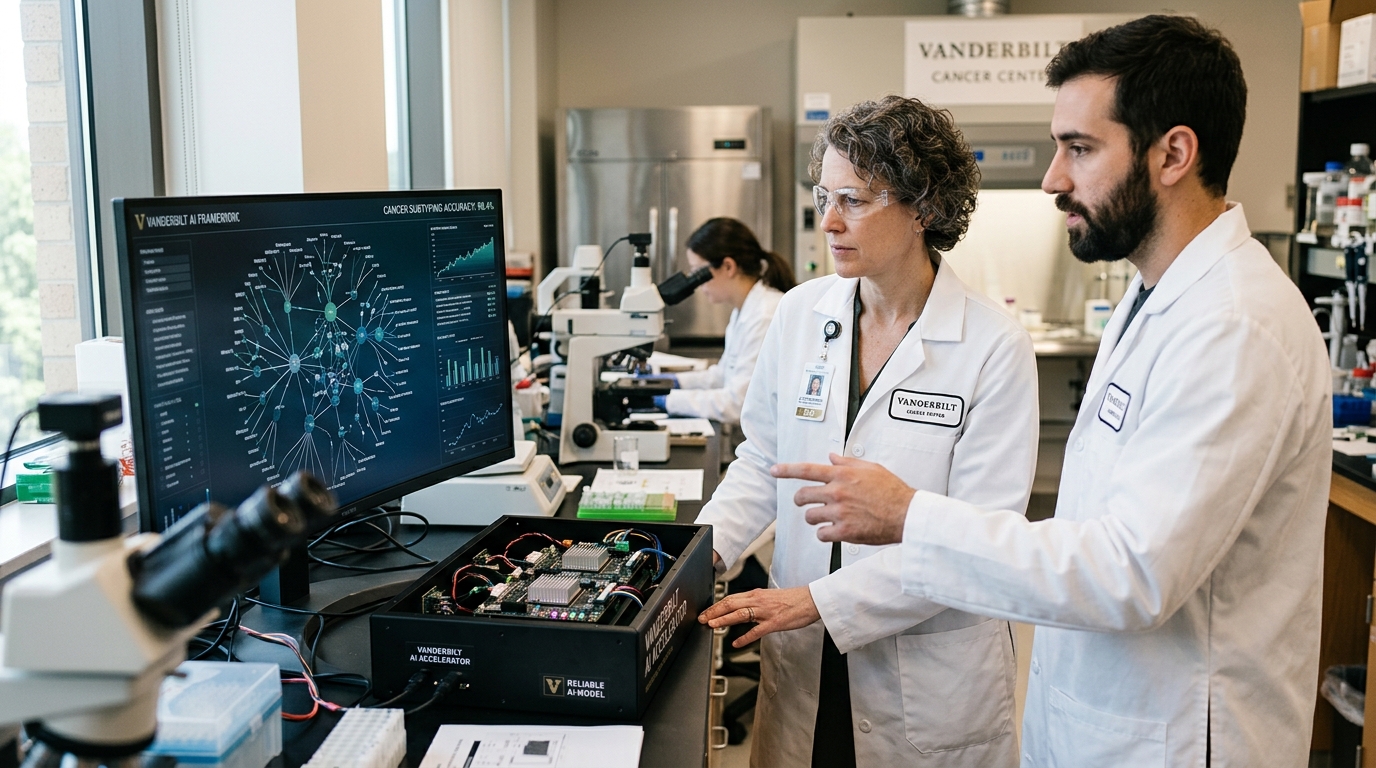
In the intricate world of oncology, precision is not merely a goal; it is the sole frontier between effective treatment and clinical failure. For years, the promise of Artificial Intelligence (AI) to analyze biopsies and categorize cancer subtypes remained trapped in a paradox: while algorithms often outperformed humans in speed, the 'black box' nature of their decision-making hindered widespread clinical adoption. New research from Vanderbilt University Medical Center (VUMC) is set to change this landscape, introducing a framework that offers not just diagnoses, but a measure of its own reliability.
The 'Black Box' Problem in Medicine
Traditional deep learning often operates as an opaque mechanism. An algorithm might identify a specific subtype of lung or breast cancer with impressive accuracy, but it can rarely explain 'why' or, more importantly, admit when it is 'unsure.' In medical practice, a wrong but confident prediction can lead to catastrophic outcomes, such as the administration of the wrong chemotherapy regimen.
The Vanderbilt team, led by experts in health informatics and pathology, developed a framework that integrates 'uncertainty quantification' (UQ). Instead of the AI providing a singular, definitive answer, the system evaluates its confidence level for every diagnosis. When uncertainty exceeds a certain threshold, the system refers the case to a human expert, acting as a safety filter that enhances, rather than replaces, human judgment.
Technological Innovation: Uncertainty-Aware AI
The new framework is built upon advanced neural network architectures trained not only to recognize patterns in histological slides but also to identify 'out-of-distribution' data. This means that if the AI encounters a rare mutation or a poor-quality sample it hasn't seen before, it will flag it as 'high uncertainty.'
- Decision Transparency: Clinicians can now see which tissue features led the AI to a specific classification.
- Diagnostic Error Reduction: The system's ability to 'raise its hand' when confused drastically reduces false positives.
- Workflow Optimization: Pathologists can focus their attention on truly difficult cases, leaving routine analysis to the automated system.
This approach addresses one of the primary ethical challenges of medical AI: accountability. By embedding uncertainty, the technology becomes a decision-support tool that respects the complexity of human biology.
Clinical Implications and the Future of Oncology
Applying this framework to cancer subtyping is critical for precision medicine. Different subtypes of the same cancer require radically different therapeutic approaches. For instance, in lung cancer, the distinction between adenocarcinoma and squamous cell carcinoma dictates the type of immunotherapy a patient will receive.
"We don't just need smart algorithms; we need humble algorithms that know their limits," the researchers noted in their report.
The Vanderbilt study demonstrates that when AI is paired with reliability mechanisms, the diagnostic accuracy of the ensemble (human + machine) improves by percentages exceeding 15% compared to traditional methods. This translates into thousands of lives that could be saved through timely and correct diagnosis.
Challenges to Universal Adoption
Despite the framework's success, the path to universal implementation in hospitals remains arduous. Training data quality is the primary limiting factor. If data originates from only a specific population, the AI may exhibit biases. Furthermore, integrating such systems into existing hospital information systems requires significant investment in infrastructure and staff training.
However, Vanderbilt's move is a powerful signal to the tech industry: trust is not earned through complexity, but through data honesty. The future of oncology appears to be hybrid, where human empathy and clinical experience are guided by algorithmic precision, creating a safety net for every patient.