At the intersection of advanced science and human resolve, a medical team has achieved what was once deemed impossible. Separating craniopagus twins—siblings joined at the head—remains one of the most daunting challenges in modern neurosurgery. However, the recent completion of a 40-hour operation, facilitated by sophisticated Artificial Intelligence (AI) and Virtual Reality (VR) systems, is more than a medical victory; it is a harbinger of the future of therapeutic intervention.
The Challenge of Shared Networks
Craniopagus twins are an extraordinary rarity, occurring in approximately one in every 2.5 million births. The primary complication is not merely the fused bone, but the reality that these children often share vital venous networks that drain blood from the brain. A millimeter-scale error in separating these vessels can lead to a stroke or the death of one or both children.
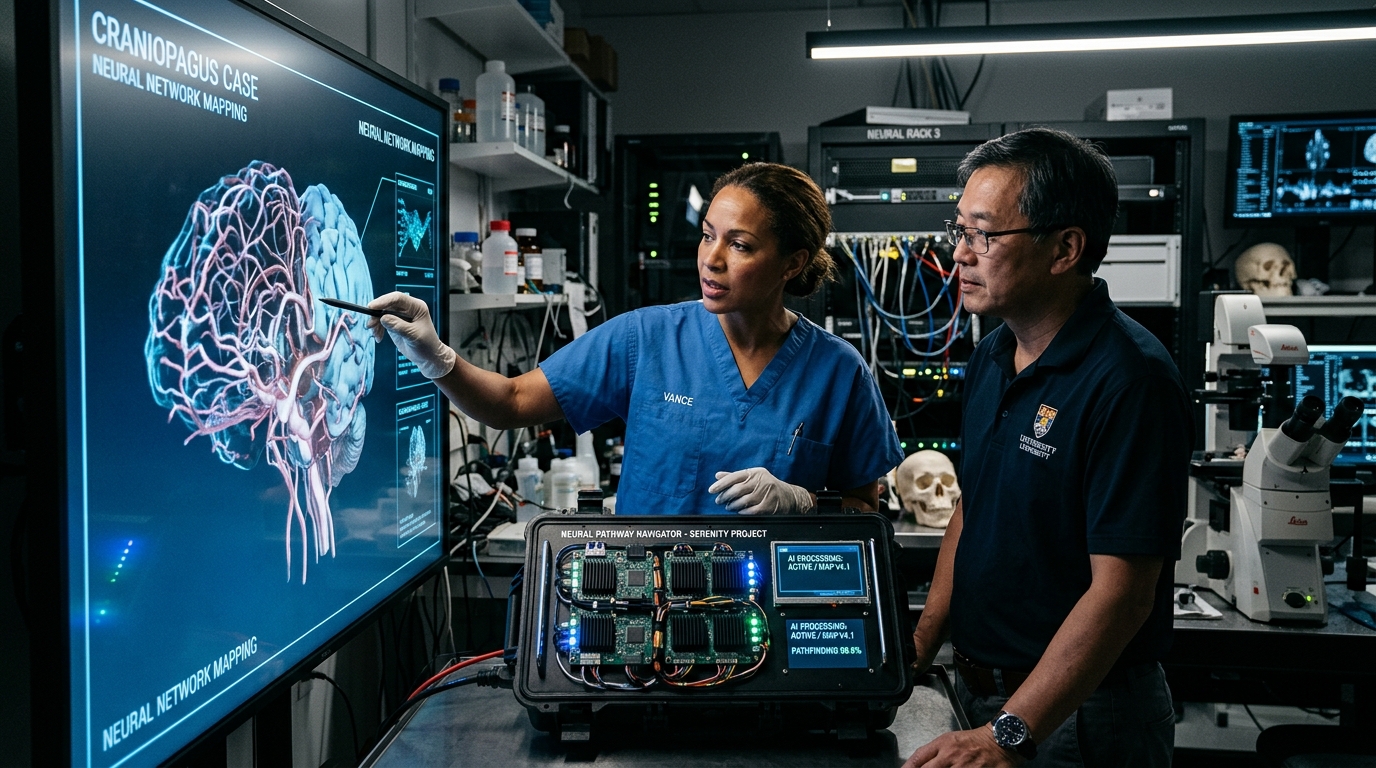
In this specific case, surgeons faced a labyrinth of vessels that traditional imaging (MRI and CT) struggled to fully decipher. This is where AI stepped in. Utilizing deep learning algorithms, the medical team created a 'digital twin' of the children's anatomy. The AI system analyzed thousands of images to predict blood flow patterns if certain vessels were occluded during surgery, providing a high-precision roadmap for the team.
Virtual Rehearsals and the Surgical Marathon
Perhaps the most striking aspect of the procedure was the use of Virtual Reality. For months prior to the first incision, surgeons from different continents donned VR headsets to 'enter' the twins' skulls. This virtual walkthrough allowed the team to practice crisis scenarios, test various surgical angles, and synchronize their movements with split-second timing.
"It was like flying to an unknown planet, but having a perfect simulator that taught us every inch of the terrain before we even landed," remarked one of the lead neurosurgeons.
The operation itself lasted 40 hours and required rotating teams of over 100 personnel, including surgeons, nurses, and AI technicians. The Artificial Intelligence remained active throughout, processing real-time data from the children's vitals and warning of potential complications before they became irreversible.
Ethical Implications and the Future of Surgery
While this success is celebrated globally, it also raises significant questions regarding accessibility. Such technologies are immensely expensive and require infrastructure that is absent in most parts of the world. Ethically, the issue of algorithmic dependence arises: Who bears responsibility if an AI prediction fails at a critical juncture?
Nevertheless, the trajectory is clear. The integration of AI into surgery is not about replacing humans but augmenting their senses. The ability to see through tissues, predict biological responses, and practice in a risk-free digital environment transforms medicine from a high-stakes art into a science of absolute precision. For the two children now recovering in separate beds, this technology was not just an assistant; it was the catalyst that granted them autonomous lives.
Conclusion
The successful outcome of this surgical feat is a milestone. It proves that when human expertise is combined with computational power, the boundaries of biology can be transcended. The next step for the global medical community is the democratization of these tools, ensuring that 'digital hope' is not a privilege of the few, but a right for the many.