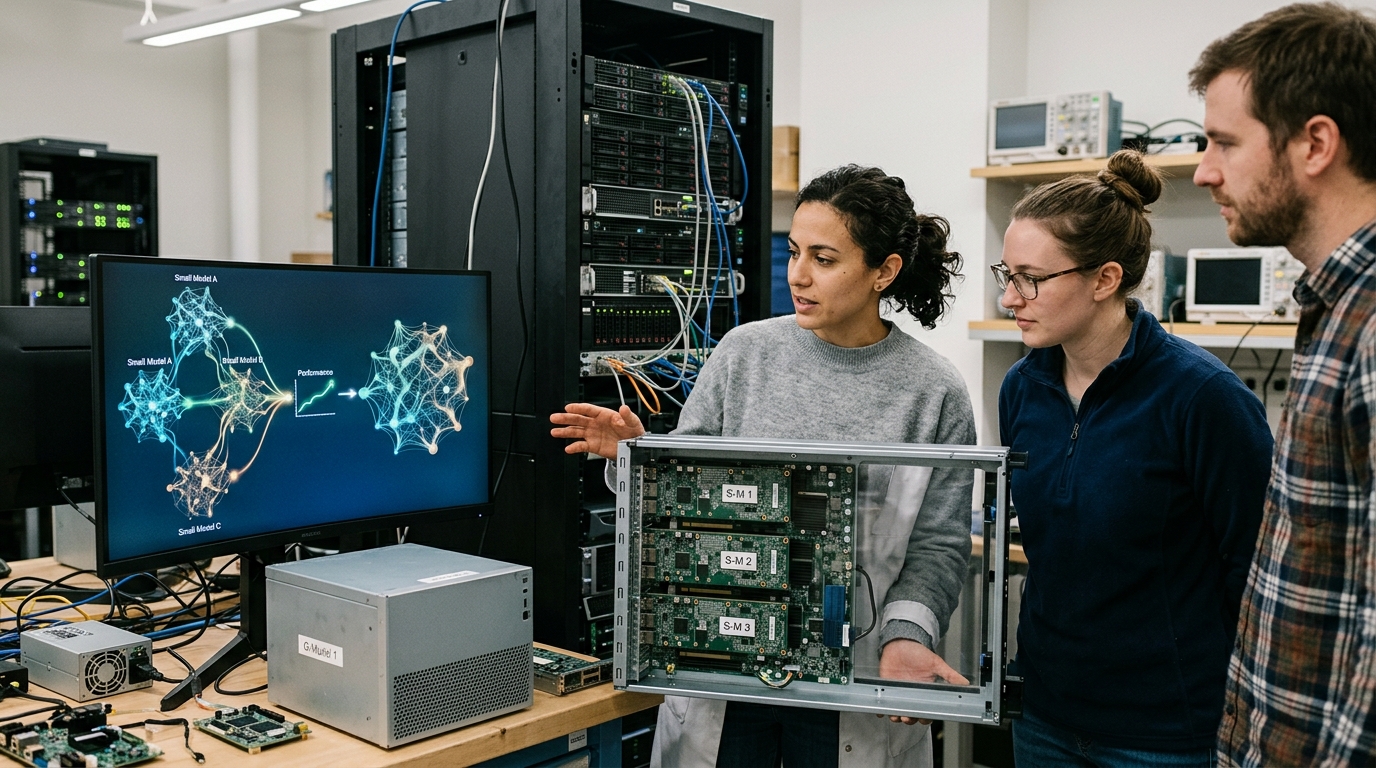
In the rapidly evolving world of artificial intelligence, the long-standing dogma of "bigger is better" is finally yielding to a more rational approach: architectural intelligence. As we navigate the second half of 2026, the industry is realizing that raw computational power is no longer the sole metric for success. A recent analysis published by bereaonline.com, fueled by breakthroughs from players like DeepSeek, highlights a disruptive reality: three smaller, specialized, and budget-friendly models can outperform a monolithic mammoth model while consuming a fraction of the resources.
The 'Divide and Conquer' Strategy in Computing
The core philosophy behind this approach is "routing." Instead of deploying a model with trillions of parameters for every query—ranging from writing a simple poem to debugging complex Python code—the system utilizes an intelligent orchestrator. This router directs the request to the most appropriate small model. For instance, a model optimized for mathematics, one for creative writing, and another for logical reasoning. When these three work in concert under a unified framework, the output is often more accurate and, crucially, significantly faster.
This shift is not merely technical; it is profoundly economic. Companies that once relied exclusively on expensive APIs from giant model providers are now facing the prospect of financial exhaustion. The "many small models" strategy allows startups to compete with Silicon Valley giants by leveraging open-source foundations and targeted data training. DeepSeek, for example, proved that through the clever use of Mixture-of-Experts (MoE) architecture, one can achieve GPT-4 or Claude 3 level performance at one-tenth of the training cost.
The End of Digital Gigantism
For years, the AI arms race was defined by parameter counts. We reached a stage where models were so massive they required the energy equivalent of entire power plants to function. However, research indicates that large models often suffer from "noise" and a lack of focus. A specialized 7-billion parameter model, trained exclusively on legal documents, will almost always outperform a general-purpose 1.5-trillion parameter model in legal analysis.
- Resource Efficiency: Reduction in energy consumption by up to 70%.
- Inference Speed: Smaller models provide near-instantaneous responses.
- Customization: Easier adaptation to specific industry needs like medicine or engineering.
- Privacy: Small models can run locally on corporate servers, eliminating the need to send sensitive data to the cloud.
The Geopolitics of AI Efficiency
It is no coincidence that this trend is being championed by players outside the traditional California axis. As semiconductor sanctions limit access to top-tier hardware for certain nations, the necessity for "smart" architecture becomes imperative. The ability to achieve more with less is no longer just a business choice; it is a survival strategy. In Europe and Asia, the focus has shifted toward algorithmic optimization rather than simply stacking more GPUs.
"Intelligence is not measured by the size of the brain, but by the ability to connect the right information at the right time. The same applies to neural networks," industry analysts note.
In conclusion, 2026 marks the maturation of the AI market. The allure of the "massive" is fading in the face of the effectiveness of the "precise." The future belongs to systems that can orchestrate multiple sources of intelligence, creating a whole that is far greater than the sum of its parts. For the end-user, this translates to cheaper, faster, and more reliable services that don't require a fortune to operate.