In the relentless race for Artificial Intelligence supremacy, Chinese tech giant Baidu has delivered a decisive blow in the fields of Optical Character Recognition (OCR) and document understanding. The company has unveiled a groundbreaking architecture designed to shatter the notorious "memory wall," enabling AI systems to read and analyze documents spanning thousands of pages with unprecedented precision. This development places Baidu ahead of DeepSeek, which had recently dominated the spotlight with its high-efficiency open-source models.
The Challenge of Long-Document Context
For years, processing large-scale documents—such as multi-hundred-page legal contracts, decades of medical records, or complex technical manuals—has been the "Achilles' heel" of Large Language Models (LLMs). The issue wasn't merely recognizing individual words, but maintaining context across the entire document. Traditional OCR systems often "forgot" the beginning of a file by the time they reached the end, or failed to correlate information found in disparate chapters.
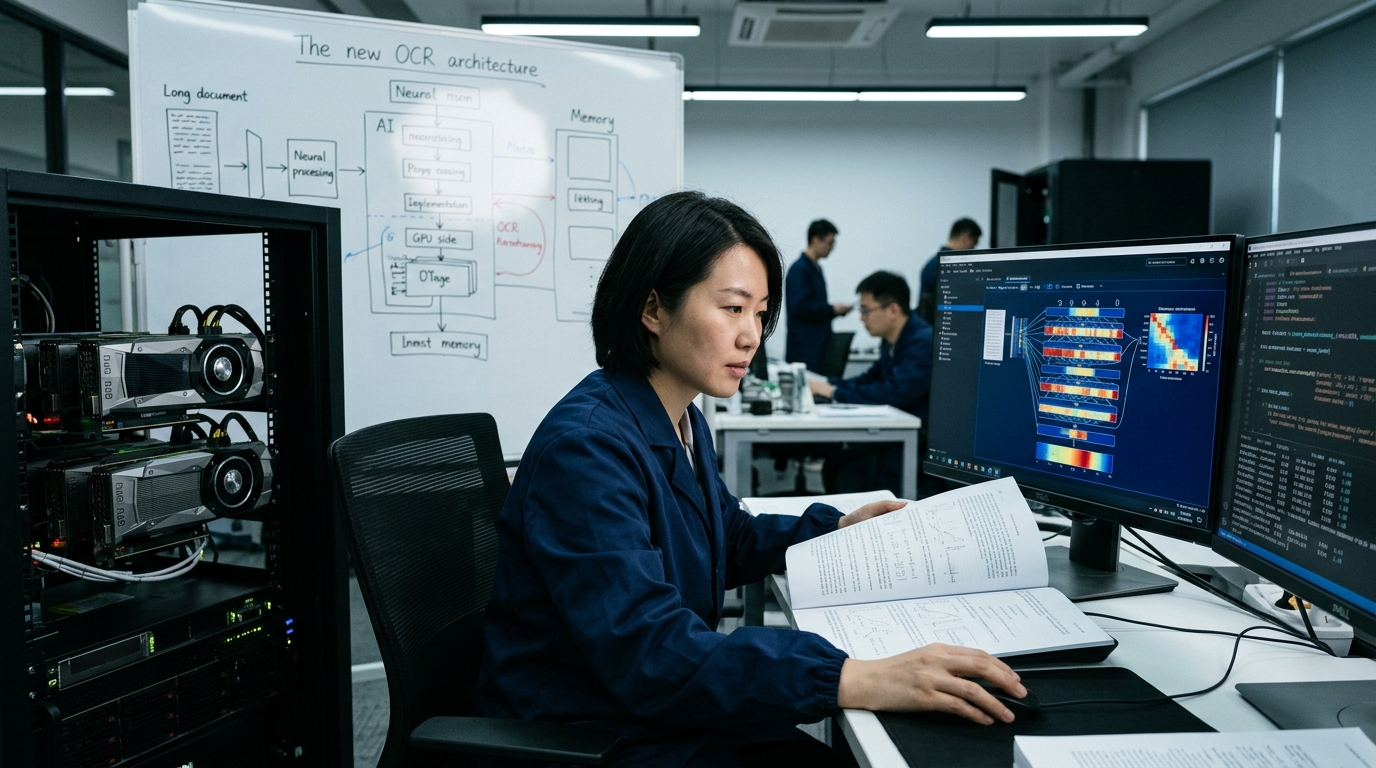
The "memory wall" refers to the hardware and software bottlenecks (specifically RAM and GPU memory) required to manage the massive data arrays generated during the processing of long-form text. Baidu’s new approach appears to have optimized this process by implementing a hierarchical processing structure that drastically reduces the computational load without sacrificing the integrity of the data.
"This isn't just about faster reading; it's about a deeper understanding of structure. The ability to link a footnote on page 5 to a clause on page 500 is a game-changer for entire industries," noted industry analysts.
Baidu vs. DeepSeek: The Data Battleground
The comparison with DeepSeek is intentional. DeepSeek had set a high bar with models that combined efficiency with low operational costs. However, Baidu's latest offering appears to outperform its rival in benchmarks involving structural layout analysis and entity extraction from complex documents containing tables, charts, and handwritten notes. Baidu's architecture utilizes a sophisticated attention mechanism that selectively focuses on the most critical segments of a document while maintaining a "compressed summary" of the broader context.
In released benchmarks, Baidu's model demonstrated a 20% higher accuracy rate in information retrieval for documents exceeding 500 pages compared to current DeepSeek implementations. This is achieved through a technique the company calls "Dynamic Context Compression," which allows the model to discard "noise" and keep only the essence of the information in its working memory.
Market Implications and Enterprise Impact
Baidu's technological victory has immediate implications for the corporate world. In the banking sector, for instance, the analysis of historical data and loan agreements can now be automated to a degree that previously required thousands of human-hours. In the legal field, searching for precedents across thousands of pages of case files is now a matter of seconds.
- Operational Cost Reduction: Enterprises can process vast volumes of data at a fraction of the cost compared to previous cloud AI solutions.
- Real-Time Accuracy: The new architecture allows for document processing in near real-time, even on edge devices.
- Democratization of Knowledge: The ability to digitize and comprehend historical archives opens new avenues for research and education.
It is evident that Baidu is not merely targeting the domestic Chinese market but is striving to set global standards for "Enterprise AI." This move forces competitors, including American giants like Google and Microsoft, to re-evaluate their strategies in OCR—a field long considered a "solved" problem that has proven to be one of generative AI's greatest hurdles.