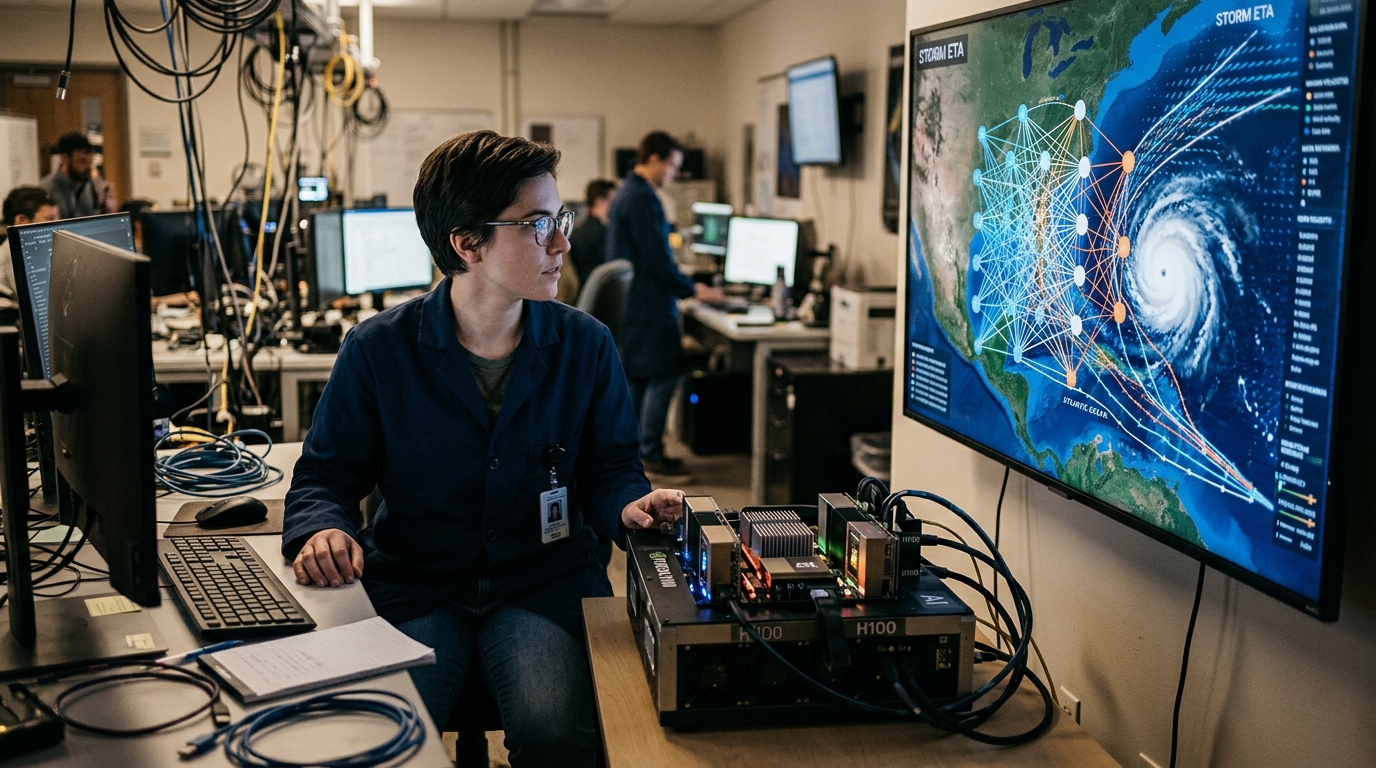
The science of meteorology is at a historic crossroads. For decades, weather forecasting has relied on Numerical Weather Prediction (NWP), a process that requires massive computing power to solve complex differential equations describing atmospheric dynamics. However, the emergence of Artificial Intelligence (AI) and its recent performance during the terrifying 2025 hurricane season, culminating in Hurricane Melissa, has proven that the future of our survival from extreme weather may lie not in physics, but in data.
Hurricane Melissa, the strongest Category 5 hurricane in the modern era, served as the ultimate stress test for AI models. The problem with AI until recently was that it was trained on historical data (such as the ERA5 dataset). Skeptics argued that a storm of this magnitude, which had never been recorded before, would be impossible to predict by an algorithm that only "knows" the past. Yet, AI models not only predicted Melissa's path with greater accuracy than the European ECMWF model, but they did so in fractions of a second, using a simple desktop computer instead of a stadium-sized supercomputer.
From Solving Equations to Pattern Recognition
Traditional meteorology operates on the basis of physics: if we know the current state of the atmosphere and the laws of thermodynamics, we can calculate the future. This approach is accurate but slow and energy-intensive. AI, by contrast, uses Graph Neural Networks to learn how weather evolves by observing millions of hours of historical data. Models like Google DeepMind's GraphCast and Huawei's Pangu-Weather have changed the rules of the game.
In the case of Melissa, AI managed to identify subtle interactions between sea surface temperature and atmospheric pressure that traditional models missed due to their computational rigidity. The AI's ability to generalize from data allowed it to "understand" the dynamics of a storm it had never seen before, debunking the argument that algorithms are bound by their historical limits. This suggests that AI has developed an internal representation of atmospheric physics, even though it was never explicitly given the equations.
The Democratization of Forecasting and Saving Lives
One of the most significant implications of this technology is its affordability. Traditional forecasting requires billions in infrastructure investment. AI allows developing nations, which are often hardest hit by climate change, to access world-class forecasting. During Melissa, early warnings issued up to 10 days in advance allowed for the evacuation of coastal areas that might otherwise have suffered thousands of casualties.
However, the transition is not without risks. The "black box" of AI—the difficulty of explaining why an algorithm made a specific decision—remains a thorn in the side of scientists. If an AI model predicts a disaster that doesn't happen, or vice versa, policymakers will struggle to justify their decisions without a clear physical rationale. Furthermore, there is the risk of over-reliance on private tech companies that control these models, shifting the responsibility for public safety from the state to Silicon Valley.
The Future: A Hybrid Alliance
The most likely scenario for the coming years is not the replacement of meteorologists, but their close collaboration with AI. Hybrid models, combining the physical rigor of NWP with the speed of AI, are the next big promise. The ability to run thousands of scenarios (ensembles) in seconds allows scientists to calculate the probabilities of extreme events with unprecedented precision.
As the climate crisis makes "mega-storms" the new normal, the need for such tools becomes imperative. Melissa was a warning. The success of AI in predicting it was a ray of hope. In the race against an increasingly unpredictable atmosphere, artificial intelligence may prove to be the most powerful shield humanity has ever built, provided we learn to trust it wisely and monitor it transparently.