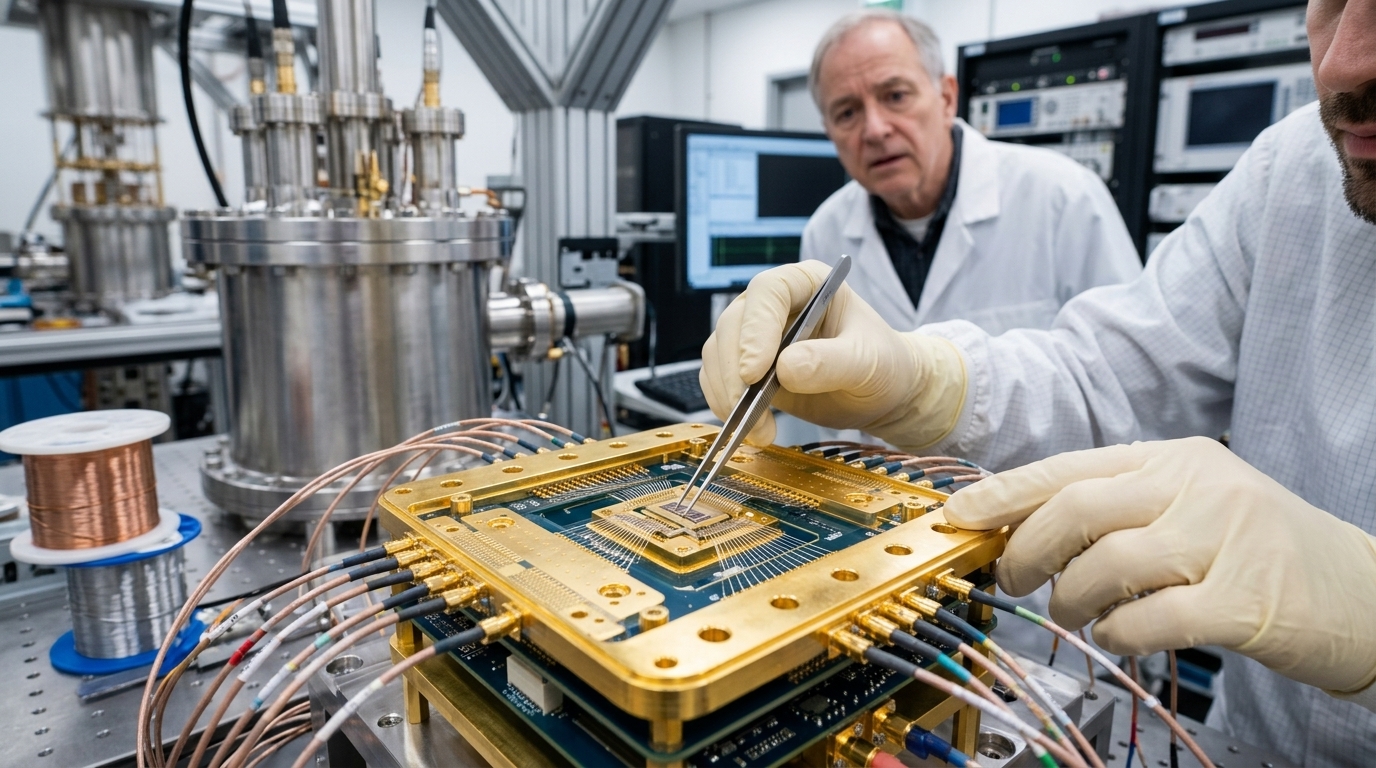
The race for quantum supremacy is not merely a speed contest between processors; it is a war of narratives, billions of dollars, and fundamental physics. In February 2025, Microsoft triumphantly announced the creation of Majorana 1, a quantum chip based on the long-sought topological qubits. Today, however, a year later, the scientific community is striking back. A new study published in the journal Nature casts a cold shadow over these expectations, arguing that the tech giant's claims were exaggerated, if not premature.
The Hunt for Majorana: Science or Science Fiction?
To understand the gravity of the critique, we must understand what Microsoft is trying to achieve. Unlike IBM and Google, which use superconducting qubits—highly sensitive to noise and requiring massive error-correction efforts—Microsoft bet everything on topological qubits. These are based on Majorana fermions, particles that are their own antiparticles. Theoretically, these qubits are inherently "shielded" against environmental interference by their very topology.
However, the existence of Majorana fermions in solid-state systems remains one of the most controversial topics in modern physics. The new Nature study, led by an international team of independent researchers, argues that the signals Microsoft interpreted as "Majorana Zero Modes" could very well be "ghost signals" caused by material imperfections or the Andreev bound state phenomenon. In simpler terms, Microsoft may have seen what it wanted to see, rather than what was actually there.
Anatomy of a Controversy
The critique focuses on the interpretation of conductance data. Microsoft researchers had claimed that the stability of the signal in the Majorana 1 chip provided indisputable proof of topological protection. The new publication refutes this, presenting simulations where similar signals appear in systems completely devoid of topological properties.
"Science requires reproducibility and rigor, not just statistical coincidences that happen to resemble theory," the paper states.
This is not the first time Microsoft has been under fire for this specific topic. In 2021, a previous study by the company in Nature was retracted due to data errors. Despite the 2025 announcement being framed as a "grand comeback," the new critique suggests that structural issues in the company's approach persist. Microsoft, for its part, stands by its results, stating that critics are using outdated models that do not reflect the complexity of the Majorana 1 architecture.
Implications for the Quantum Industry
Why does a dispute between physicists matter to the rest of us? Because the credibility of these claims dictates the flow of billions in investment. If the topological path proves to be a dead end, Microsoft will have lost a decade of research and massive capital, leaving the field open to its competitors. Furthermore, such controversies fuel the fear of a "Quantum Winter"—a period where investors withdraw due to the technology's unfulfilled promises.
- Transparency: The need for open data in quantum research is becoming imperative.
- Expectations: The gap between a laboratory experiment and a commercial product remains vast.
- Competition: IBM and Google continue to gain ground with more traditional, albeit noisy, methods.
Ultimately, science progresses through conflict. Even if Microsoft is proven wrong, the effort to harness Majorana fermions has led to significant breakthroughs in materials science. However, the market is not interested in "collateral knowledge"; it is interested in results. Majorana 1 might not be the revolution we were promised, but it is certainly a lesson in humility for the giants of big tech.