For over a century, X-ray crystallography has been the backbone of our understanding of matter at the atomic scale. Yet, this formidable technique has always harbored a significant blind spot: hydrogen. As the lightest and most abundant element in the universe, hydrogen is virtually invisible to X-rays because of its extremely low electron density. Today, a revolutionary approach powered by Artificial Intelligence promises to fill these gaps, fundamentally altering how we design drugs and advanced materials.
The Problem of the 'Invisible' Atom
In the realm of chemistry, the position of hydrogen atoms is far from a trivial detail. Hydrogen is the primary actor in 'hydrogen bonding'—the subtle forces that zip together DNA strands, dictate how a drug molecule binds to a protein, and determine the stability of crystalline structures. However, because X-rays interact with electrons, and hydrogen possesses only one, its signal is frequently drowned out by the noise of heavier atoms like carbon, nitrogen, or oxygen.
Until now, the only reliable solution was neutron diffraction. But this method comes with heavy caveats: it requires unusually large crystals—which are notoriously difficult to grow—and access to nuclear reactors or spallation sources. Such facilities cost billions of dollars and are few and far between globally. The inability to precisely locate hydrogen meant scientists often had to 'guess' its position based on idealized geometric models, a process prone to inaccuracies in complex biological environments.
The AI Breakthrough: From Shadows to Structure
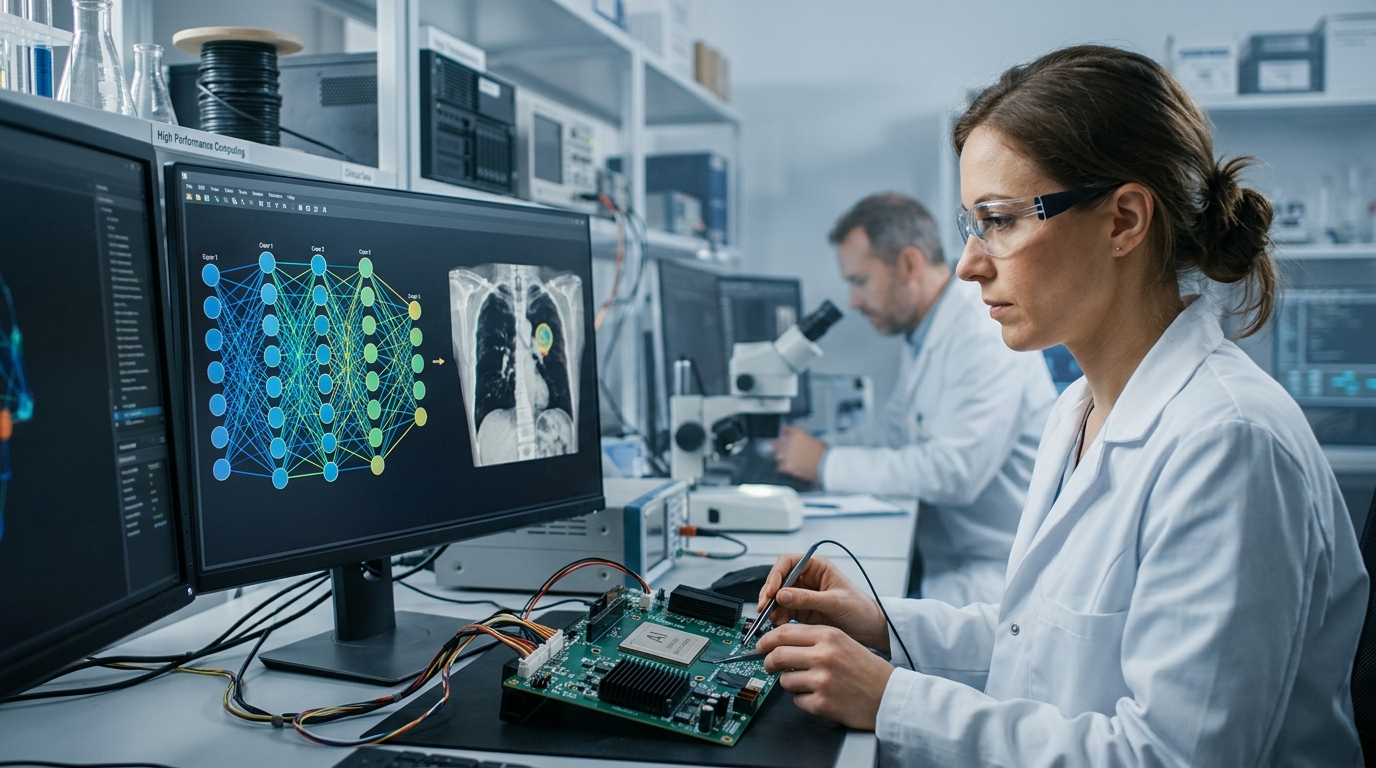
Recent research highlighted by Chemistry World showcases a deep learning model trained on high-fidelity datasets derived from neutron diffraction experiments. This model doesn't just make educated guesses; it 'learns' the intricate, non-linear relationships between heavy atoms and their hydrogen companions. When presented with an incomplete X-ray structure, the AI can place hydrogen atoms with a precision that rivals neutron experiments, but it does so in a fraction of a second on standard computing hardware.
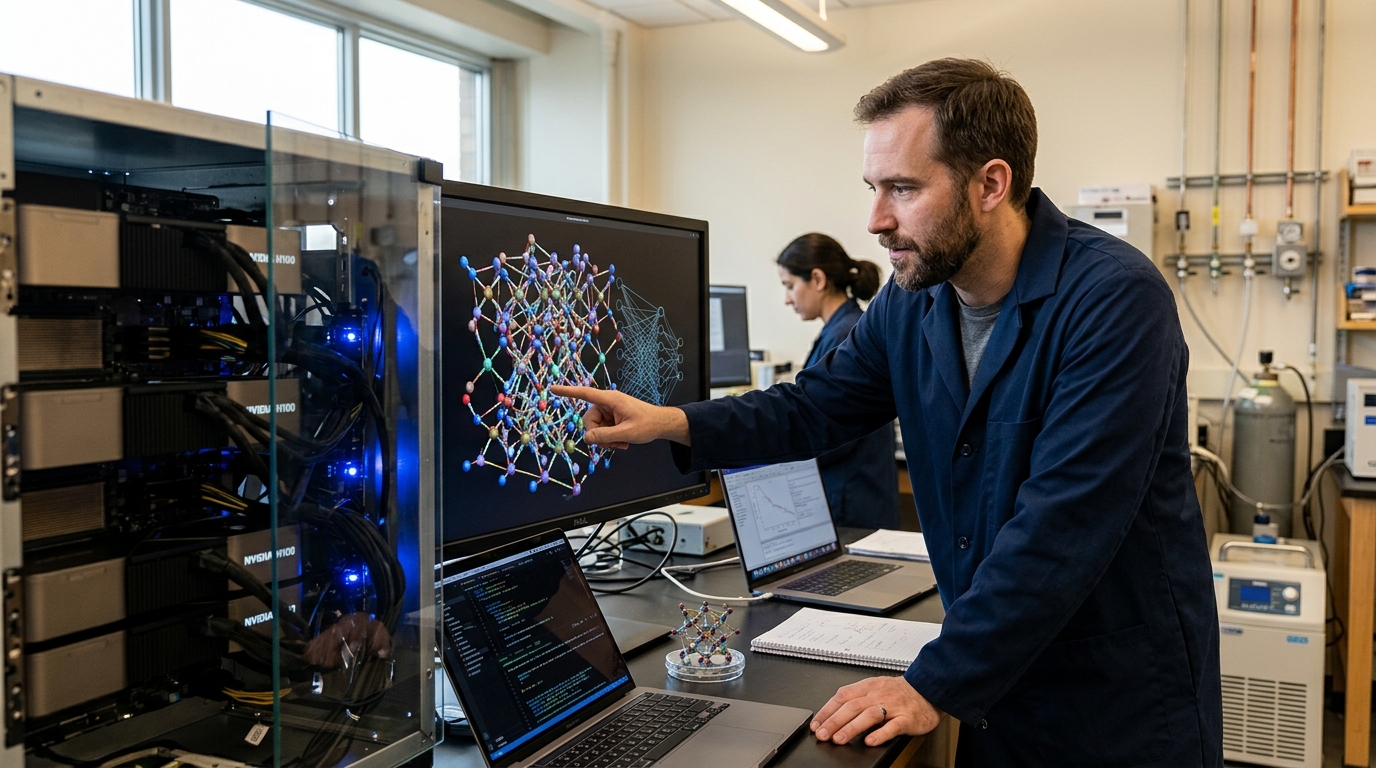
At the heart of this success are Graph Neural Networks (GNNs). By treating molecules as networks of nodes and edges, these architectures can capture the chemical environment and stereochemical pressures at every point in the crystal lattice. The AI can predict whether a hydrogen atom is engaged in a specific bond or if its position is distorted by the proximity of a neighboring molecule, providing a holistic and dynamic view of molecular architecture that was previously unattainable for most researchers.
Implications for Pharmacy and Energy
The ramifications of this breakthrough are profound. In the pharmaceutical industry, knowing the exact position of hydrogen atoms can explain why one drug candidate is highly effective while a near-identical one fails. It allows researchers to optimize the 'docking' of drugs into body receptors, potentially reducing side effects and increasing therapeutic potency. This is particularly crucial for the development of next-generation antivirals and cancer treatments.
In the sector of green energy, understanding crystal structures is vital for developing new hydrogen storage materials and more efficient fuel cells. The ability to 'see' hydrogen without the need for nuclear facilities accelerates the innovation cycle from years to months. Furthermore, this method democratizes high-level science, allowing smaller laboratories with limited budgets to perform research that previously required access to elite international facilities like the Oak Ridge National Laboratory or the Institut Laue-Langevin.
Toward a Digital Crystallography
Despite the enthusiasm, the scientific community remains cautious. An AI model is only as robust as the data it was trained on. There is a persistent risk of 'hallucinations'—where the model predicts a structure that looks plausible but does not reflect physical reality, especially under extreme conditions like high pressure or ultra-low temperatures. However, the integration of these models into the standard crystallographic workflow now seems inevitable.
We are at a turning point where observational science meets the predictive power of computational intelligence. The 'invisible' hydrogen is ceasing to be a secret of nature and is becoming another data point in our digital toolkit. The ability of AI to fill the gaps in human perception is not merely a technical upgrade; it is an expansion of our vision into the microcosmic world, allowing us to see the fundamental building blocks of life with unprecedented clarity.